
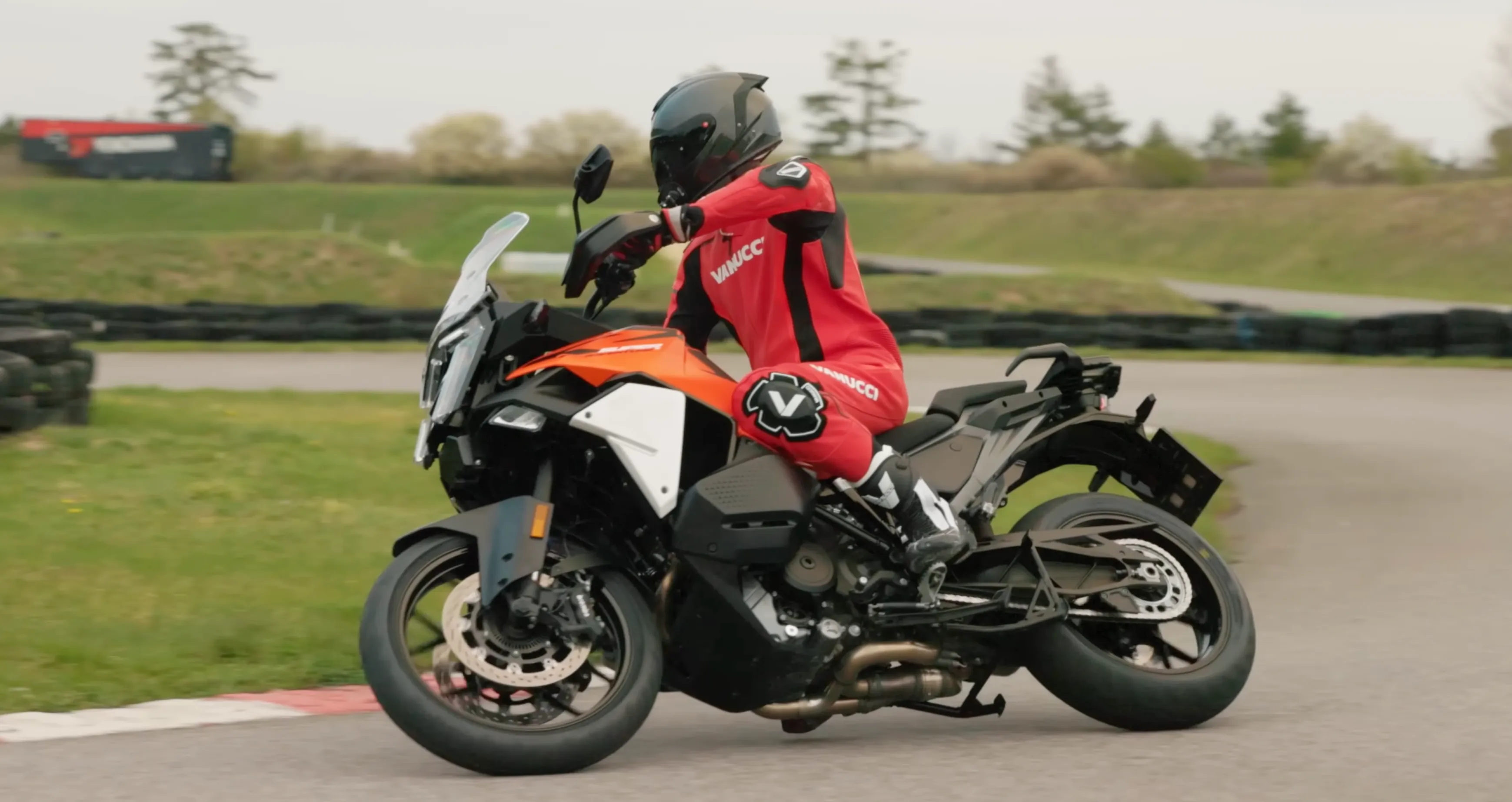
Four big adventure bikes, one tight little supermoto track, one cold April morning. By the time I climbed off the KTM, my hands were still buzzing harder than they had on any of the other three. I’ve ridden well over a thousand motorcycles, and I should be past the point where a spec sheet makes me giddy. This one got me anyway.
Stupid fast, and somehow easy
On paper the 1390 Super Adventure S Evo is just a big touring adventure bike. More than 170 hp, all-day comfort, every feature you’d want for a long haul. So I expected a handful on a track full of tight hairpins. It isn’t. You sit down, poke through the menus once, set your ride mode on that big TFT, and you’re moving quick almost immediately. And that’s the thing I actually care about on a day like this: how fast do I learn to trust a bike I’ve never ridden? On the KTM, scary fast. It hands you the keys instead of testing you.
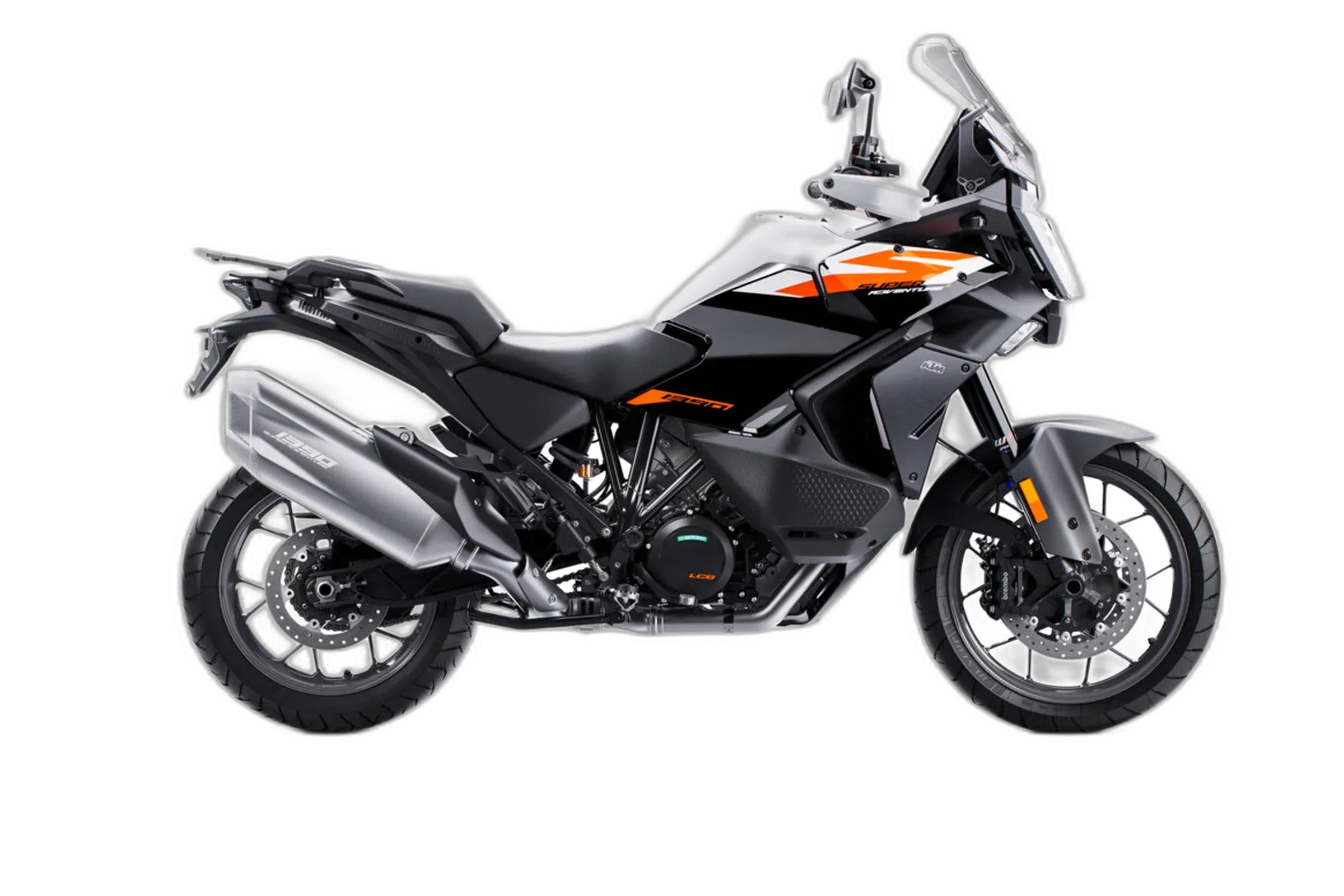
No clutch lever. None.
You go looking for the clutch and it’s just not there. That’s the automated gearbox. You get a shift lever, no clutch lever, like a quickshifter on steroids. The whole transmission runs in either automatic or manual mode. Automatic does exactly what it says: it picks the gears, slips the clutch, shifts up and down, all of it, while you sit there and ride. Manual lets you grab the lever yourself when the bike’s choices don’t match your mood. On a track this tight, the real question is which one actually makes you faster. So I played with both.
Why I let the bike shift for me
Here’s the uncomfortable truth: this is one of the very few bikes where I stayed in automatic and meant it. There’s an obvious downside. The bike has no idea what’s waiting around the next corner, so it can’t set up for it the way I would. Didn’t matter. With the shifting handled, every bit of my attention went to the line and the throttle, and on a bike with this much punch that’s where the time is. On the BMW R 1300 GS with its automatic box, I went the other way and rode it in manual. The KTM just takes the job off your plate so smoothly that all you’re left with is the fun part.
The electronics are the fast part, not you
Let’s be real for a second. The speed isn’t coming from your talent. It’s the package: the automated gearbox, traction control, ABS, a stout chassis, and a motor with a silly 107 lb-ft of torque. String all that together and the bike feels deeply electronic, in the good way, because it metes out that big lump of torque so cleanly that the wallop never scares you. Even with all that displacement and grunt, even when the gearbox slots a ratio I didn’t ask for, the front stays hooked up and you feel planted. You’re not white knuckling a beast hoping it doesn’t spit you off. You just get on the gas without thinking.
My cheat code was the rear brake
My little trick on the tight stuff: the rear brake. I used it to fine tune the last five percent of balance and speed. When a shift came through a touch rough, or the revs weren’t quite where I wanted, a light drag on the rear brake cleaned it up and kept the drivetrain loaded so nothing knocked me off my line. Throttle hand lights the fire, rear brake does the detail work, and that wonder box of motor and electronics handles everything in between. Where all that computing power actually lives, I honestly couldn’t tell you. Somewhere up top, probably. The teamwork, though, is something else.
The biggest adrenaline hit of the day
I rode four adventure bikes back to back, including gems like the Ducati Multistrada V4 Rally and a GS with the auto gearbox. The one I stepped off shaking was the KTM. I won’t tell you it’s the best bike for everyone or the outright fastest. But I was lit up. That’s the thing KTM keeps nailing, whether you’re climbing off a Super Duke, a supermoto, or this big adventure rig: it never feels sanded down or beige. That dumb grin, that I just absolutely sent it feeling, you only really get it on a KTM.
A cold track and the trust I didn’t quite have
Honest bit, and it’s on me, not the bike. At 61°F of asphalt the Bridgestone T33 is fine, but a cold morning still messes with my head. I didn’t have full trust in the grip, because it was a touch too chilly for my taste. The KTM still felt blisteringly quick and let me focus on the important stuff anyway. That’s the whole point of running them like this: all four bikes, same day, same track, same T33, same temperature. If you want to compare these machines honestly, this is the cleanest set of data you’ll find, because the tire and the cold count the same for everybody.
Where the lap landed
The video with the on screen time isn’t live yet, and it’ll likely go up weeks from now, so treat this as context, not a scoreboard. We ran our own timed laps on a tight supermoto track in Austria, and the KTM turned a 1:08.0 on the T33 at 61°F. Sitting just above it: the BMW R 1300 GS (2024, Bridgestone A41, 88°F) at 1:07.2 and the Ducati Multistrada V4 S (2021, Pirelli Scorpion Trail II, 86°F) at 1:07.3. Right in the same pocket is the Husqvarna Svartpilen 801 (2024, Pirelli MT 60 RS, 104°F) at 1:08.0. Just below sit the KTM 890 Duke (2021, Michelin Power GP, 54°F) at 1:08.3 and the Honda Transalp 750 (2024, Pirelli Scorpion Trail II, 91°F) at 1:08.7. Read those numbers with the tire and the asphalt temp next to them, every time, because both move the result more than you’d think.
About that track in Austria
This is a compact supermoto loop, tight hairpins, quick direction changes, a couple of short straights. It’s not a big racetrack and it isn’t meant to be. It’s a stand in for the stuff you actually ride: city streets, alpine passes, narrow back roads. The format’s simple and strict. Ten warm up laps, then one flying lap from a near standstill, so clutch feel and traction off the line feed straight into the number. What I really take away from a day like this isn’t the time. It’s how quickly a bike earns my trust, because that’s exactly what saves you on a cold, blind mountain switchback. The KTM earned mine in a hurry, and that’s the part worth holding onto.