
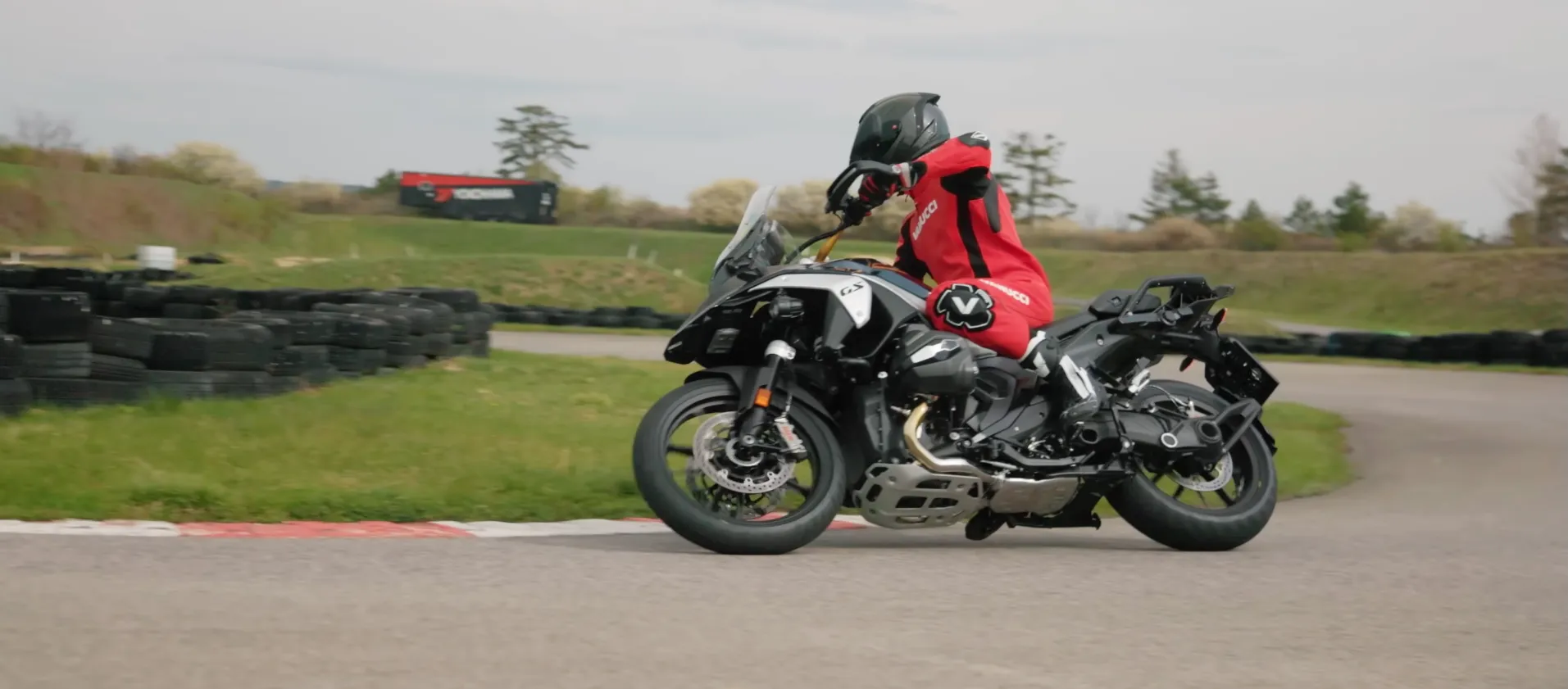
Pull in the clutch — except there’s no clutch lever. Right. ASA. Snap it into first, load the driveline with a hint of throttle, then it’s wide open. The big GS launches, the front goes light for half a beat, and we’re already braking for the first hairpin of our Austrian lap-time benchmark — a tight supermoto loop tucked into Lower Austria. Asphalt sits at 54 °F. Under the rear wheel: the same Bridgestone T33 we’re running on every adventure bike at this year’s comparison day. And the question I’m here to answer is the one every GS rider’s been asking since the press release dropped: is this auto box a comfort gadget for highway gliders, or can you actually ride it hard?
Confidence Shows Up Fast on the GS
Here’s the thing about climbing onto a 1300 GS: you sight your line, you tip in, and within a couple of laps the front and rear are just there. Even on a chilly morning, even when you’re not totally awake. I’ll be honest with you — I didn’t ride a single track day all winter. I’m not in the form I want to be in. And the GS just shrugged that off and handed me a sporty pace on a plate. Once you’re inside the GS world, once you’ve made peace with the boxer’s quirks at the front end, you settle in fast. That’s the whole point of a tight supermoto loop. Lap times are secondary. What matters is how quickly you trust the bike.
ASA in Auto Mode? Not on This Track.
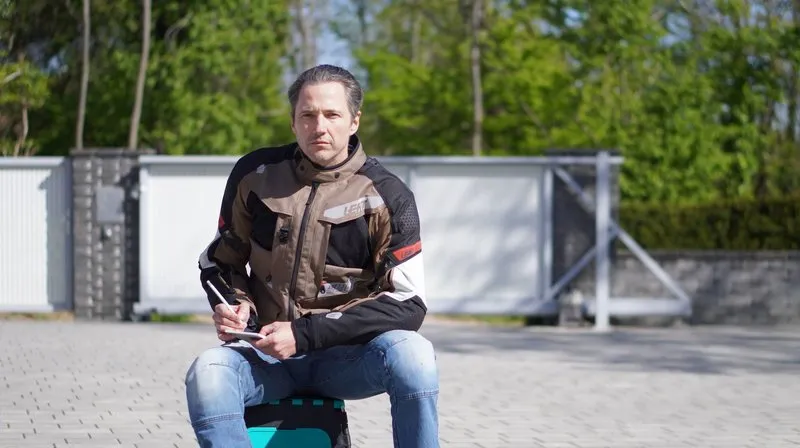
So about the gearbox. In full auto, on a track this tight, the GS picks shift points that don’t match what I’d pick myself. Tight, technical corner combinations need you to commit to a gear and stay there. I flicked it into manual mode and that’s where it gets interesting: this is basically a quickshifter on steroids. Up, down, no clutch lever, no blip on the throttle. Done. The shifts come fast and clean. On the road, in traffic, I’d leave it in auto every single time. But on a track or attacking a pass like the Stelvio? Manual mode, hand on heart. That’s where you find the time.
The Standing Start Mystery
Here’s a thing I’ll just admit: I’m not 100 % sure I launched the ASA correctly. With a regular clutch you’d hold revs, slip it out, drive forward. With this thing? Hold revs in neutral, snap into first, go? Or first gear, light throttle pressure, then full beans? I went with option two — a hair of throttle to load the driveline, then wide open. It felt almost anticlimactic. No clutch to feather, no engine to scream. It might be fast precisely because you can’t screw it up. It might also leave time on the table.
Honda DCT vs. BMW ASA, Briefly
Every comparison question lands on the same desk: how does this stack up against Honda’s DCT, specifically the Africa Twin? Bluntly put: Honda’s DCT shifts quicker. The cog-swaps on the Honda system are faster, and that’s just a fact of the hardware. But the BMW takes a different swing at the problem. ASA keeps a real shift lever for the people who like a real shift lever — and lets them coast in auto mode for 95 % of the day. Around our office, most testers leave it in auto for touring and just enjoy the ride. As an alternative to a regular gearbox, it’s a clean upgrade. As a direct rival to Honda’s DCT, it’s a different philosophy.
Bridgestone T33 and a 54 °F Morning
What worked out cleanly today was the relationship between the GS and the Bridgestone T33. The tire comes up to temperature quickly, doesn’t hold the bike back, and gives you neutral, calm handling at lean. It’s a good partnership. That said, 54 °F is cold for any street rubber, and it shows up in the times — that’s just physics. The flip side is that we’re running every adventure bike at this comparison day on the same T33, on the same track, on the same temperature. So when you eventually see the times pop up alongside the GS, the Multistrada, the Africa Twin, the Pan Am — read them as a same-day side-by-side, not as an absolute record sheet.
First Gear or Second? On This Boxer, Either.
I kept switching between first and second through the same corner sets, trying to decide which one was the better line. First gives you a little more headroom and a little more noise. Second has slightly less torque under you — though on a 1,300 cc boxer with 149 Nm (110 lb-ft) under your right hand, “slightly less” still means more than enough. By the end of the morning I’d basically concluded it didn’t matter. Pick a gear, commit, drive out. The rider aids stayed out of the way, the brakes did their job, and that was that.
No Sweat, Real Speed
If I had to guess where the time will land, I’d say I rode a genuinely quick lap on the GS today. And not one drop of sweat. No fear moments. No “oh hell” corners. Just a 523 lb adventure bike with 145 HP dancing around a tight supermoto track at the pace of a much smaller, much sportier machine. That’s the wild thing about where adventure bikes have landed in 2026: not just the price ceiling, but the accessibility. Big bikes that ride small. On the YouTube video for this session — out in a few weeks on the 1000PS channel — you’ll see the lines. The article stands on its own until then.
How the Time Sits in the Database
Lap time on the day: 1:08.0 on Bridgestone T33 at 54 °F. Above sits an earlier BMW R 1300 GS (MY 2024, Bridgestone A41, 88 °F) at 1:07.2 and the Yamaha MT-07 Y-AMT (MY 2025, Dunlop Sportmax Q5A, 102 °F) at 1:07.760. In the same neighborhood: the Triumph Speed Twin 1200 (MY 2022, Metzeler Racetec RR, 108 °F) at 1:08.0. Below: the KTM 890 Duke (MY 2021, Michelin Power GP, 54 °F) at 1:08.3 and the Honda XL750 Transalp (MY 2024, Pirelli Scorpion Trail II, 91 °F) at 1:08.7. Read tire and asphalt temperature alongside every line — both shift the result more than people think.
About the Austrian Supermoto Track
The test loop sits at a small motorsport facility in Lower Austria — a compact supermoto layout with tight hairpins, switchbacks, and short straights. Not a Grand Prix circuit, and that’s the whole point. The course is a stand-in for city traffic, alpine passes, and narrow back roads. The procedure stays the same on every bike: about ten warm-up laps, then a flying lap launched from a dead stop just before the timing line. That short run-up means clutch dosing and traction off the line feed straight into the time. Tire compound and asphalt temperature swing every result by a meaningful margin — anyone using these times for absolute comparisons is misreading the table.
So would I buy a GS with ASA? If I lived on alpine passes and wanted to ride them sportier than most, I’d want the manual mode at my fingertips and I’d be glad to have it. If I lived on the highway and wanted to roll up the West Coast without a thought about gears, I’d never touch the lever and be perfectly happy. Both kinds of riders exist. The GS, as always, makes room for both.