
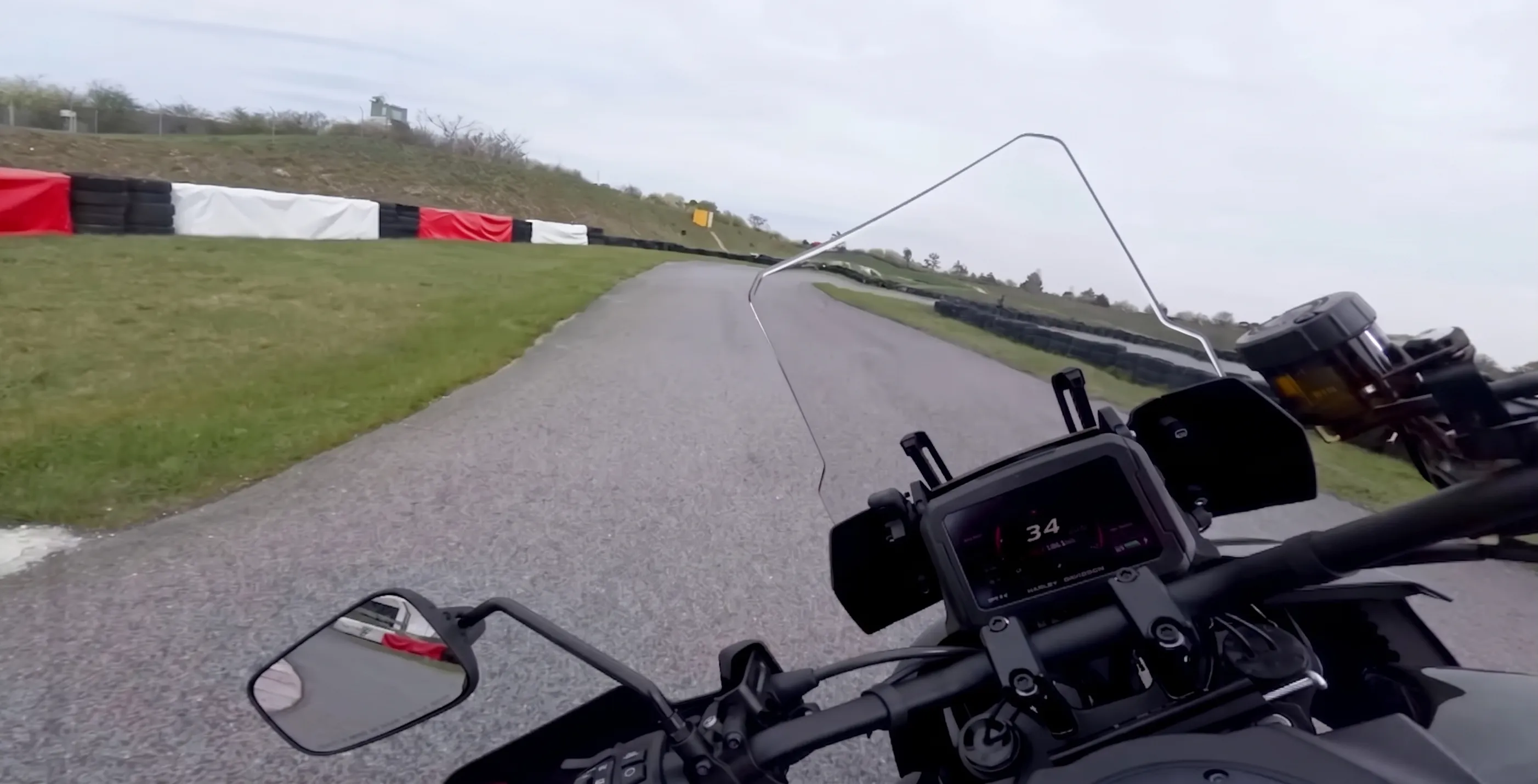
It’s opening day of the 2026 season at our supermoto-track benchmark in Austria, the asphalt’s sitting at a stubborn 52 °F, and I’m rolling out for my first timed lap of the year on a Harley-Davidson Pan America 1250 Limited. Same Bridgestone Battlax T33 tires I’ll bolt onto the four other adventure bikes I’m riding back-to-back today — KTM Super Adventure, BMW R 1300 GS, Ducati Multistrada V4 Rally. The point of this kind of compact, twisty test isn’t really the lap time. It’s how fast you trust the bike when the conditions aren’t doing you any favors.
ARH and why you settle in so fast
The Pan America’s Adaptive Ride Height does serious work the moment you swing a leg over. The bike’s a bulky thing on paper — heavy, tall, wide — but the second you’re in the saddle, it shrinks around you. That bought me a lot of trust on a chilly opening day. Bar reach lines up cleanly, the seat doesn’t fight my one-point-eight-four meters (about six feet on the nose), and I can put both feet down with zero drama. There was still plenty of winter rust in my bones after the off-season, but from the very first lap I’m thinking: alright, let’s go ride this thing properly.
Touring bike with a sporty itch
Here’s what Harley actually nails on this one: a balancing act other manufacturers in the segment rarely pull off cleanly. On one side, you’ve got a touring concept that feels like it could swallow Highway One whole without you ever getting off — range, comfort, luggage, the works. On the other side, the moment the road tightens up, this mischievous urge to ride properly comes out. The Pan America Limited isn’t just a polite long-distance cruiser. Push it on a tight, twisty surface, and you find more bike than the silhouette and the spec sheet hint at.
About 150 HP, and not a single brutal spike
Beyond the comfortable cockpit, the engine’s what really shines. On a compact supermoto course, this powerplant turns out to be genuinely useful — not impressive on paper, useful in practice. Up top you’ve got around 150 HP to work with. But down low, there are no spikes, no surprise hits, no ugly drivetrain tantrum. You roll into the throttle pleasantly, the power builds clean and even, and you can meter it, regulate it, steer the bike with it without ever getting jumped by an unexpected wave of torque. That’s exactly what builds trust on a heavy machine on a cold April morning. You get on the gas freely because you already know what’s coming next.
Off-idle hiccup in the tightest corners
Where it doesn’t feel perfect: the very tightest corners, specifically the shift from first into second. Combined with the strict Euro 5 Plus emissions tune that has the engine running pretty lean, you get a slight hiccup in throttle response right as you upshift and pick the gas back up. On a course where lap times come down to tenths, hundredths, even thousandths of a second, that fractional hesitation costs real time. My fix was pragmatic — I rode everything in second. The throttle was easier to meter, the fine load-change reactions disappeared, and I could keep my head on the line. Calmer pace, less risk on a cold morning.
Cold asphalt, four warm-up laps, a working tire
At 52 °F asphalt to start the season, even sporty touring rubber like the Bridgestone Battlax T33 needs three to four laps to come up to working temperature. From over a hundred timed-lap tests in our internal database, you can read it pretty clearly: once asphalt drops below roughly 60 °F, even a good touring tire enters compromise territory. You see it in the lap time. It’s not absolute-fastest pace, but it’s comparable in the only way that actually matters here — same track, same tires, same day, four adventure bikes back-to-back, all of them dealing with the same cold morning.
Vibration low, line easy
What helped a lot under those conditions was the Pan America’s low vibration level. The engine’s refined enough that you can pour your full attention into the only thing that wins time on this kind of layout — catching the right line. When nothing buzzes or rattles under you, you can give your full attention to the inside line, the brake point, the throttle pickup. The Bridgestone Battlax T33 plays a serious role here too — sporty, well-sorted touring tire that, despite the cold and the heft, lets you commit to a precise line. On the YouTube video on the 1000PS channel, you’ll see the bike clipping the inside cleanly through the tighter sequences. The video sometimes goes live a few weeks after this article, but the article stands on its own.
Brake feel: fine for the road, mild for the track
With sporty riding pushed harder, today was the first time I noticed the Pan America’s brakes could use a touch more aggression for my taste. Maybe I’m still a bit out of shape after winter — that’s possible. But I left time on the table at the brake markers. Side by side with the others today, I can already feel before the data comes in that the rivals are gonna have a lot more bite at the lever. For day-to-day touring, two-up with luggage, or for relaxed gravel work, this brake setup’s plenty. Riders pushing hard on a tight track will want more first-bite from the lever — small thing, irrelevant on the road.
Chassis balance, end to end
What I genuinely enjoyed about the Pan America Limited was how planted it feels — both ways. In tight radii, in wide sweepers, doesn’t matter. I always had the option of getting on the gas exactly when I wanted to, the line was easy to commit, and the bike stayed predictable through the whole arc. That kind of balance isn’t a given on a tall, voluminous adventure bike with a high seat. It speaks to the work Harley’s done on the setup. The transition from braking to turn-in is drama-free, the front talks back cleanly, the rear settles early when you’re driving out. On a cold spring asphalt, that kind of trust is what separates a quick lap from one that scares you out of trying again.
Won’t win the group test, and that’s fine
Put the Pan America Limited directly against the other adventure bikes from this comparison day, and it won’t win outright. Each rival’s better at something specific. On most ranking lists, the Harley’s not at the top. But here’s the thing: nobody’s getting off this bike disappointed. That’s the real point. It’s accessible, it’s comfortable, it’s sporty enough to deliver an honest lap on a tight course. And if you’re a Harley-Davidson fan, you also get the brand identity — the thing the competition just can’t offer.
Where the lap time lands in the database
With a lap time of 1:08.723 on the Bridgestone Battlax T33 at 52 °F asphalt, the 2026 Pan America 1250 Limited lands in a clear region of our long-running database. Above it sit the BMW R 1300 GS (MY 2024, Bridgestone A41, 88 °F) at 1:07.2 and the Ducati Multistrada V4 S (MY 2021, Pirelli Scorpion Trail II, 86 °F) at 1:07.3. In the same region you’ll find the previous Pan America 1250 Special (MY 2021, Michelin Scorcher Adventure, 86 °F) and the Honda Transalp 750 (MY 2024, Pirelli Scorpion Trail II, 91 °F), both at 1:08.7. Anyone comparing these times directly should always read tire and asphalt temperature alongside — both move the result noticeably.
The track and the test format, in plain English
The track we use for these timed laps is a compact supermoto course in Austria — tight hairpins, transitions, short straights. It’s deliberately not a real grand-prix circuit. Instead, it stands in for the kind of riding most people actually do: city traffic, Alpine passes, narrow country roads. The format runs the same way every time. About ten warm-up laps, then one timed flying lap from a standing start. That means clutch control, traction off the line, and the speed at which you trust the bike all feed into the result. Tires and asphalt temperature shift every number significantly, which has to be kept in mind when stacking entries against each other in the long-running database.