
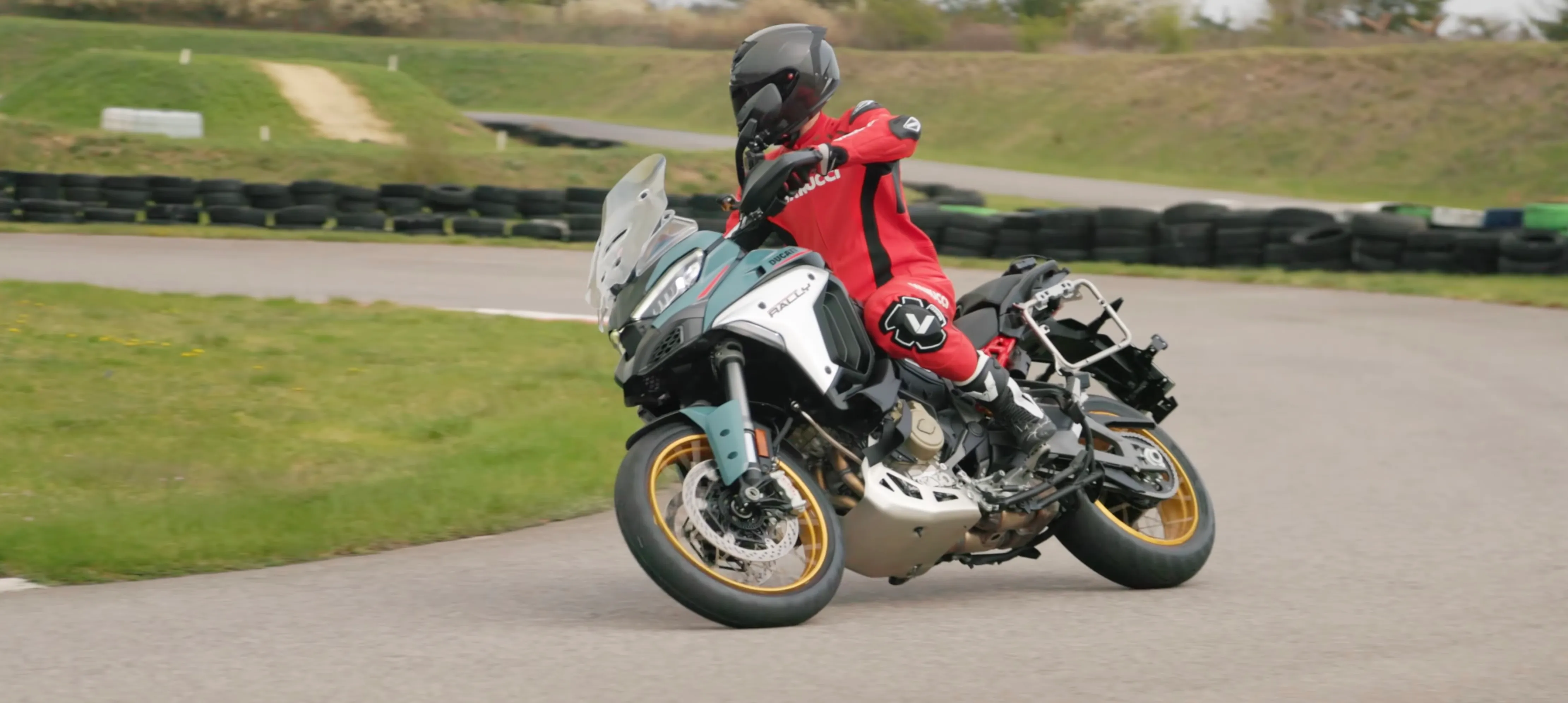
When a 529 lb tourer starts behaving like a supermoto
You roll up onto the Multistrada V4 Rally and the first thing that gets you is the size. This bike has presence. Big tank up front, wide bars, that 19-inch front wheel staring back like it would rather be on a Moroccan dune than on a tight Austrian asphalt loop. You think: okay, today is going to be about survival, not lap times. Then you go out and dial in your warm-up laps. And by lap three, the bike has rearranged your entire mental model of what a 529 lb tourer is allowed to do.
The lap-three moment
By the third lap, this thing shouldn’t be doing what it’s doing. I’m on a fully-loaded touring rig — a 529 lb bike with a fuel tank built for crossing time zones — and it’s responding like a quirky sport-naked. There’s a lightness to it. A snap in direction changes. A willingness to rev. I’m not going to say it rides like a sportbike — that’d be a lie. But the feeling of sitting on a very, very sporty motorcycle? That’s dead on. Then you climb off, walk a slow circle around the thing, and your brain has to recalibrate: this is the touring version. There are sportier Multistradas above it in the lineup. And it still moves like this.
What sets the Rally apart from the V4 S
The Rally is the long-haul Multistrada. Big fuel tank for huge range. 19-inch front for unpaved sections. Longer travel. The Rally is what you grab when you’re crossing continents with luggage strapped to the back. The V4 S is the road-focused, sharper-handling sibling — it’s the one that wins paper comparisons on pavement. So why is the Rally version, with all its touring baggage, behaving like an excitable lightweight on a tight supermoto loop? Because Ducati’s chassis people got something fundamental right: even with the big tank sitting up high, the Rally turns in with a neutral line. You can drift through a radius smooth as glass, then snap it onto an aggressive line when you want to. It cooperates either way.
The electronics that stay out of your way
Here’s where the Multistrada V4 separates itself from most of the segment, and it isn’t about horsepower. It’s about how the electronics show up exactly when you need them and disappear when you don’t. Traction control and ABS work shockingly well on this tight Austrian loop — never that abrupt “whoa, computer just took over” moment that makes you tense up mid-corner. The semi-active suspension calibrates itself to whatever you’re asking for. Brakes hit when you ask, soften when you don’t. The Bridgestone T33s on this Rally setup blend into the package — never the limiting factor, never the hero either. This isn’t a bike that bullies you with power. It’s a bike that defines itself by precision, and you feel that in every load change you make.
Euro 5 throttle, and how it actually works down low
Here’s where Ducati deserves real credit. Euro 5 V4s have a reputation for being prickly off idle — that off-throttle stumble, that sharpness in rolling loads. The Multistrada V4’s Granturismo motor handles all of that better than most. Down in the lower rpm range, where you spend half your time on a tight loop, I could dial the motor in clean. Rolling phases, brake zones, trail-braking into a hairpin — the engine talked back without snatching. Trustworthy. Smooth without being soft. The 168 HP is there when you want it, but it never feels like it’s about to kick the front wheel out from under you. This is a V4 that knows when to be polite and when to push.
Three boxes, one bike
This is the trick the Rally pulls off that nothing else in the segment really does. Sport. Accessibility. Touring comfort. Three boxes, all checked, on one platform. Look at the competition. The Pan America is comfortable — genuinely comfortable — but it doesn’t have this kind of sport edge or this kind of beginner-friendly throttle. Every other adventure tourer has its own peak strength, but none of them cover all three corners the way the Rally does. If you want a bike you won’t be intimidated to throw a leg over, that still wakes up when you push it, that can also haul you across two countries without your back screaming — this is currently the best motorcycle in the segment. Hill I’ll die on.
The small annoyances are still there
It’s not all sunshine. The phone integration still isn’t where I want it. Apple CarPlay would be the simplest fix, and Ducati hasn’t gotten there yet. If you’re not the tech-tinkerer type, climbing on this bike and figuring out which mode, which submenu, which preset goes where takes a minute. There’s a learning curve. The reward, once you’re past it, is real — the tech gives back precision and consistency you can’t get from a bike that hides its cards. But it’s a bike that asks for your attention. Some riders love that. Some won’t. Decide which one you are before you sign the financing paperwork.
Where this lap time sits on the board
The Rally laid down a 1:06.375 on the supermoto loop with Bridgestone T33s, asphalt at 61 °F. Above it on the leaderboard sit the 2022 Yamaha MT-10 on Bridgestone Battlax S22 (91 °F, 1:06.2) and the 2025 Kawasaki Z900 SE on Bridgestone S23 (97 °F, 1:06.328). Below it: the 2021 Ducati Multistrada V4 S on Pirelli Scorpion Trail II (86 °F, 1:07.3) and the 2024 BMW R 1300 GS on Bridgestone A41 (88 °F, 1:07.2). Further down sits the 2021 Harley-Davidson Pan America 1250 Special on Michelin Scorcher Adventure (86 °F, 1:08.7). Anybody comparing these times directly should always read the tire and the asphalt temperature alongside — both move the result more than you’d think.
The track and the test format
This wasn’t a press launch. It was a comparison test on a compact supermoto course in Austria — tight hairpins, transitions, short straights. Deliberately not a real grand-prix circuit. It stands in for the kind of riding most people actually do: city traffic, Alpine passes, narrow country roads. The format runs the same way every time. About ten warm-up laps, then one timed flying lap from a near-standing start, with only 20 meters (about 65 ft) of run-up before the timing line. Clutch finesse and traction off the line feed straight into your time. Tire choice and asphalt temperature shift every result. On the YouTube video on the 1000PS channel you’ll see the bike clipping the inside cleanly through the tighter sequences. The video sometimes goes live a few weeks after this article — the article stands on its own.
Quick specs
1158 cc V4 Granturismo. 168 HP (170 PS) at 10,750 rpm, 91 lb-ft (123.8 Nm) at 9,000 rpm. Wet weight without fuel: 529 lb (240 kg). Seat height adjustable 34.3–35.0 in (870–890 mm). Wheelbase 61.9 in (1,572 mm). Tested on Bridgestone T33s, asphalt at 61 °F. Lap time on the Austrian supermoto loop: 1:06.375.