
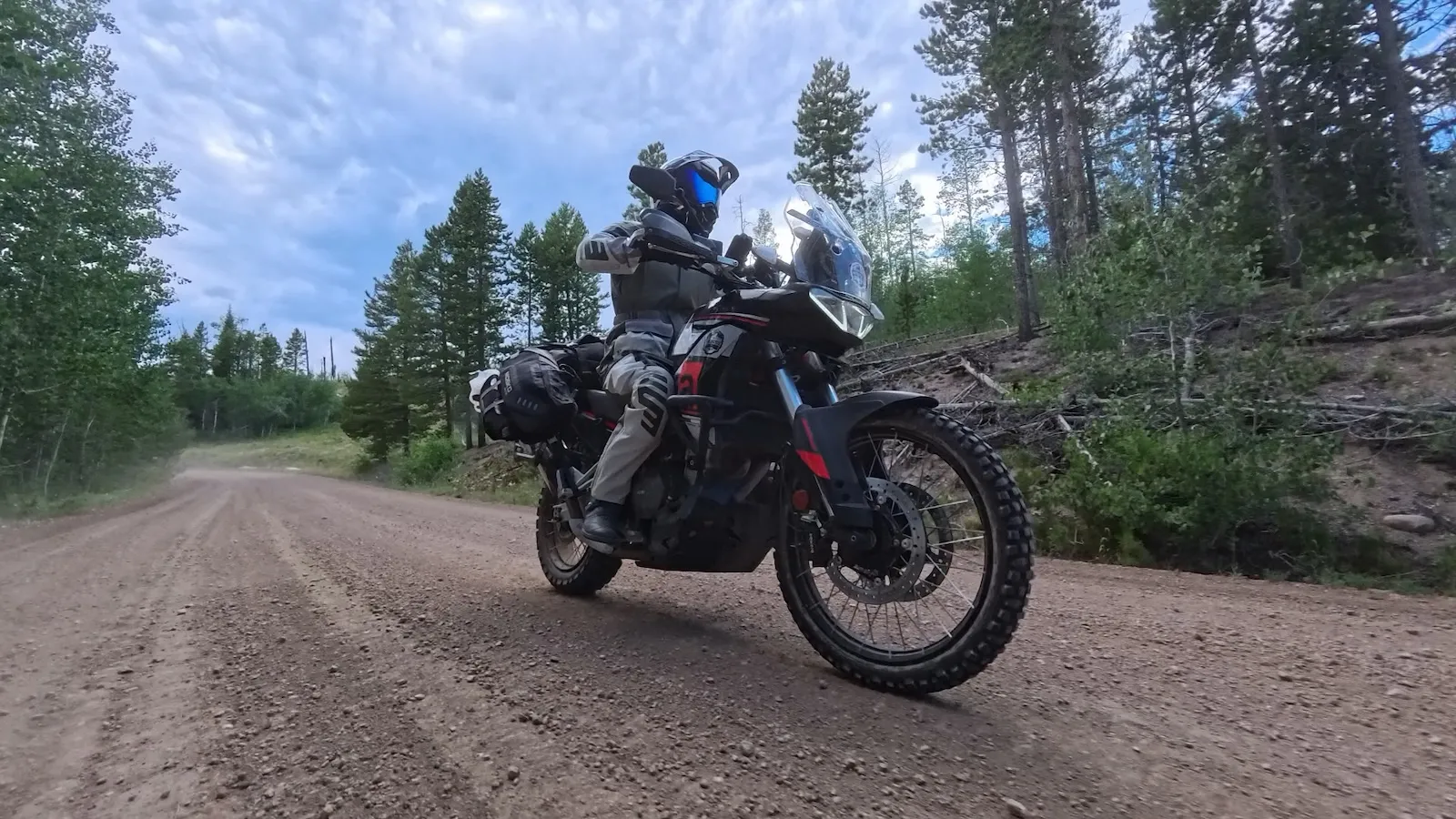
It is the classic complaint of every season. After two hours the lower back nags, the neck goes hard, the forearms shut down. And then the hunt for the culprit begins: a different handlebar, a different seat, bar risers, and if none of that works, a different motorcycle altogether. I have been arguing for years that these complaints are rarely an ergonomics problem and usually a fitness problem of the middle of your body. That sounds like a personal trainer talking. In Colorado I spent two weeks feeling exactly why it is true anyway.
The Handlebar Is Not a Grab Rail
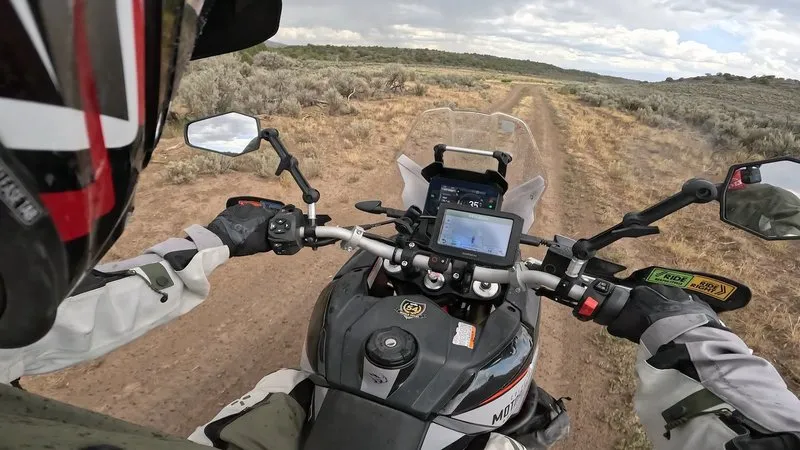
I like to describe the handlebar as a delicate conductor’s baton, something to be operated with feeling rather than gripped. It is a sensor and a steering device, not a grab rail and not a climbing frame. If you carry no tension through your middle you hang off your arms, and if you hang off your arms you hold on to the bar. That is not the end of the problem, that is where it starts. A handlebar that is being pushed and pulled stops sending information, because it is permanently busy carrying the rider’s weight instead of reporting what the front wheel is doing.
What follows is a chain every one of us knows. Cramped arms produce a wooden line, the wooden line produces unease, and the unease produces even more tension. Because the hands are squeezing continuously through all of it, the forearms eventually give up. The physics underneath is simple: braking and acceleration forces have to travel from rider into machine somehow, and the only question is whether they run through weak arms or through a strong middle. My phrasing on this is deliberately blunt. The handlebar is not to blame for the abdominal muscles you never built, so it should not be the part that suffers for them.
What Actually Happens Inside the Forearm
Arm pump is not imagination, it is mechanics. The medical name is chronic exertional compartment syndrome of the forearm, and while motorcycling is where it gets the most attention, it is equally documented in climbers, rowers and paddlers. The muscle works, it swells, and it sits inside a fascial sheath that cannot expand with it. Diagnosis is made through dynamic pressure measurement inside that compartment: in motocross racers the pressure sat at around 15 mmHg at rest and rose to around 78 mmHg under exertion. In 70 to 100 percent of cases both arms are affected, which fits the cause neatly, because nobody holds on with one hand only.
What I find remarkable is how little known this is. In a survey run by the French motorcycling federation, 29 percent of the licensed riders who answered had never heard of the condition, and more than a quarter of those affected had seen at least two practitioners before anyone named it. In racing, stubborn cases end up with the fascia surgically released, and in professional riders the pain score dropped from a median of 53 to 7 and stayed stable across five years. A touring rider should never get near that point, but it shows the cause sits in the grip rather than in the diameter of your handlebar.
Your Back Is the Bigger Lever
With the back, the context is even clearer. Low back pain has been the leading cause of years lived with disability worldwide since 1990. In 2020 it affected 619 million people, and 843 million are projected for 2050. This is not a motorcycling question, it is a human one. We just happen to do a great deal on a motorcycle to make it worse: we sit, we move little, we absorb vibration, and we route the forces through a passive upper body. Anyone who already has a weak core will find close to perfect conditions on a motorcycle to discover the fact.
What core actually means gets reduced to the six-pack far too often, which is why so many people start with sit-ups and feel nothing. It includes the transverse abdominis, the multifidus, the obliques and the rectus abdominis, the spinal erectors, the pelvic floor and the diaphragm. The transverse abdominis is regarded as the primary stabiliser of the lumbar spine and fires before any movement of the limbs. And the evidence points one way: core stability training reduces pain intensity and functional disability in non-specific chronic low back pain.
Colorado Was the Test Bench
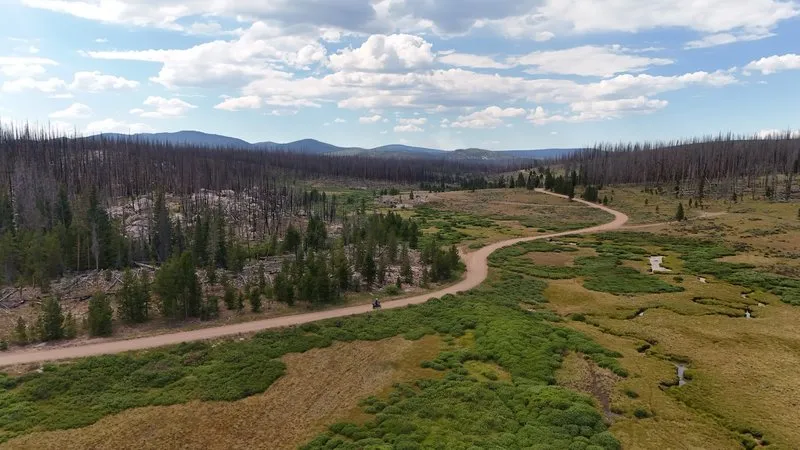
And now the part I did not see this clearly before the trip. The Colorado Backcountry Discovery Route is officially 745 miles long, which came to 1,060 miles the way we rode it, and most of that is unpaved. Off road, standing on the pegs is the basic position, because the legs work as suspension, the centre of gravity drops and your view down the trail improves. In practice that means standing, for hours, for days on end. No gym on earth asks you this question as honestly as a week of loose surface does.
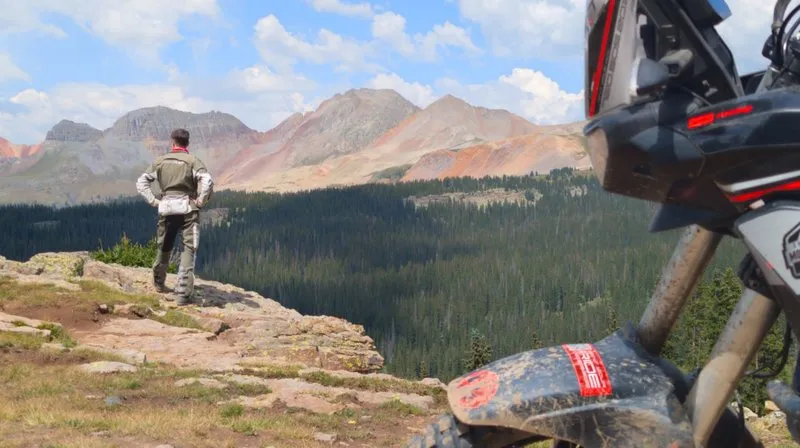
The Aprilia Tuareg 660 showed me how cleanly ergonomics can support that, and at the same time that it never takes the job over. A seat height of 860 mm, a narrow seat, 240 mm of travel at both ends and wide off-road pegs add up to a silhouette that stays slim exactly where you stand on it. The work was still done by the core. On Cinnamon Pass at around 12,600 feet the steering ran almost entirely through legs and feet, through small inputs on the pegs and through where I was looking. My hands were essentially unemployed, and that is precisely the state in which nothing hurts.
Altitude Does the Maths for You
What made this trip especially honest was elevation, because it invoices you immediately for every wasted bit of muscle work. Without acclimatisation, maximum oxygen uptake drops by a little over six percent per 1,000 metres of ascent, and at around 10,000 feet it sits some 21 percent below sea level values. Acclimatisation claws back only part of that; you never reach your home level up there. Above 8,200 feet there is acute mountain sickness on top, tracked with the Lake Louise score, and it becomes more common with every further 1,000 metres. You notice all of it in the least dramatic way possible: strapping luggage to the bike and being out of breath.
This is the real reason core strength matters more on a trip than at home. When your oxygen supply shrinks by a fifth, every unnecessary bit of muscle work turns expensive, and hanging off the handlebar burns oxygen for nothing. The second factor nobody budgets for is vibration, which is epidemiologically recognised as a risk factor for the frequency and intensity of back pain in professional drivers. The European vibration directive sets a daily action value of 0.5 and a limit of 1.15 metres per second squared over eight hours, assessed under ISO 2631-1. A week on gravel is vibration exposure whether you account for it or not.
Three Things That Work Immediately
The foundation is your feet, and it is the change with the best ratio of effort to effect. The balls of your feet belong on the pegs, not the arch and certainly not the heel. The moment the ball is on the peg, tension rises through the whole leg and part of your weight travels into the machine through the pegs instead of through the seat into your lumbar spine. The second change is the spine itself: actively lengthen it instead of surrendering your torso to gravity. That sounds like harder work and over a long day it is the opposite, because your weight then rests on muscle rather than on discs.
The third point is a check, and it is the most honest self-diagnosis I know. On a quiet road, in a gentle lean, try to flap your elbows. If that is easy, your grip is fine and the forces run through your middle. If not, you are hanging off your arms and you know where your evening pain comes from. In a dynamic system the calm, comfortable riding position is not the relaxed one; the active one that goes along with the motorcycle is.
What I Do Differently Now
I do not train for the motorcycle. I train so the motorcycle stops hurting. That is a small difference in motivation and it lasts far longer than any resolution to get fitter. Twenty minutes of core work twice a week across the six weeks before a trip is enough to feel a difference by the third day. On tour one free ritual helps: every half hour, deliberately open your hands and let your shoulders drop. If you cannot do that without the bike getting unsettled, you have your answer.
What the Gear Contributes
Gear matters less than muscle, but it matters wherever it either allows movement or prevents it. A suit that pulls at the shoulders when you stand pushes you back into the passive posture this whole article argues against. With a helmet, what counts at the end of a long day is weight, because every gram works as a lever on your neck.
The trip itself came from Colorado Motorcycle Adventures in Golden near Denver, including both Aprilias and the programmed tracks. If you are heading out there, put twenty minutes of core work a week into your calendar six weeks out. It is cheaper than any bar riser and it is the one component on your motorcycle you cannot buy.