By NastyNils·
Motorcycle comparison · Supersport
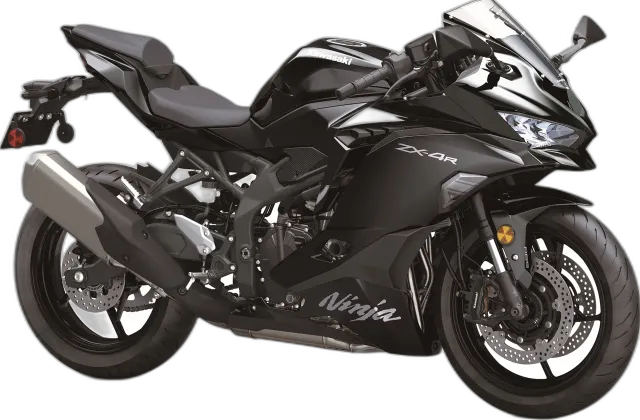
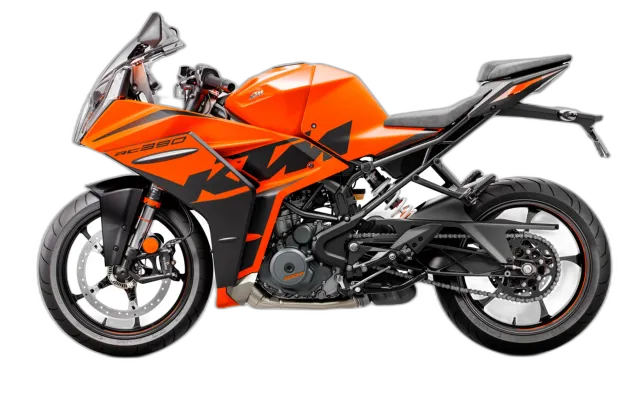
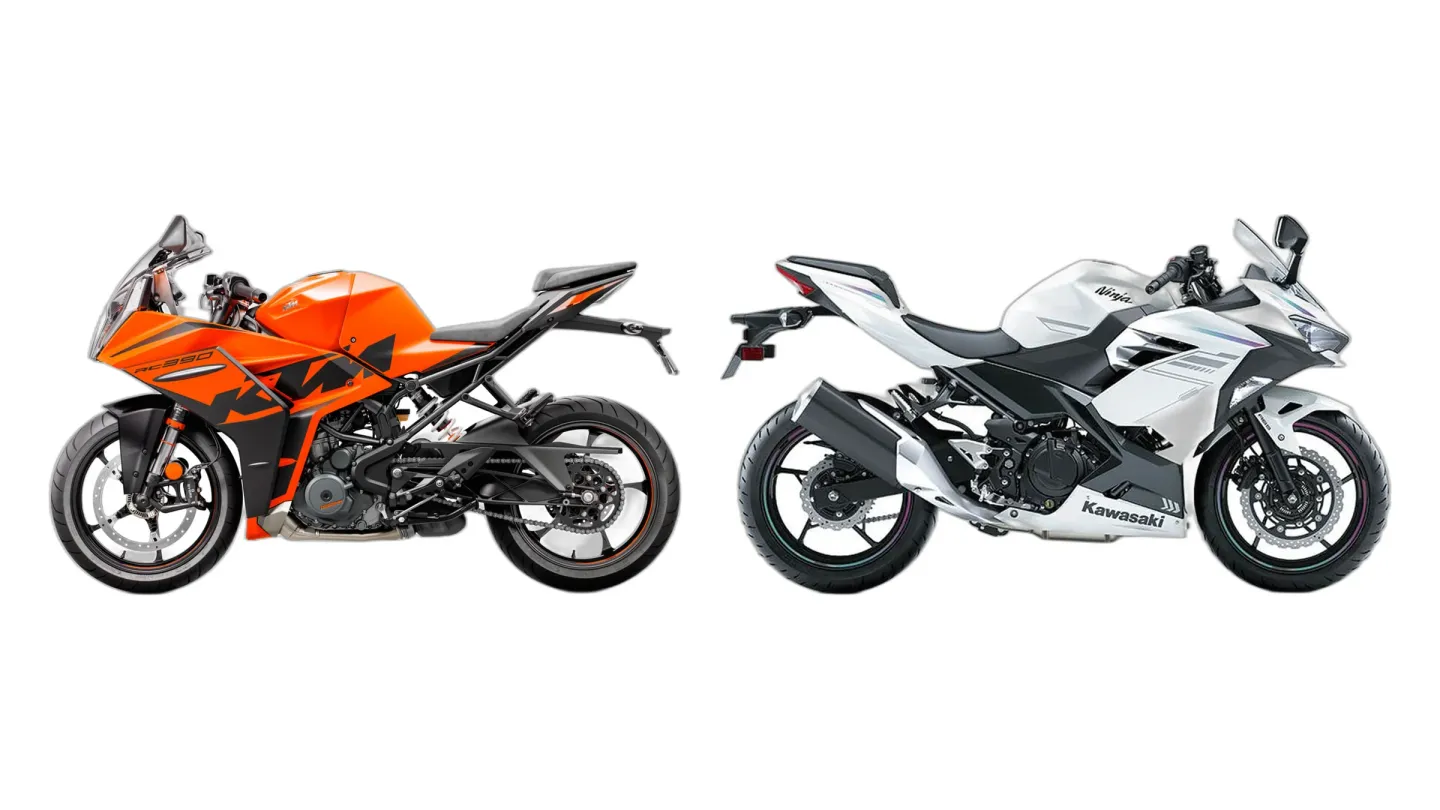
KTM RC 390 (MY2022) vs Kawasaki Ninja 400 (MY2018)
KTM RC 390 vs Kawasaki Ninja 400: one garage spot. Here's what should decide it.
Through a tight bend, the KTM RC 390 snaps in quick, and it's the midrange punch that hauls you off the apex. The Kawasaki Ninja 400 doesn't hustle the turn, and there's nothing to fight on the way in. It tracks exactly where you've pointed it, every time.
So which one do you buy?
The RC 390 has the edge if…
Racetrack use
Narrow edge: RC 390
For track days, the RC 390 comes out a touch ahead. Put it down to stronger brakes. Your setup and tires matter just as much.
Sporty riding on twisty roads
Small edge: RC 390
The RC 390 is a touch more fun when the road starts bending. Just a touch.
The Ninja 400 has the edge if…
Keeping running costs low
By a nose: Ninja 400
On running costs, the Ninja 400 edges it. Not by enough to bank on.
Daily commuting & city riding
Slight edge: Ninja 400
For the Monday-to-Friday grind, the Ninja 400 pulls a nose in front. Your own commute could easily flip it.
Which one's the smarter buy
Money won't decide it
The RC 390 costs less, but that doesn't make it the better buy. Neither bike is the clear winner on value alone. Your choice depends on what you want it for.
What makes each one tick
RC 390
On a street on-ramp or a track day, the RC 390's light chassis and WP suspension steer with the same precision. At corner entry, the front settles on its line from a small push on the bar, and there's no second correction. The single doesn't need wringing out.
Ninja 400
Nothing on the Ninja 400 needs learning, and it's got you smiling before you've reached second gear. Low weight and low rotating mass make quick direction changes feel almost automatic. The parallel twin doesn't stumble on fueling, even when the throttle opens hard. It pulls cleanly low down. Its hardest shove waits near the top of the tach.
Nils rode the Ninja 400 in Slovakia in 2023 (NastyNils Testride).
The Voice of Experience

What actually separates them
- The Ninja 400 has the lower seat: 30.9 in (785 mm) vs 32.4 in (824 mm).
- The Ninja 400 has the larger engine: 399 cc vs 373 cc.
- ABS: standard on the RC 390, option on the Ninja 400.
Which one for the way you ride
Comfortable long-distance riding
Neither one fits
For all-day comfort, both fall short. Keep the rides short and you'll get on fine with either.
Who each one is built for
What's good, and what you'll live with
RC 390
What owners say
Strengths
- Agile and precise handling
- Peppy and accessible engine
Trade-offs
- Questionable long-term reliability
Ninja 400
Strengths
- Agile without ever going nervous
- Goes exactly where you point it
- Zero learning curve
- The seat is actually soft
- 45 hp feels like enough
Trade-offs
- Mixed-power groups kill it
- Suspension is set for the street
- One front disc, real limits
- Slicks overwhelm the chassis
- Weak front brake feel and bite
Known problems to check before you buy
RC 390
- E-throttle failure causing sudden idle (Recall 26V196) Recall 26V196000 Moisture can migrate into the electronic throttle's connector, eroding contacts. The ECU detects a voltage deviation and sets the engine to idle speed, causing loss of motive power. Affects 2022-2024 RC 390 models; remedy is replacement with improved e-throttle.
Ninja 400
- Assist & Slipper Clutch premature wear — slipping, false neutrals, gear dropping Premature wear of the assist and slipper clutch is one of the most frequently reported problems on the Ninja 400. The cable-operated clutch has little wear margin, and the assist-and-slipper ramp design adds to it, so the clutch pack can start slipping early in the bike's life. The first symptom is usually the clutch slipping under moderate to hard acceleration, most noticeably in the higher gears. Some owners also report false neutrals between the upper gears, gears not engaging cleanly and the transmission jumping out of gear. Track riding and aggressive launches make it worse. The usual fix is new friction plates and springs, along with a check of the clutch cable free play.
- OEM cylinder coolant seal deformation causing external coolant leak The rubber coolant seal between the crankcase and cylinder block at the front of the engine tends to deform, fold over, and allow coolant to leak externally. The factory seal is a tall, narrow rubber piece sitting in an open cavity without mechanical retention. Once deformed, coolant weeps from the front of the engine.
What they cost used
These prices compare a 4-year-old RC 390 with a 4-year-old Ninja 400.
- RC 390
- $4,500
- Ninja 400
- $4,800
At four years old, the KTM RC 390 sits around $4,500 while the Kawasaki Ninja 400 runs about $4,800. That's a $300 gap in the RC 390's favor. They're pulled from earlier market records, not live listings.
What they share
- Cooling
- Liquid-cooled
- Gearbox
- 6-speed
- Final drive
- Chain
- Front tire
- 110/70-17
- Rear tire
- 150/60-17
Where the spec sheets split
| RC 390 | Ninja 400 | |
|---|---|---|
| Seat height | 32.4 in (824 mm) | 30.9 in (785 mm) |
| RC 390 | Ninja 400 | |
|---|---|---|
| Displacement | 373 cc | 399 cc |
| Engine | Single-cylinder | Parallel twin |
| Power | 44 hp (32 kW) | 45 hp (33 kW) |
| Torque | 27 lb-ft (37 Nm) | 28 lb-ft (38 Nm) |
| RC 390 | Ninja 400 | |
|---|---|---|
| Fuel capacity | 3.6 US gal (13.7 L) | 3.7 US gal (14 L) |
| RC 390 | Ninja 400 | |
|---|---|---|
| Fork | Upside-down (USD) | Telescopic |
| Front brake | 320 mm | 310 mm |
What comes fitted, what costs extra
| RC 390 | Ninja 400 | |
|---|---|---|
| ABS | Standard | Option |
| Cornering ABS | Standard | Not offered |
| Traction Control | Standard | Not offered |
| Manually Adjustable Front Suspension | Standard | Not offered |
| Quickshifter | Option | Not offered |
| TFT Display | Standard | Not offered |
Head to head, area by area
Both bikes on the same scale, one area at a time.