By NastyNils· ·
Motorcycle comparison · Supersport
BMW S 1000 RR (K46) vs Yamaha YZF-R1 (RN49)
BMW S 1000 RR vs Yamaha YZF-R1: one garage spot. Here's what should decide it.
Hard on the gas over a wet, dusty road, the BMW S 1000 RR's electronics catch the slip and you'll barely feel them work. The Yamaha YZF-R1's uneven crossplane beat keeps begging for revs.
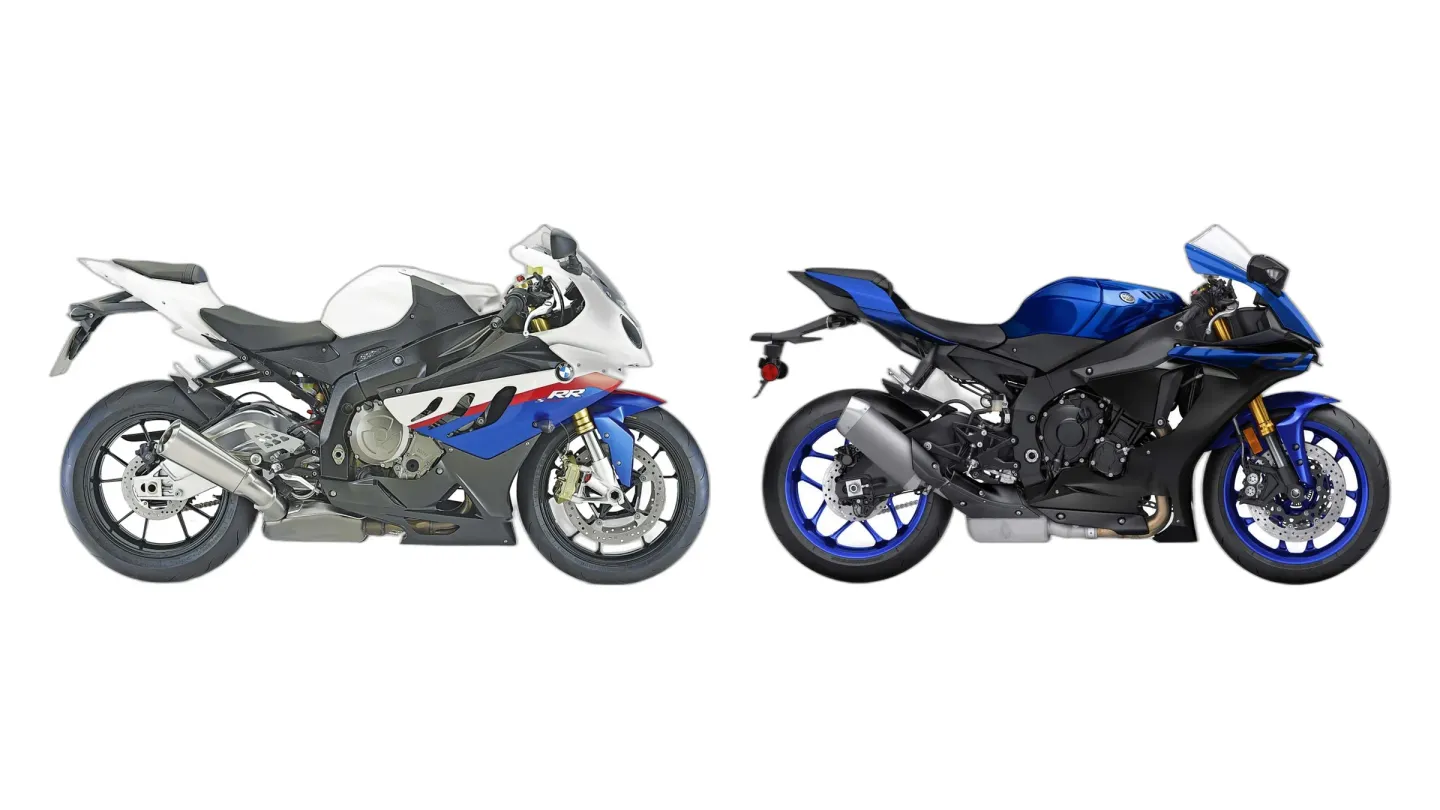
So which one do you buy?
Which one's the smarter buy
Money won't decide it
Neither bike is the clear better buy at these used prices. The S 1000 RR costs less, but that doesn't make it the smarter spend.
What makes each one tick
S 1000 RR
From the chain at the back to the switchgear on the bars, the S 1000 RR shares nothing with the rest of BMW's lineup. Riders switching from other brands will feel at home here faster than long-time BMW customers. The familiar click that confirms each gear is engaged simply isn't there. Still, there's never a missed downshift. Into a long, fast sweeper, the front tire turns in without fuss, and the aluminum frame holds the lean while you're still on the gas. Off the apex, the rear tire pushes and doesn't stutter.
Nils rode the S 1000 RR in Portugal in 2009, in Andalusia, Austria, Slovakia, and the Czech Republic in 2010, in Andalusia, Hungary, Slovakia, and the Eifel in 2011, in Andalusia and Spain in 2012, in 2014, in Andalusia in 2015, in Oman & UAE in 2016, and in Qatar in 2017 (NastyNils Testride).
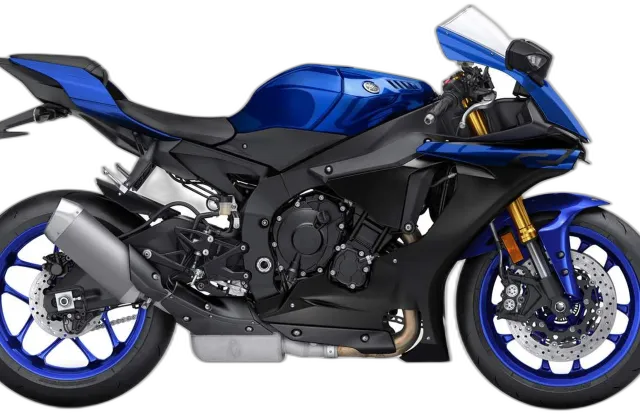
YZF-R1
Up top, there's a huge rush from the YZF-R1's inline-four, and its odd firing order gives the exhaust a voice of its own. The firm suspension doesn't soak up much of a street bump. The forward crouch never lets up. The bars keep reporting grip down to the pegs.
Nils rode the YZF-R1 in 2017, and in Switzerland in 2020 (NastyNils Testride).
The Voice of Experience
What actually separates them
- The S 1000 RR has the lower seat: 32.1 in (815 mm) vs 33.7 in (855 mm).
- ABS: standard on the YZF-R1, option on the S 1000 RR.
- Cornering ABS: standard on the YZF-R1, not offered on the S 1000 RR.
Which one for the way you ride
A confidence-building first motorcycle
Both miss here
Learning on either of these is the hard way. A gentler bike will make you a better rider sooner.
These two run dead level on track days, commuting, twisty roads, and running costs. Sit on both in the showroom and trust what your body says.
Who each one is built for
What's good, and what you'll live with
S 1000 RR
Strengths
- Top End Never Signs Off
- Traction Control That Trims
- Clutchless In Both Directions
- Planted In Fast Sweepers
- Class-leading peak power
Trade-offs
- It Does Not Flick
- Thin Below The Power Band
- City Riding Is Work
- Brake Lever Point Migrates
- Snatchy throttle response (2010–2011)
YZF-R1
What owners say
Strengths
- Addictive, charismatic engine
- Outstanding cornering precision
Trade-offs
- Tall seat height
Known problems to check before you buy
S 1000 RR
- Fuel pump flange may crack and leak fuel Recall 20V471000 The pneumatic fastening tool used at the fuel-pump supplier introduced stress at the pump flange during assembly. Over time, cracks can propagate at the flange and fuel can leak — fire risk in the presence of an ignition source. The recall covers MY2010–MY2011 S 1000 RR within a much larger 50,184-unit BMW two-wheel campaign that also covered other BMW Motorrad models. Remedy: dealer reinforces the flange with a support ring or replaces the fuel pump. A follow-up campaign (NHTSA 20V471) replaces fuel pumps that received only the support-ring repair under 13V617.
- Sachs suspension underdamped for spirited / track use (especially 2010) The 2010 Sachs front fork is widely judged underdamped for spirited or track use; damping was improved in 2011 within the same generation. Cartridge re-valving is non-trivial because Sachs uses non-standard shim sizes — most track riders fit aftermarket cartridge kits. The Sachs rear shock is not user-rebuildable, and seal leaks have been reported.
- Quickshifter intermittent or inoperative — wiring/connector at shift sensor Quickshifter stops working intermittently or completely. Documented root cause is most often the wiring or connector at the shift-sensor side rather than the sensor itself; BMW issued a service measure on the shift sensor. Some dealers misdiagnose and replace the sensor unnecessarily before fixing the wiring.
- Balance-pipe / exhaust valve servomotor failure On MY2015–2016 K46 bikes (and some MY2017–2018), the balance-pipe valve servomotor bushing wears, the actuating cables can break, or the servo can seize in the activated position. Symptom: loud clicking on ignition, fault code, valve stuck open or closed. BMW has replaced full header systems under warranty in some documented cases. Aftermarket "servo eliminator" devices (HealTech, Servo Buddy) are common workarounds.
- DDC dashboard error / calibration failure On MY2015–2018 K46 bikes optioned with DDC (Dynamic Damping Control), a "DDC!" dashboard warning or calibration failure can appear. Documented root causes include corroded or loose battery terminals, CAN-bus faults, and rear travel sensor displacement. Often resolves with re-calibration or wiring fix; in some cases the DDC shock has been replaced under warranty.
- Brake judder / pulsing at the lever, mostly under track / hard road use Brake judder reported at the lever after hard use. Community consensus is that the cause is most often uneven pad-material deposit on the stock rotors (rather than true disc warpage), with stock pads judged inadequate for sustained track use. Common owner fix: switch to higher-spec pads (e.g., Brembo Z04) or upgraded discs.
- Cam chain rattle at cold start (cam chain tensioner spring pressure) Loud cam chain rattle, particularly on cold start. BMW issued a service measure that replaces the original BLACK screw plug at the cam chain tensioner with a longer SILVER screw plug to increase tensioner spring pressure. The fix is applied only after approximately 9,300 mi (15,000 km) and only when the symptom is documented. Some owners switch to aftermarket manual cam chain tensioners (e.g., Alpha Racing) for track use. No engine failures attributed to the rattle in documented sources.
- Vibration through tank, handlebars and pegs above 6,000 rpm Distinct vibration through tank, bars, footpegs and mirrors, intensifying past approximately 10,000 rpm. The K46 inline-four has no secondary balancer. Mirrors can blur at sustained high revs.
- Aluminium frame transfers significant heat to rider's inner legs The aluminium twin-spar frame (used as a load-bearing element with the engine inclined into it) transfers significant engine and exhaust heat to the rider's inner legs, particularly in low-speed traffic and warm weather. Documented across all K46 model years. Common owner-installed mitigation: aftermarket carbon frame covers (e.g., Ilmberger).
YZF-R1
- Brake lever sponginess, weak initial bite, accelerated rotor glazing under track use The Advics 4-piston front calipers are competent, but the OEM pads, master cylinder, and rotor thickness are consistently identified as the system's weakness. ABS-induced lever sponginess is widely reported. Under sustained track use, rotors glaze and bite drops further. On 2018–2019 models, the linked-brake system draws criticism: the rear brake feels loose under heavy braking and can produce a tyre-squealing fishtail on track. Common owner remedy: replacement pads (HH compounds), braided lines, ABS-bypass for track-only bikes.
- Wafer-thin OEM seat causes acute discomfort on rides over approx. 60 minutes The OEM seat is universally described as "wafer-thin" and "torture after a couple of hours." Combined with high pegs, narrow tank, and aggressive bar position, road comfort is sub-class for use cases beyond track days and short fast-road rides. This is a deliberate design choice (track-bias positioning) rather than a defect, but it is consistently raised as a primary practical limitation of the bike.
- Auto-blipper requires excessive lever pressure at low rpm, or quickshifter sensor fails outright The MY2018+ auto-blipper (clutchless downshift) requires noticeably more lever pressure at low rpm according to riders. The quickshifter sensor itself can short out without warning, leaving both upshift and downshift functions inoperative until replacement.
What they cost used
These prices compare an 8-year-old S 1000 RR with an 8-year-old YZF-R1.
- S 1000 RR
- about $12,100
- YZF-R1
- about $14,000
At eight years old, the BMW S 1000 RR sits around $12,100 while the Yamaha YZF-R1 runs about $14,000. That leaves the S 1000 RR cheaper by roughly $1,900. These are US market estimates, not live listings.
What they share
- Engine
- Inline-four
- Cooling
- Liquid-cooled
- Gearbox
- 6-speed
- Final drive
- Chain
Where the spec sheets split
| S 1000 RR | YZF-R1 | |
|---|---|---|
| Seat height | 32.1 in (815 mm) | 33.7 in (855 mm) |
| Wet weight | 450 lb (204 kg) | 441 lb (200 kg) |
| S 1000 RR | YZF-R1 | |
|---|---|---|
| Displacement | 999 cc | 998 cc |
| Power | 199 hp (146 kW) | 200 hp (147 kW) |
| Torque | 83 lb-ft (113 Nm) | 83 lb-ft (112 Nm) |
| Top speed | 186 mph (299 km/h) | 186 mph (300 km/h) |
| S 1000 RR | YZF-R1 | |
|---|---|---|
| Fuel economy | 37 mpg (US) / 6.4 L/100 km | 34 mpg (US) / 7 L/100 km |
| Fuel capacity | 4.6 US gal (17.5 L) | 4.5 US gal (17 L) |
| S 1000 RR | YZF-R1 | |
|---|---|---|
| Front tire | 120/70 ZR17 | 120/70-17 |
| Rear tire | 190/55 ZR17 | 190/55-17 |
| Wheelbase | 56.1 in (1425 mm) | 55.3 in (1405 mm) |
What comes fitted, what costs extra
| S 1000 RR | YZF-R1 | |
|---|---|---|
| ABS | Option | Standard |
| Cornering ABS | Not offered | Standard |
| Wheelie Control | Option | Standard |
| Launch Control | Option | Standard |
| Quickshifter | Option | Standard |
| TFT Display | Not offered | Standard |
| LED Headlight | Not offered | Standard |
Head to head, area by area
Both bikes on the same scale, one area at a time.