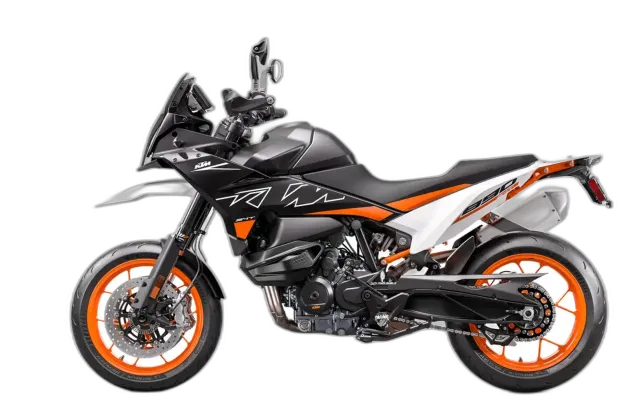
By NastyNils·
Motorcycle comparison · Sport Tourer
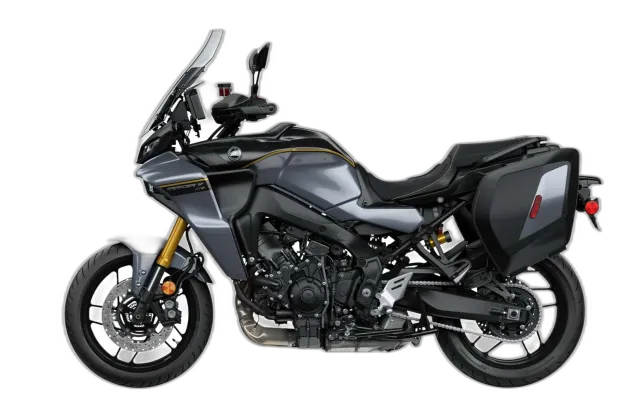
Yamaha Tracer 9 (MY2021-GT) vs KTM 890 SMT (MY2023)
Yamaha Tracer 9 vs KTM 890 SMT: long days, loaded bags, one choice to make.
Rolling on from low revs, the Yamaha Tracer 9 shoves hard and doesn't ask for a downshift. The KTM 890 SMT's twin pulls cleanly off the bottom, and it's still gathering pace. Up top it rushes and wants every gear wrung out.
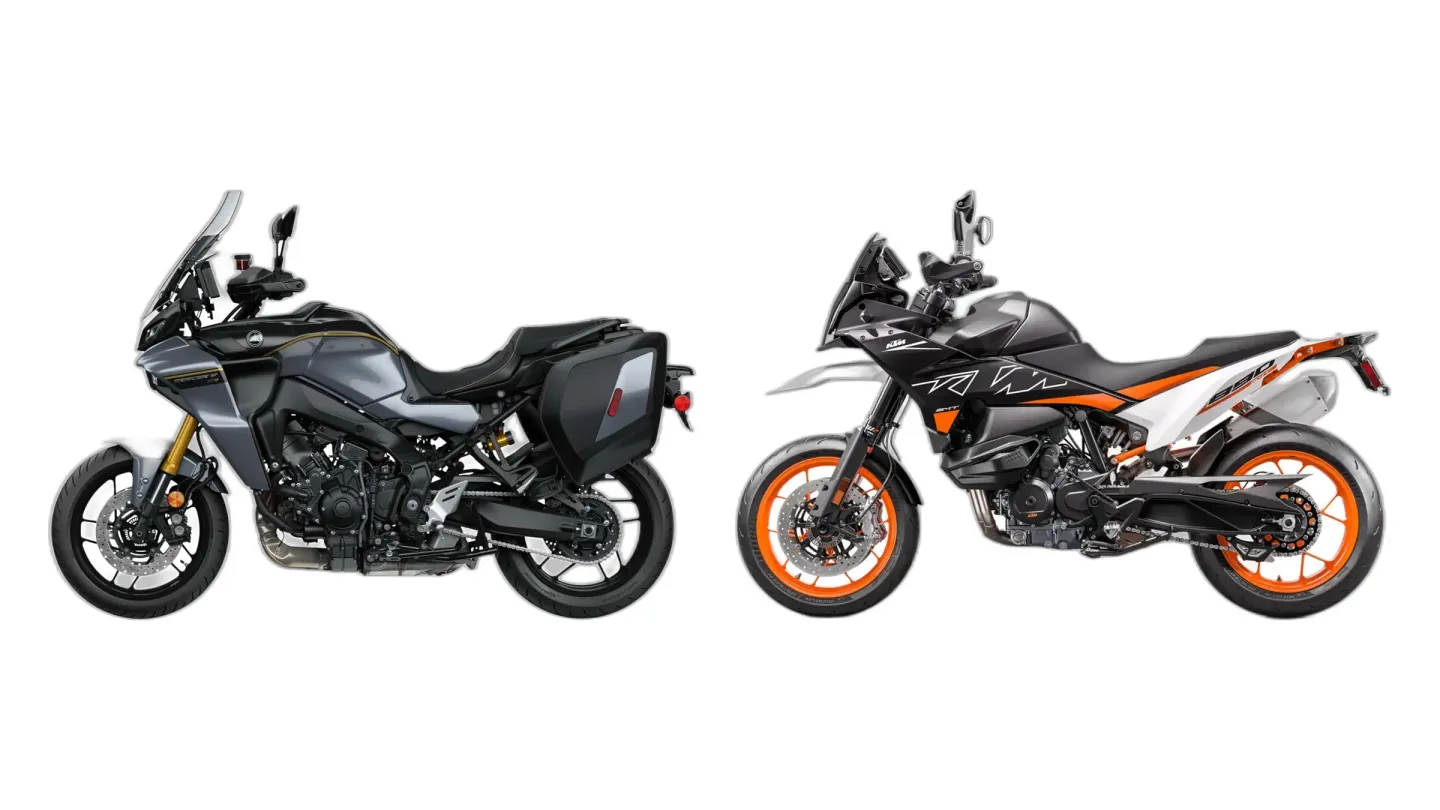
So which one do you buy?
The Tracer 9 has the edge if…
Comfortable long-distance riding
Slight edge: Tracer 9
Hour after hour, the Tracer 9 feels a little kinder to you. That comes from a better reliability record. It's a close-run thing, though.
Keeping running costs low
Narrow edge: Tracer 9
The Tracer 9 should be a little cheaper to keep on the road. It's a small gap.
Daily commuting & city riding
Nose ahead: Tracer 9
On the way to work, the Tracer 9 asks a little less of you. Close enough that the test ride should settle it.
The 890 SMT has the edge if…
Sporty riding on twisty roads
Edges it: 890 SMT
Back-road fun leans slightly toward the 890 SMT. Put it down to lighter steering. It's a narrow call, so trust your test ride.
Which one's the smarter buy
Money won't decide it
The 890 SMT costs less, but that doesn't make it the better buy for everyone. Neither bike is the clear winner on value alone. Your choice depends on what you want the bike to do.
What makes each one tick
Tracer 9
Of everything on the Tracer 9, it's the CP3 triple's exhaust note that stays with you. Its KYB suspension doesn't fake the change between Sport and Comfort, and each mode sets its own ride over the same pavement. Corner entry stays light on forged wheels that carry less spinning weight. Then the front holds its line.
Nils rode the Tracer 9 in 2021 (NastyNils Testride).
890 SMT
Supermoto bones show in how the 890 SMT snaps into tight backroad bends on its sticky Michelins. Over broken pavement the WP Apex fork and shock stay forgiving, yet there's still support underneath once you're pushing. Trailing the brake lever into a bend isn't a gamble, since the ABS reads how far the bike leans. The seat holds up all day.
The Voice of Experience

What actually separates them
- The Tracer 9 has the lower seat: 31.9 in (810 mm) vs 33.9 in (860 mm).
- The Tracer 9 makes more peak power: 119 hp (88 kW) vs 105 hp (77 kW).
- The 890 SMT makes more peak torque: 74 lb-ft (100 Nm) vs 69 lb-ft (93 Nm).
Which one for the way you ride
A confidence-building first motorcycle
Both miss here
Learning on either of these is the hard way. A gentler bike will make you a better rider sooner.
Who each one is built for
What's good, and what you'll live with
Tracer 9
What owners say
Strengths
- Engine character — torquey, flexible CP3
- Excellent value — comprehensive standard kit
- Chassis precision and agility
- Functional semi-active KYB suspension
- Comprehensive electronics package
Trade-offs
- Wind buffeting and helmet noise
- Stock seat — slope and hardness
- Handlebar vibration zone 3.8–5.0k rpm
- Hard 1st-gear engagement and occasional false neutrals
- Two-screen TFT layout (GT only) — cluttered, daylight contrast
890 SMT
What owners say
Strengths
- Agile, planted supermoto handling
- Responsive and wide-spread LC8c twin
- All-day comfort with upright ergonomics
- Supple yet supportive WP Apex suspension
Known problems to check before you buy
Tracer 9
- Cruise control orange light flashes; cruise cannot be set or resumed The cruise control indicator flashes and the system refuses to set or resume. Cause traced in some cases to a sticky front-brake light switch or clutch-position switch (cruise interlocks) — sometimes resolved by an ignition cycle, sometimes requiring switch replacement; some owners report recurrence after dealer-replaced switches.
- Vibration through handlebar and footpegs in the 3,800–5,000 rpm range Owners report a buzz/numbness through the handlebar concentrated at approximately 3,800–5,000 rpm — a range that overlaps with 6th-gear highway cruising for many speeds. Smooths above approximately 5,000 rpm. Inherent to the long-stroke CP3 in this chassis.
- Front turn-signal mounting brackets work loose The front indicator stalks loosen at the bracket mounting point; light contact (e.g., a brush in the garage) can detach them. Refastening securely is difficult.
890 SMT
No confirmed faults on file yet. That's not the same as fault-free.
What they cost used
These prices compare a 2-year-old Tracer 9 with a 2-year-old 890 SMT.
- Tracer 9
- about $11,100
- 890 SMT
- about $9,500
At two years old, the Yamaha Tracer 9 sits around $11,100 while the KTM 890 SMT lands near $9,500. That puts the 890 SMT about $1,600 cheaper. These are US market estimates, not live listings.
What they share
- Cooling
- Liquid-cooled
- Gearbox
- 6-speed
- Final drive
- Chain
- Front tire
- 120/70-17
- Rear tire
- 180/55-17
Where the spec sheets split
| Tracer 9 | 890 SMT | |
|---|---|---|
| Seat height | 31.9 in (810 mm) | 33.9 in (860 mm) |
| Tracer 9 | 890 SMT | |
|---|---|---|
| Displacement | 890 cc | 889 cc |
| Engine | Inline-three | Parallel twin |
| Power | 119 hp (88 kW) | 105 hp (77 kW) |
| Peak power at | 10,000 rpm | 8,000 rpm |
| Torque | 69 lb-ft (93 Nm) | 74 lb-ft (100 Nm) |
| Peak torque at | 7,000 rpm | 6,500 rpm |
| Tracer 9 | 890 SMT | |
|---|---|---|
| Fuel economy | 43 mpg (US) / 5.5 L/100 km | 51 mpg (US) / 4.6 L/100 km |
| Fuel capacity | 4.8 US gal (18 L) | 4.2 US gal (15.9 L) |
| Tracer 9 | 890 SMT | |
|---|---|---|
| Front brake | 298 mm | 320 mm |
What comes fitted, what costs extra
| Tracer 9 | 890 SMT | |
|---|---|---|
| Electronic Suspension | Standard | Not offered |
| Cruise Control | Standard | Option |
| Quickshifter | Standard | Option |
| Smartphone Connectivity | Not offered | Option |
| Navigation | Not offered | Standard |
| USB Charging Port | Option | Standard |
| Heated Grips | Standard | Option |
| Adjustable Windscreen | Standard | Not offered |
| Luggage System | Standard | Option |
| Cornering Lights | Standard | Not offered |
Head to head, area by area
Both bikes on the same scale, one area at a time.