By NastyNils·
Motorcycle comparison · Sport Tourer
Kawasaki Versys 650 (LE E) vs Versys 1000 (LZT00C)
Kawasaki Versys 650 vs Versys 1000: which one you'd rather spend the big miles on.
In slow traffic just off idle, the Kawasaki Versys 650 pulls clean from low revs and doesn't shake. The Kawasaki Versys 1000's throttle isn't one to learn on.
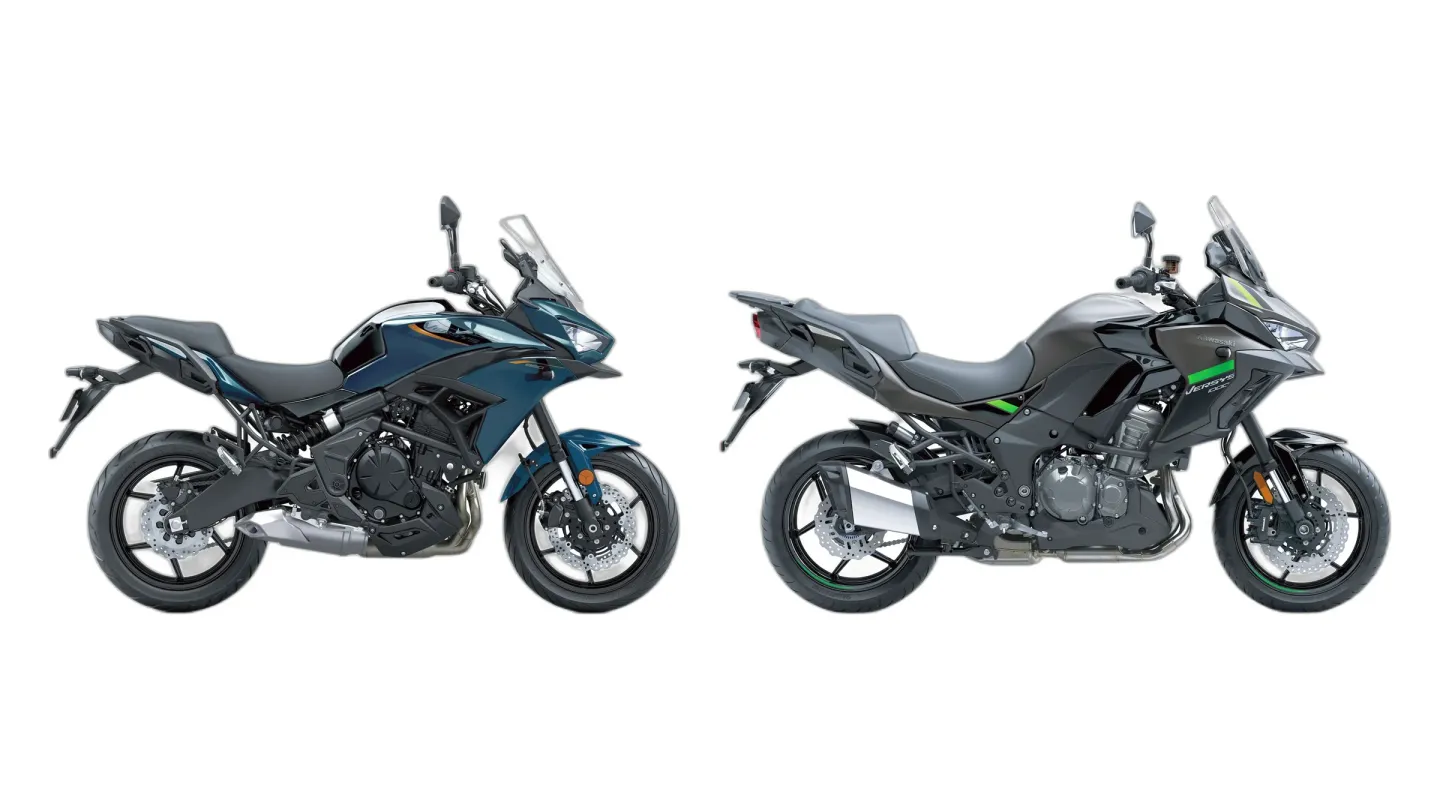
So which one do you buy?
The Versys 1000 has the edge if…
Comfortable long-distance riding
A touch ahead: Versys 1000
Deep into a long ride, the Versys 1000 asks slightly less of your back and shoulders. The reason: a smoother engine. A small margin, and seat fit can overrule it.
Which one's the smarter buy
No clear advantage
The price gap doesn't produce a clear winner. Neither bike is the clear better buy for the money.
What makes each one tick
Versys 650
With a wide bar to lean on, the Versys 650 flicks from one bend to the next on the Blue Ridge Parkway. Its chassis carries 476 lb (216 kg) wet, and it doesn't fight the bar at town speeds. A sharp bump doesn't travel far past the compliant fork and shock. The seat barely registers it.
Nils rode the Versys 650 in the Canary Islands in 2020 (NastyNils Testride).
Versys 1000
Hours into a long day, the Versys 1000's long-travel suspension hasn't stopped soaking up the road. The chassis stays planted. A twist of the throttle gets a creamy shove from the inline-four. Two-up, the four's mid-range hauls a passenger all day.
The Voice of Experience

What actually separates them
- The Versys 650 has the lower wet weight: 476 lb (216 kg) vs 558 lb (253 kg).
- The Versys 1000 makes more peak power: 120 hp (88 kW) vs 69 hp (51 kW).
- The Versys 1000 makes more peak torque: 75 lb-ft (102 Nm) vs 47 lb-ft (64 Nm).
Which one for the way you ride
A confidence-building first motorcycle
Not built for it: Versys 1000
No first-bike verdict for the Versys 1000. It's a step up for later.
These two run dead level on commuting, twisty roads, and running costs. Sit on both in the showroom and trust what your body says.
Who each one is built for
What's good, and what you'll live with
Versys 650
What owners say
Strengths
- Agile, neutral handling
- Butter‑smooth power delivery
Versys 1000
What owners say
Strengths
- Great value for money
What they cost used
These prices compare a 5-year-old Versys 650 with a 5-year-old Versys 1000.
- Versys 650
- about $5,500
- Versys 1000
- about $12,700
At five years old, the Versys 650 sits around $5,500 while the Versys 1000 runs about $12,700. That's a $7,200 gap in the US market. These are estimates from earlier records, not live listings.
What they share
- Seat height
- 33.1 in (840 mm)
- Cooling
- Liquid-cooled
- Fuel capacity
- 5.5 US gal (21 L)
- Gearbox
- 6-speed
- Fork
- Upside-down (USD)
- Front tire
- 120/70-17
Where the spec sheets split
| Versys 650 | Versys 1000 | |
|---|---|---|
| Wet weight | 476 lb (216 kg) | 558 lb (253 kg) |
| Versys 650 | Versys 1000 | |
|---|---|---|
| Displacement | 649 cc | 1043 cc |
| Engine | Parallel twin | Inline-four |
| Power | 69 hp (51 kW) | 120 hp (88 kW) |
| Torque | 47 lb-ft (64 Nm) | 75 lb-ft (102 Nm) |
| Versys 650 | Versys 1000 | |
|---|---|---|
| Rear tire | 160/60-17 | 180/55-17 |
What comes fitted, what costs extra
| Versys 650 | Versys 1000 | |
|---|---|---|
| Cornering ABS | Not offered | Standard |
| Traction Control | Not offered | Standard |
| Ride Modes | Not offered | Standard |
| Cruise Control | Not offered | Standard |
| Quickshifter | Not offered | Option |
| Slipper Clutch | Not offered | Standard |
| Smartphone Connectivity | Not offered | Option |
| LED Headlight | Not offered | Standard |
| Cornering Lights | Not offered | Option |
Head to head, area by area
Both bikes on the same scale, one area at a time.