By NastyNils·
Motorcycle comparison · Sport Tourer
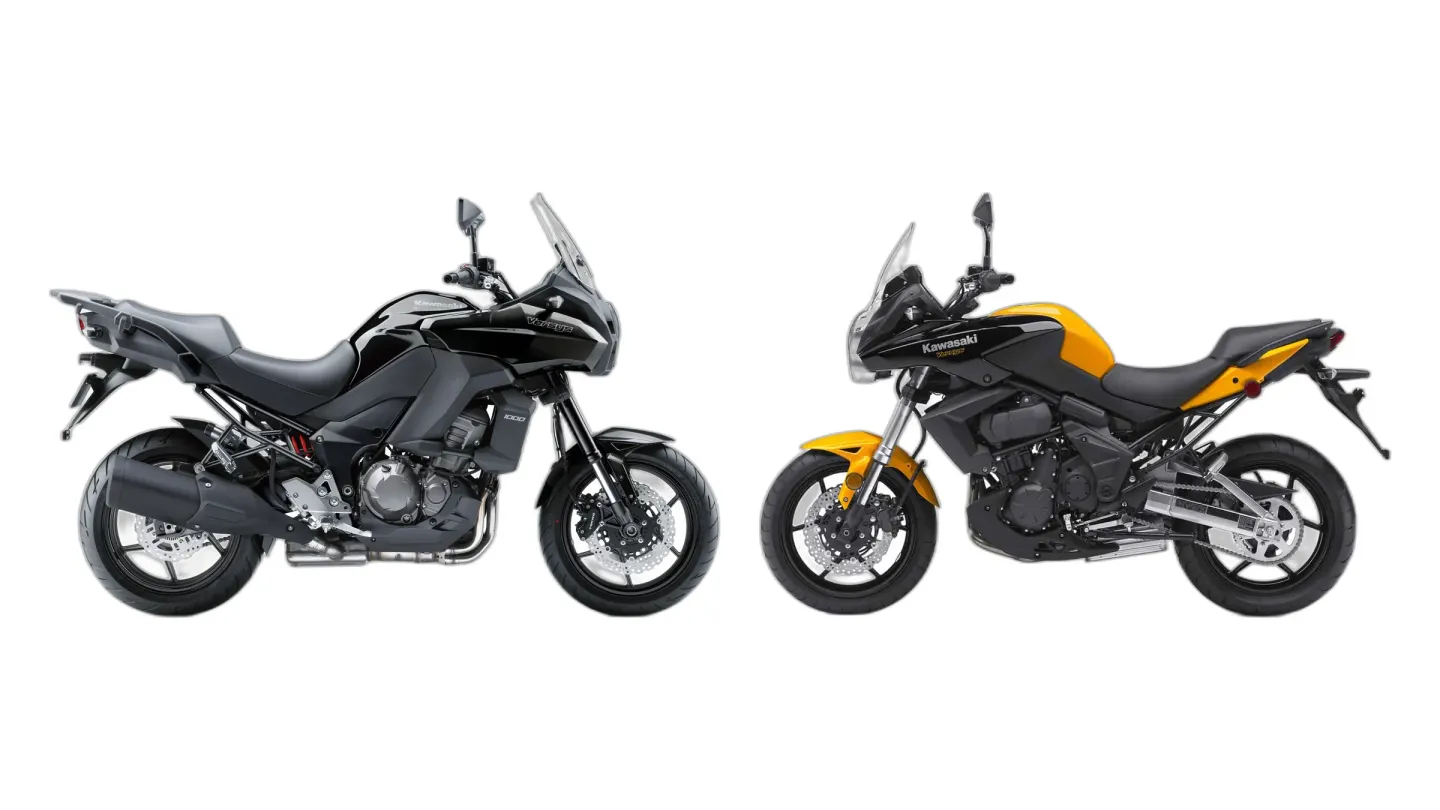
Kawasaki Versys 1000 (LZT00A) vs Versys 650 (LE C)
Kawasaki Versys 1000 vs Versys 650: long days, loaded bags, one choice to make.
On a half-open throttle in top gear, the Kawasaki Versys 1000 shoves from low revs and there's no buzz in the mirrors. The Kawasaki Versys 650 wants the needle swinging higher, and it's happy up there. It's keen through the middle and spins up freely.
So which one do you buy?
The Versys 1000 has the edge if…
Comfortable long-distance riding
By a nose: Versys 1000
Long days lean slightly toward the Versys 1000. That comes from a smoother engine. Your own body is the better judge of a gap this small.
The Versys 650 has the edge if…
Sporty riding on twisty roads
Inches ahead: Versys 650
The Versys 650 nudges ahead once the pavement starts to wiggle. Credit lighter steering and more feel through the bars. Don't expect a night-and-day difference.
What makes each one tick
Versys 1000
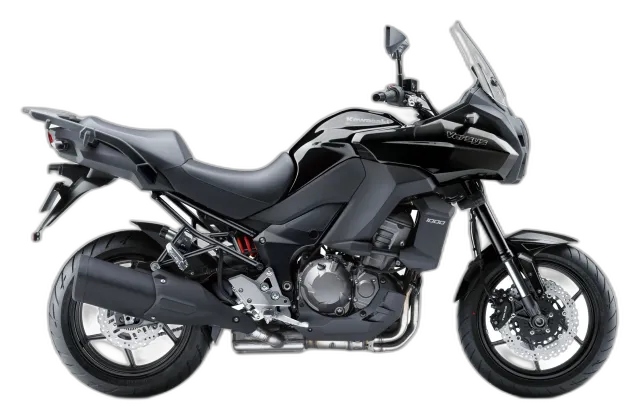
Even two-up, the Versys 1000 pulls past a semi on one smooth surge, and the inline-four doesn't send a tingle through the bars. Its tall screen and supple suspension soak up long interstate days for two. Once you've squeezed the brake lever for a bend, the bike settles. The steering stays neutral from there. The pegs still clear the asphalt with lean to spare.
Nils rode the Versys 1000 in 2012 (NastyNils Testride).
Versys 650
The Versys 650's parallel twin has enough punch to make a twisty back road fun, and its pull stays smooth and predictable. Corner entry doesn't take more than a light push on the wide handlebar. It's planted at lean. At walking pace, it turns around in one sweep.
The Voice of Experience

What actually separates them
- The Versys 650 has the lower wet weight: 454 lb (206 kg) vs 527 lb (239 kg).
- The Versys 1000 makes more peak power: 118 hp (87 kW) vs 64 hp (47 kW).
- The Versys 1000 makes more peak torque: 75 lb-ft (102 Nm) vs 45 lb-ft (61 Nm).
Which one for the way you ride
A confidence-building first motorcycle
Not suited: Versys 1000
Leave the Versys 1000 for your second or third bike. It's too much to learn on.
Call it even on commuting and running costs. Choose on fit, price and the one that makes you grin.
Who each one is built for
What's good, and what you'll live with
Versys 1000
What owners say
Strengths
- Exceptional reliability and low running costs
- Supremely comfortable for long‑distance touring
- Excellent value with standard electronic aids
- Surprisingly agile handling for its size
Trade-offs
- Polarizing styling not loved by all
Versys 650
What owners say
Strengths
- Lively, responsive parallel-twin engine
- Low-speed agility is excellent, with light steering and a tight turning circle
- Comfortable all-day ergonomics
Trade-offs
- Hard seat limits touring comfort
Known problems to check before you buy
Versys 1000
No confirmed faults on file yet. That's not the same as fault-free.
Versys 650
- Stator failure at high mileage The stator can fail after approximately 31,000 mi (50,000 km), leading to charging system failure. Often preceded by dimming lights or battery warning; replacement is the fix.
- Regulator/rectifier failure The shunt-type regulator/rectifier can overheat and fail, often linked to stator problems. Replacing with a series-type unit is a common preventative measure.
- Front fork seal leakage Some owners report premature fork seal leaks. Not widespread but noted in long-term ownership.
What they share
- Seat height
- 33.3 in (845 mm)
- Cooling
- Liquid-cooled
- Gearbox
- 6-speed
- Final drive
- Chain
- Fork
- Telescopic
- Front brake
- 300 mm
- Front tire
- 120/70-17
Where the spec sheets split
| Versys 1000 | Versys 650 | |
|---|---|---|
| Wet weight | 527 lb (239 kg) | 454 lb (206 kg) |
| Versys 1000 | Versys 650 | |
|---|---|---|
| Displacement | 1043 cc | 649 cc |
| Engine | Inline-four | Parallel twin |
| Power | 118 hp (87 kW) | 64 hp (47 kW) |
| Peak power at | 9,000 rpm | 8,000 rpm |
| Torque | 75 lb-ft (102 Nm) | 45 lb-ft (61 Nm) |
| Peak torque at | 7,700 rpm | 6,800 rpm |
| Top speed | 140 mph (225 km/h) | 128 mph (206 km/h) |
| Versys 1000 | Versys 650 | |
|---|---|---|
| Fuel economy | 41 mpg (US) / 5.7 L/100 km | 40 mpg (US) / 5.9 L/100 km |
| Fuel capacity | 5.5 US gal (21 L) | 5.0 US gal (19 L) |
| Versys 1000 | Versys 650 | |
|---|---|---|
| Rear tire | 180/55-17 | 160/60-17 |
What comes fitted, what costs extra
| Versys 1000 | Versys 650 | |
|---|---|---|
| ABS | Standard | Option |
| Traction Control | Standard | Not offered |
| Ride Modes | Standard | Not offered |
| Heated Grips | Option | Not offered |
Head to head, area by area
Both bikes on the same scale, one area at a time.