By NastyNils·
Motorcycle comparison · Sport Tourer
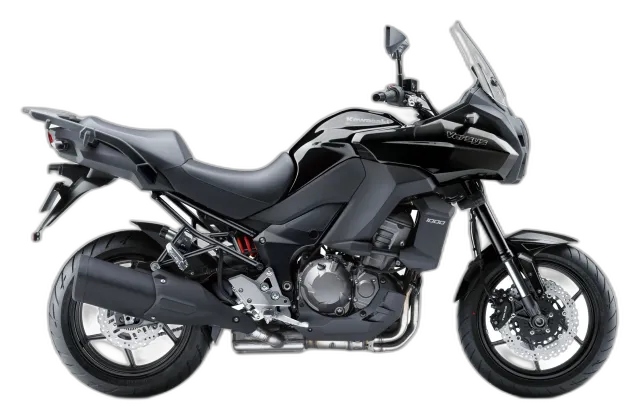
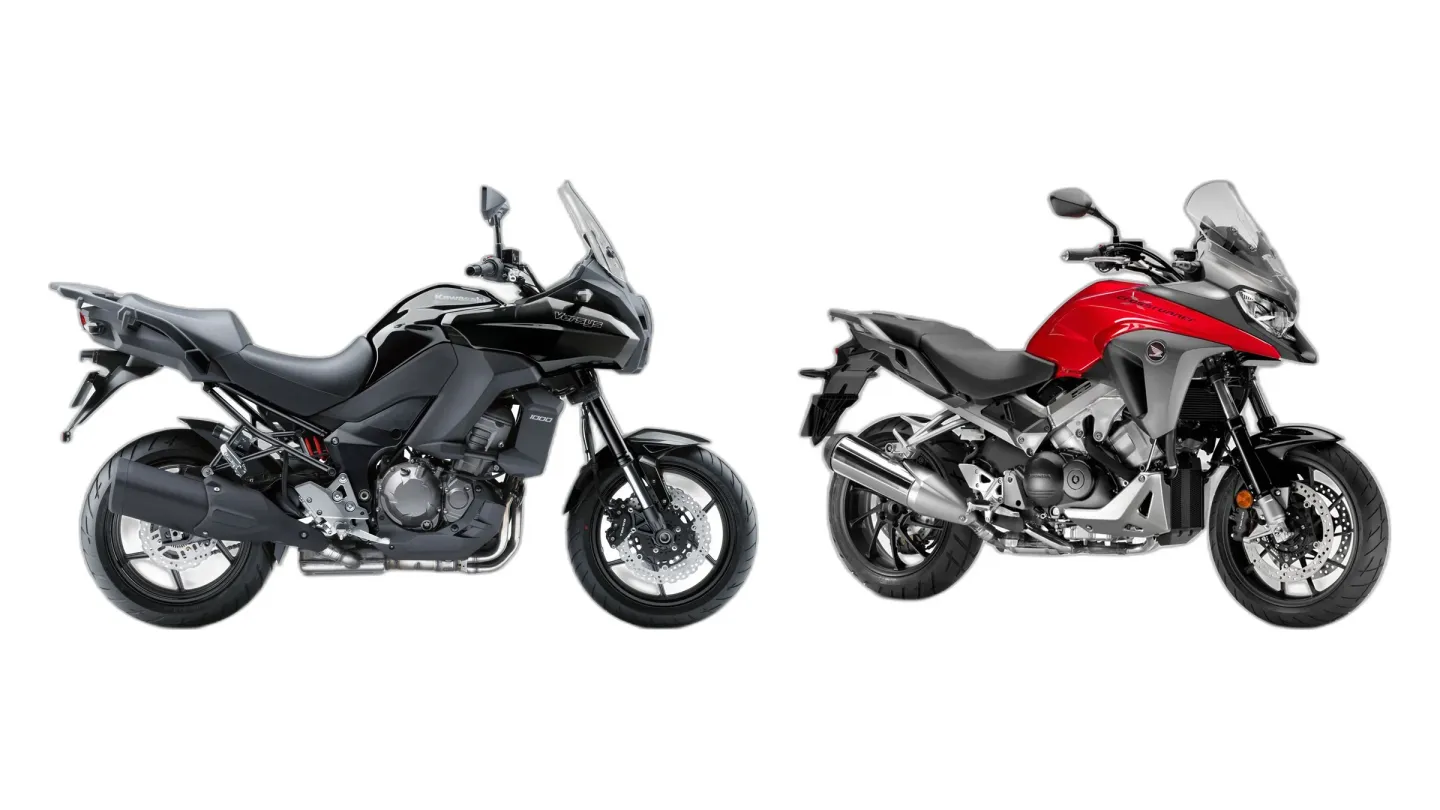
Kawasaki Versys 1000 (LZT00A) vs Honda VFR800X Crossrunner (MY2015)
Across the first stretch of rutted pavement, the Kawasaki Versys 1000 sinks softly into each hit and doesn't kick the jolt up through the seat. The Honda VFR800X Crossrunner stays supple over those same ruts, but there's a firmness underneath that holds the chassis level. It won't wallow, and the nose barely dives.
So which one do you buy?
The Versys 1000 has the edge if…
Comfortable long-distance riding
Small edge: Versys 1000
Long days lean slightly toward the Versys 1000. Credit better wind protection. Your own body is the better judge of a gap this small.
The VFR800X Crossrunner has the edge if…
Sporty riding on twisty roads
Narrow edge: VFR800X Crossrunner
On a twisty road, the VFR800X Crossrunner edges ahead. It's down to more feel through the bars. Not by enough to settle it alone.
What makes each one tick
Versys 1000
Low in the revs, the Versys 1000's inline-four pulls hard enough to pass a truck two-up, and there's no buzz in the bars. Coming off the brake lever, the bike turns into a bend with neutral steering. There's room under the pegs. Those upright bars and that tall screen eat highway miles.
Nils rode the Versys 1000 in 2012 (NastyNils Testride).
VFR800X Crossrunner
Near the top of the revs, the Crossrunner's engine finds its rush, and there's an exhaust note all its own. A mid-corner bump disappears into the long-travel suspension. The steering doesn't twitch. Every panel on it lines up tight.
Nils rode the VFR800X Crossrunner in Austria in 2015 (NastyNils Testride).
The Voice of Experience

What actually separates them
- The VFR800X Crossrunner has the lower seat: 32.1 in (815 mm) vs 33.3 in (845 mm).
- The Versys 1000 makes more peak power: 118 hp (87 kW) vs 106 hp (78 kW).
- The Versys 1000 makes more peak torque: 75 lb-ft (102 Nm) vs 55 lb-ft (75 Nm).
Which one for the way you ride
A confidence-building first motorcycle
Not their thing
A first bike should forgive mistakes, and these two don't do that well enough. Come back to them later.
Nothing splits them on commuting and running costs. Ride both back to back and the decision usually makes itself.
Who each one is built for
What's good, and what you'll live with
Versys 1000
What owners say
Strengths
- Exceptional reliability and low running costs
- Supremely comfortable for long‑distance touring
- Excellent value with standard electronic aids
- Surprisingly agile handling for its size
Trade-offs
- Polarizing styling not loved by all
VFR800X Crossrunner
What owners say
Strengths
- Balanced, neutral handling
- Plush yet composed suspension
- Superb build quality and reliability
What they share
- Cooling
- Liquid-cooled
- Gearbox
- 6-speed
- Final drive
- Chain
- Fork
- Telescopic
- Front tire
- 120/70-17
- Rear tire
- 180/55-17
Where the spec sheets split
| Versys 1000 | VFR800X Crossrunner | |
|---|---|---|
| Seat height | 33.3 in (845 mm) | 32.1 in (815 mm) |
| Wet weight | 527 lb (239 kg) | 534 lb (242 kg) |
| Versys 1000 | VFR800X Crossrunner | |
|---|---|---|
| Displacement | 1043 cc | 782 cc |
| Engine | Inline-four | V4 |
| Power | 118 hp (87 kW) | 106 hp (78 kW) |
| Torque | 75 lb-ft (102 Nm) | 55 lb-ft (75 Nm) |
| Top speed | 140 mph (225 km/h) | 124 mph (200 km/h) |
| Versys 1000 | VFR800X Crossrunner | |
|---|---|---|
| Fuel economy | 41 mpg (US) / 5.7 L/100 km | 44 mpg (US) / 5.32 L/100 km |
| Fuel capacity | 5.5 US gal (21 L) | 5.5 US gal (20.8 L) |
What comes fitted, what costs extra
| Versys 1000 | VFR800X Crossrunner | |
|---|---|---|
| Ride Modes | Standard | Not offered |
| Quickshifter | Not offered | Option |
| Heated Grips | Option | Standard |
Head to head, area by area
Both bikes on the same scale, one area at a time.