By NastyNils·
Motorcycle comparison · Sport Tourer
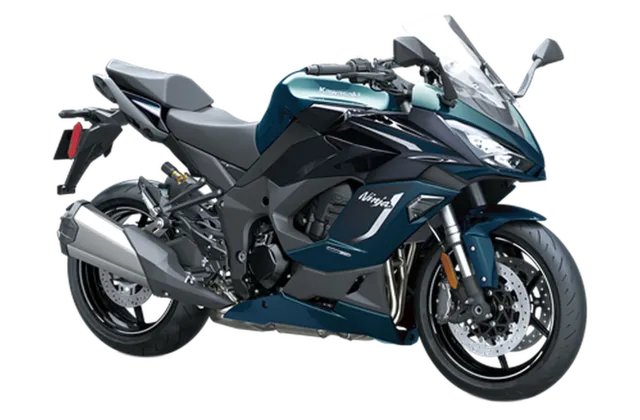
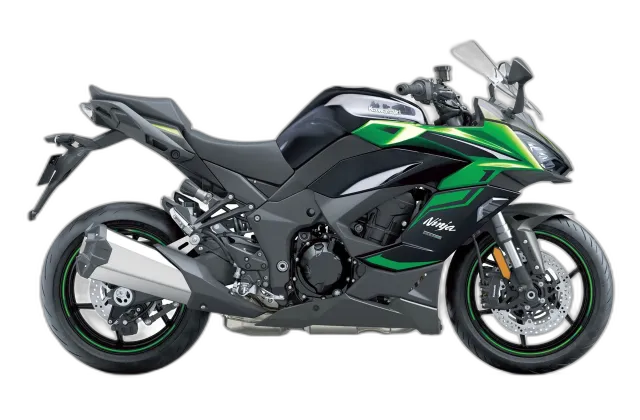
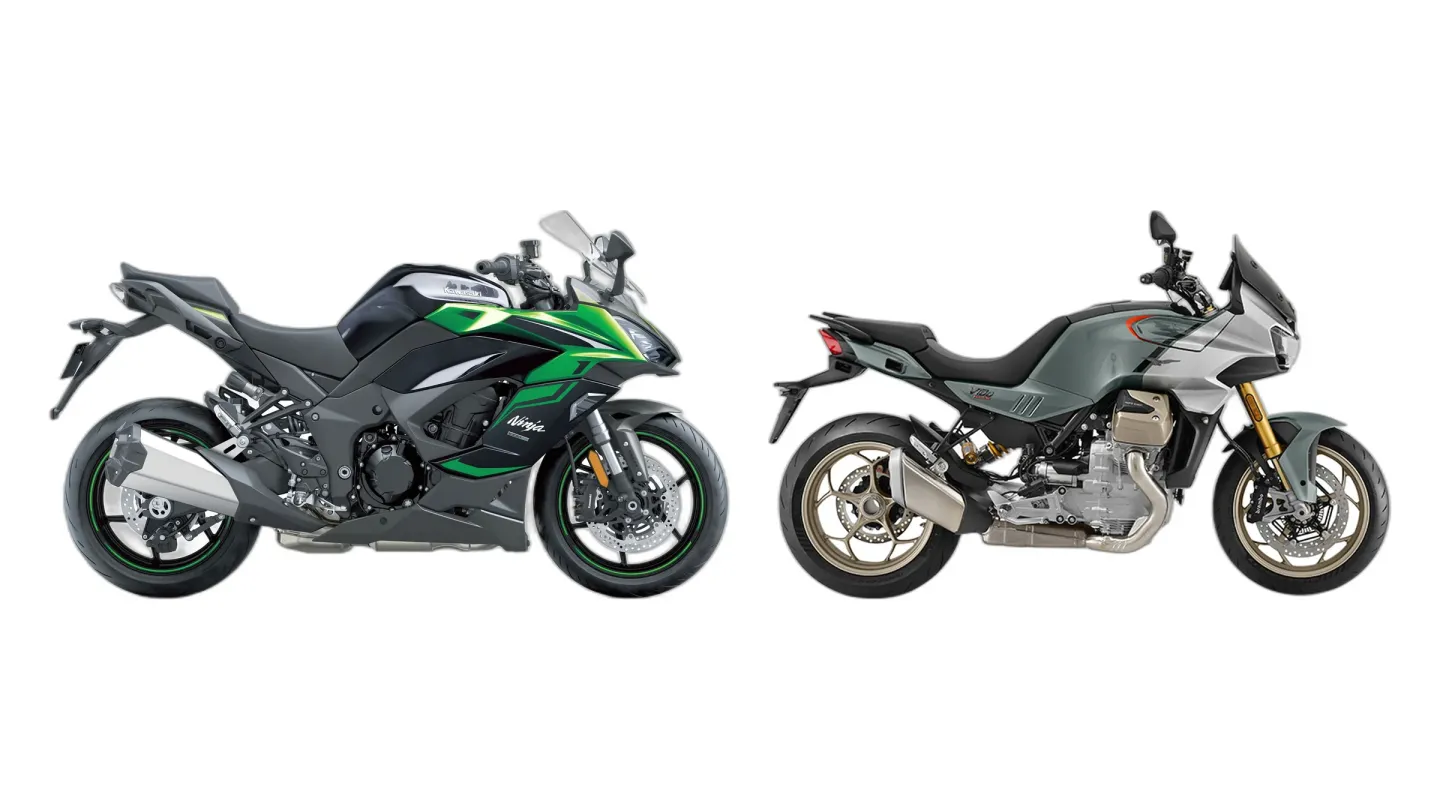
Kawasaki Ninja 1000 SX (MY2020) vs Moto Guzzi V100 Mandello (MY2023)
You'll feel the Kawasaki Ninja 1000 SX tip into a corner the instant you ask, and it stays planted at any speed. On the Moto Guzzi V100 Mandello, the fork feels underdamped once you're pushing into the turn. Its front end wallows before it settles.
So which one do you buy?
The Ninja 1000 SX has the edge if…
Sporty riding on twisty roads
Inches ahead: Ninja 1000 SX
On a winding road, the Ninja 1000 SX comes out a touch ahead. Credit harder acceleration. You wouldn't bet much on a gap like that.
Comfortable long-distance riding
Nose ahead: Ninja 1000 SX
The Ninja 1000 SX nudges ahead once the miles pile up. Put it down to more range per tank. Still, it's a narrow gap.
Daily commuting & city riding
Slight edge: Ninja 1000 SX
For the Monday-to-Friday grind, the Ninja 1000 SX pulls a nose in front. Your own commute could easily flip it.
Which one's the smarter buy
Depends what you want it for
The Ninja 1000 SX costs less, but that gap doesn't make it the better buy. Neither bike is the clear winner on value.
What makes each one tick
Ninja 1000 SX
There's grip and feedback coming up through the bars of the Ninja 1000 SX on every surface it meets. The throttle draws pull from the inline-four anywhere between idle and redline, and there's no flat spot to ride around. Its seat slopes forward and shoves you into the tank under braking. Top gear doesn't mind a crawl.
V100 Mandello
There's a torquey throb from the V100 Mandello's transverse twin at low revs, with a rich mechanical soundtrack and a gentle rock through the chassis. Light steering at the bar and a neutral seat-to-peg reach let the bike flick through the curves of the Blue Ridge Parkway while it's steady at highway pace. A sharp bump jolts straight through the Kayaba shock, and it's most pronounced two-up or in a rough bend. Up top, the twin's still singing.
The Voice of Experience
What actually separates them
- The Ninja 1000 SX makes more peak power: 142 hp (104 kW) vs 115 hp (85 kW).
- The Ninja 1000 SX makes more peak torque: 82 lb-ft (111 Nm) vs 77 lb-ft (105 Nm).
- The Ninja 1000 SX has the larger fuel tank: 5.0 US gal (19 L) vs 4.5 US gal (17 L).
Which one for the way you ride
A confidence-building first motorcycle
Wrong job for both
Both of these ask too much of a rookie. Spend your first year on something lighter.
Nothing splits them on running costs. Ride both back to back and the decision usually makes itself.
Who each one is built for
What's good, and what you'll live with
Ninja 1000 SX
What owners say
Strengths
- Exceptional value for money
- Smooth, linear power delivery
Trade-offs
- Seat comfort insufficient for long-distance touring
- No center stand option
- No electronic suspension
- Small, vibration-prone mirrors
- Windscreen causes buffeting at highest position
V100 Mandello
What owners say
Strengths
- Distinctive Italian style
- Soulful liquid-cooled V-twin
Trade-offs
- Base suspension lacks refinement
Known problems to check before you buy
Ninja 1000 SX
- KQS downshift function rough and unreliable below ~3,500 rpm The bidirectional quickshifter (KQS) works reliably for upshifts. Downshifts (auto-blip) are inconsistent: below approximately 3,500 rpm the system frequently fails to engage, throttle blips are uneven, and the system is sensitive to residual pedal contact between shift operations. Many owners routinely use the clutch for downshifts in urban riding. Multiple dealer visits have been reported without permanent resolution. The down-shift function is haphazard.
- TFT dashboard resets spontaneously — clock, trip, fuel consumption data lost The TFT dashboard resets without rider input: clock, fuel consumption values, lean angle log, trip data, and other parameters return to zero. Occurs primarily at ignition-on, occasionally during riding. In some cases, the display toggles spontaneously between light/dark mode. Kawasaki has not issued an official fix; dealer display replacements did not consistently resolve the issue. Suspected causes: voltage drops below ~10V during starting (weak/loose battery, loose ground connections), vibration at battery terminals. An Australian petition (103 signatures) documented the problem for MY2020–2022.
- Cruise control deactivates spontaneously or refuses to engage The electronic cruise control intermittently refuses to activate or deactivates spontaneously during riding. The most commonly identified root cause is a misadjusted rear brake light switch from the factory — the system interprets it as brake application and disengages. Additional reported causes: faulty wiring to left handlebar switch cluster (repaired under warranty in documented cases), intermittent switch failures.
- Noticeable vibrations in the engine's mid-range — mirrors blur, felt through footpegs and handlebars Pronounced vibrations show up in the engine's mid-range, blurring the mirrors and coming through the footpegs and handlebars. This is partly inherent to the inline-four configuration at these revs and partly amplified by fairing resonance. Kawasaki added foam pads at strategic locations as a factory mitigation. Switching from the stock Bridgestone S22 to alternative tires such as the Michelin Road 5 has eased the issue in some cases, pointing to additional contributing factors.
V100 Mandello
- Rear shock absorber missing bushings (Recall 23V-572) Recall 23V572000 Kayaba rear shock may be missing one or both bushings, causing rigidity and potential breakage. Affects certain 2023 models; recall offers free inspection and replacement.
- Gear selector problems Owners report persistent gear selector faults leading to missed shifts or warning lights.
What they cost used
These prices compare a 2-year-old Ninja 1000 SX with a 2-year-old V100 Mandello.
- Ninja 1000 SX
- $11,500
- V100 Mandello
- $12,500
At two years old, the Kawasaki Ninja 1000 SX sits around $11,500 while the Moto Guzzi V100 Mandello runs about $12,500. That's a $1,000 gap in the Ninja's favor. These figures come from earlier US market records, not live listings.
What they share
- Cooling
- Liquid-cooled
- Gearbox
- 6-speed
- Front tire
- 120/70-17
Where the spec sheets split
| Ninja 1000 SX | V100 Mandello | |
|---|---|---|
| Seat height | 32.3 in (820 mm) | 32.1 in (815 mm) |
| Wet weight | 518 lb (235 kg) | 525 lb (238 kg) |
| Ninja 1000 SX | V100 Mandello | |
|---|---|---|
| Displacement | 1043 cc | 1042 cc |
| Engine | Inline-four | 90° V-twin |
| Power | 142 hp (104 kW) | 115 hp (85 kW) |
| Torque | 82 lb-ft (111 Nm) | 77 lb-ft (105 Nm) |
| Ninja 1000 SX | V100 Mandello | |
|---|---|---|
| Fuel capacity | 5.0 US gal (19 L) | 4.5 US gal (17 L) |
| Ninja 1000 SX | V100 Mandello | |
|---|---|---|
| Final drive | Chain | Shaft |
| Rear tire | 190/50-17 | 190/55-17 |
What comes fitted, what costs extra
| Ninja 1000 SX | V100 Mandello | |
|---|---|---|
| Electronic Suspension | Not offered | Option |
| Quickshifter | Standard | Option |
| Smartphone Connectivity | Standard | Option |
| USB Charging Port | Option | Standard |
| Electrically Adjustable Windscreen | Not offered | Standard |
| Cornering Lights | Not offered | Standard |
Head to head, area by area
Both bikes on the same scale, one area at a time.