By NastyNils· ·
Motorcycle comparison · Sport Tourer
BMW R 1300 RS (MY2026) vs Kawasaki Ninja 1000 SX (MY2020)
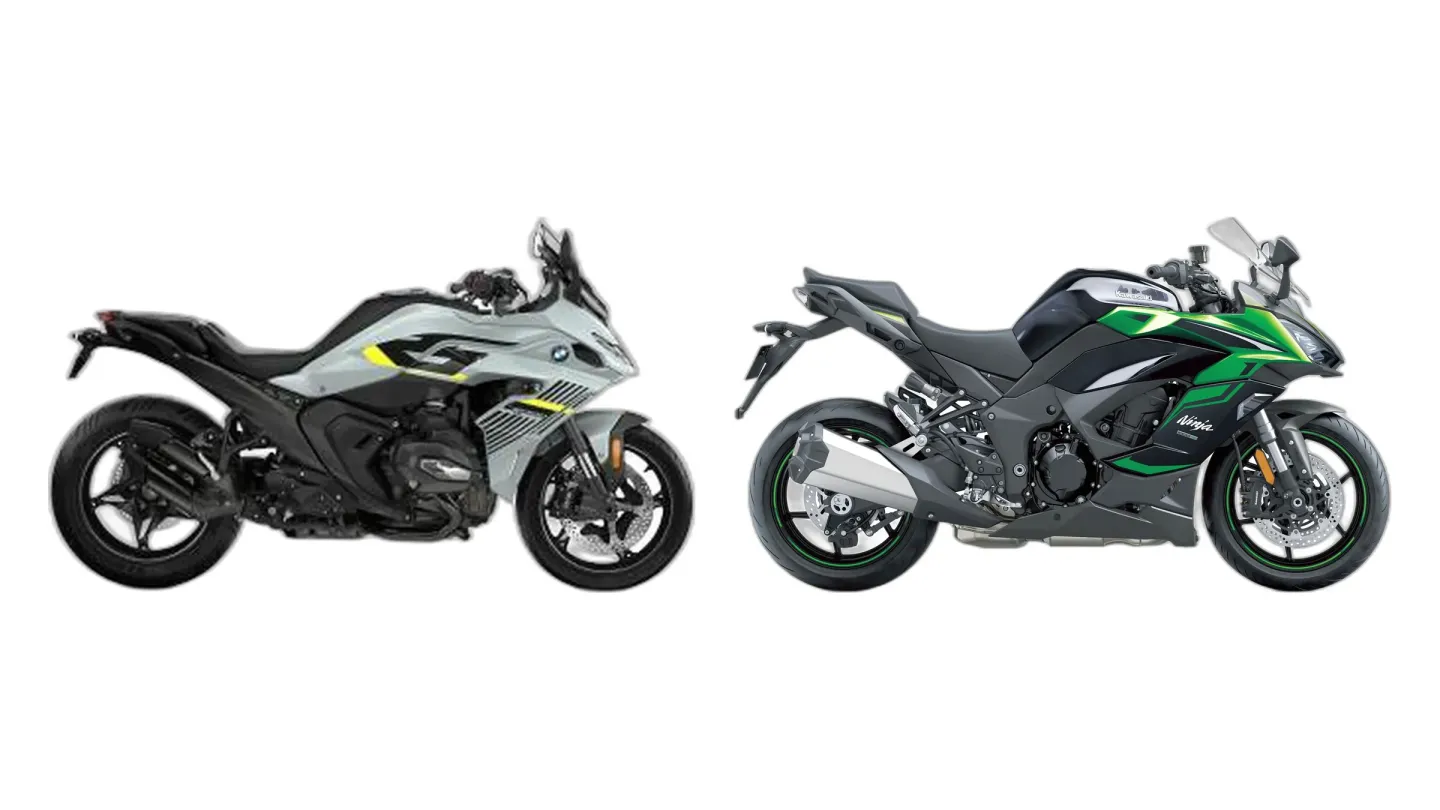
BMW R 1300 RS vs Kawasaki Ninja 1000 SX: which one you'd rather spend the big miles on.
You'll feel the BMW R 1300 RS's boxer shove you forward the moment you open the throttle, and highway passes are over quickly. The Kawasaki Ninja 1000 SX's power builds in one clean line instead, and there's no step anywhere from idle to redline. Any gear pulls at any speed.
So which one do you buy?
The R 1300 RS has the edge if…
Comfortable long-distance riding
By a nose: R 1300 RS
Long days lean slightly toward the R 1300 RS. Your own body is the better judge of a gap this small.
What makes each one tick
R 1300 RS
The R 1300 RS's mass sits in the middle of a stiffer frame, and the bike doesn't fuss as it drops into a bend. There's no wander as the brake lever eases off at the apex. The chassis holds a neutral arc. The seat's still kind at sundown.
Ninja 1000 SX
The Ninja 1000 SX's front end tips into a corner willingly, and it's just as eager at any pace. Leaned over, it stays settled. The front tire's always reporting its grip.
The Voice of Experience
What actually separates them
- The R 1300 RS has the lower seat: 31.1 in (790 mm) vs 32.3 in (820 mm).
- The Ninja 1000 SX has the lower wet weight: 518 lb (235 kg) vs 536 lb (243 kg).
- The R 1300 RS makes more peak torque: 110 lb-ft (149 Nm) vs 82 lb-ft (111 Nm).
Which one for the way you ride
A confidence-building first motorcycle
Neither one fits
Both of these ask too much of a rookie. Spend your first year on something lighter.
Call it even on commuting, twisty roads, and running costs. Choose on fit, price and the one that makes you grin.
Who each one is built for
What's good, and what you'll live with
R 1300 RS
What owners say
Strengths
- More powerful boxer engine
- Sharper, sportier handling
Ninja 1000 SX
What owners say
Strengths
- Exceptional value for money
- Smooth, linear power delivery
Trade-offs
- Seat comfort insufficient for long-distance touring
- No center stand option
- No electronic suspension
- Small, vibration-prone mirrors
- Windscreen causes buffeting at highest position
Known problems to check before you buy
R 1300 RS
No confirmed faults on file yet. That's not the same as fault-free.
Ninja 1000 SX
- KQS downshift function rough and unreliable below ~3,500 rpm The bidirectional quickshifter (KQS) works reliably for upshifts. Downshifts (auto-blip) are inconsistent: below approximately 3,500 rpm the system frequently fails to engage, throttle blips are uneven, and the system is sensitive to residual pedal contact between shift operations. Many owners routinely use the clutch for downshifts in urban riding. Multiple dealer visits have been reported without permanent resolution. The down-shift function is haphazard.
- TFT dashboard resets spontaneously — clock, trip, fuel consumption data lost The TFT dashboard resets without rider input: clock, fuel consumption values, lean angle log, trip data, and other parameters return to zero. Occurs primarily at ignition-on, occasionally during riding. In some cases, the display toggles spontaneously between light/dark mode. Kawasaki has not issued an official fix; dealer display replacements did not consistently resolve the issue. Suspected causes: voltage drops below ~10V during starting (weak/loose battery, loose ground connections), vibration at battery terminals. An Australian petition (103 signatures) documented the problem for MY2020–2022.
- Cruise control deactivates spontaneously or refuses to engage The electronic cruise control intermittently refuses to activate or deactivates spontaneously during riding. The most commonly identified root cause is a misadjusted rear brake light switch from the factory — the system interprets it as brake application and disengages. Additional reported causes: faulty wiring to left handlebar switch cluster (repaired under warranty in documented cases), intermittent switch failures.
- Noticeable vibrations in the engine's mid-range — mirrors blur, felt through footpegs and handlebars Pronounced vibrations show up in the engine's mid-range, blurring the mirrors and coming through the footpegs and handlebars. This is partly inherent to the inline-four configuration at these revs and partly amplified by fairing resonance. Kawasaki added foam pads at strategic locations as a factory mitigation. Switching from the stock Bridgestone S22 to alternative tires such as the Michelin Road 5 has eased the issue in some cases, pointing to additional contributing factors.
What they share
- Gearbox
- 6-speed
- Fork
- Upside-down (USD)
- Front tire
- 120/70-17
Where the spec sheets split
| R 1300 RS | Ninja 1000 SX | |
|---|---|---|
| Seat height | 31.1 in (790 mm) | 32.3 in (820 mm) |
| Wet weight | 536 lb (243 kg) | 518 lb (235 kg) |
| R 1300 RS | Ninja 1000 SX | |
|---|---|---|
| Displacement | 1300 cc | 1043 cc |
| Engine | Flat-twin (boxer) | Inline-four |
| Cooling | Air/liquid-cooled | Liquid-cooled |
| Power | 145 hp (107 kW) | 142 hp (104 kW) |
| Peak power at | 7,750 rpm | 10,000 rpm |
| Torque | 110 lb-ft (149 Nm) | 82 lb-ft (111 Nm) |
| Peak torque at | 6,500 rpm | 8,000 rpm |
| Top speed | 149 mph (240 km/h) | 155 mph (249 km/h) |
| R 1300 RS | Ninja 1000 SX | |
|---|---|---|
| Fuel capacity | 4.5 US gal (17 L) | 5.0 US gal (19 L) |
| R 1300 RS | Ninja 1000 SX | |
|---|---|---|
| Final drive | Shaft | Chain |
| Front brake | 310 mm | 300 mm |
| Rear tire | 190/55-17 | 190/50-17 |
What comes fitted, what costs extra
| R 1300 RS | Ninja 1000 SX | |
|---|---|---|
| Electronic Suspension | Standard | Not offered |
| Manually Adjustable Rear Suspension | Not offered | Standard |
| Adaptive Cruise Control | Option | Not offered |
| Quickshifter | Option | Standard |
| USB Charging Port | Standard | Option |
| Tire Pressure Monitoring (TPMS) | Option | Not offered |
| Adjustable Windscreen | Not offered | Standard |
Head to head, area by area
Both bikes on the same scale, one area at a time.