By NastyNils·
Motorcycle comparison · Retro Classic vs Naked Bike
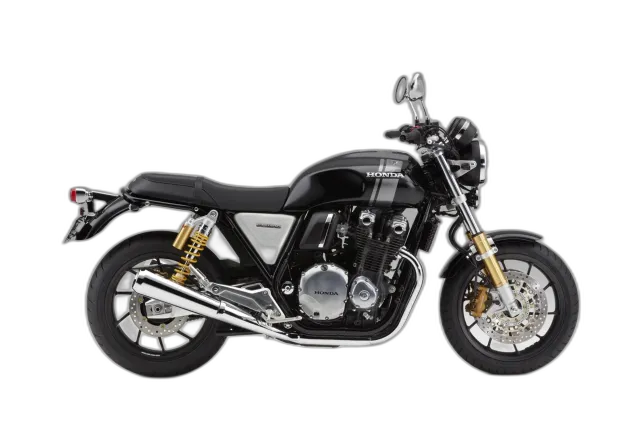
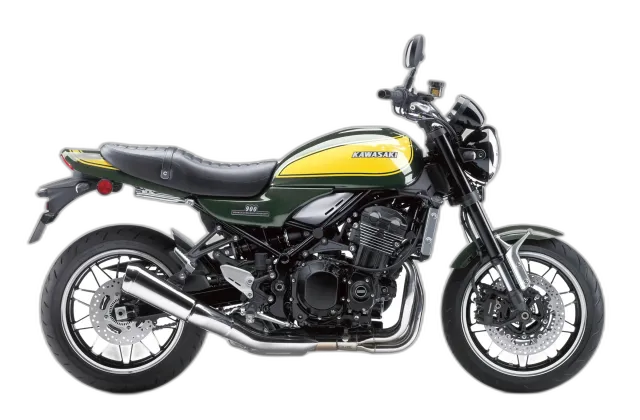
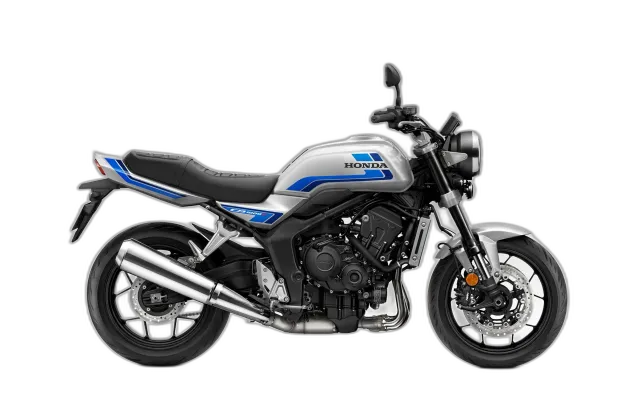
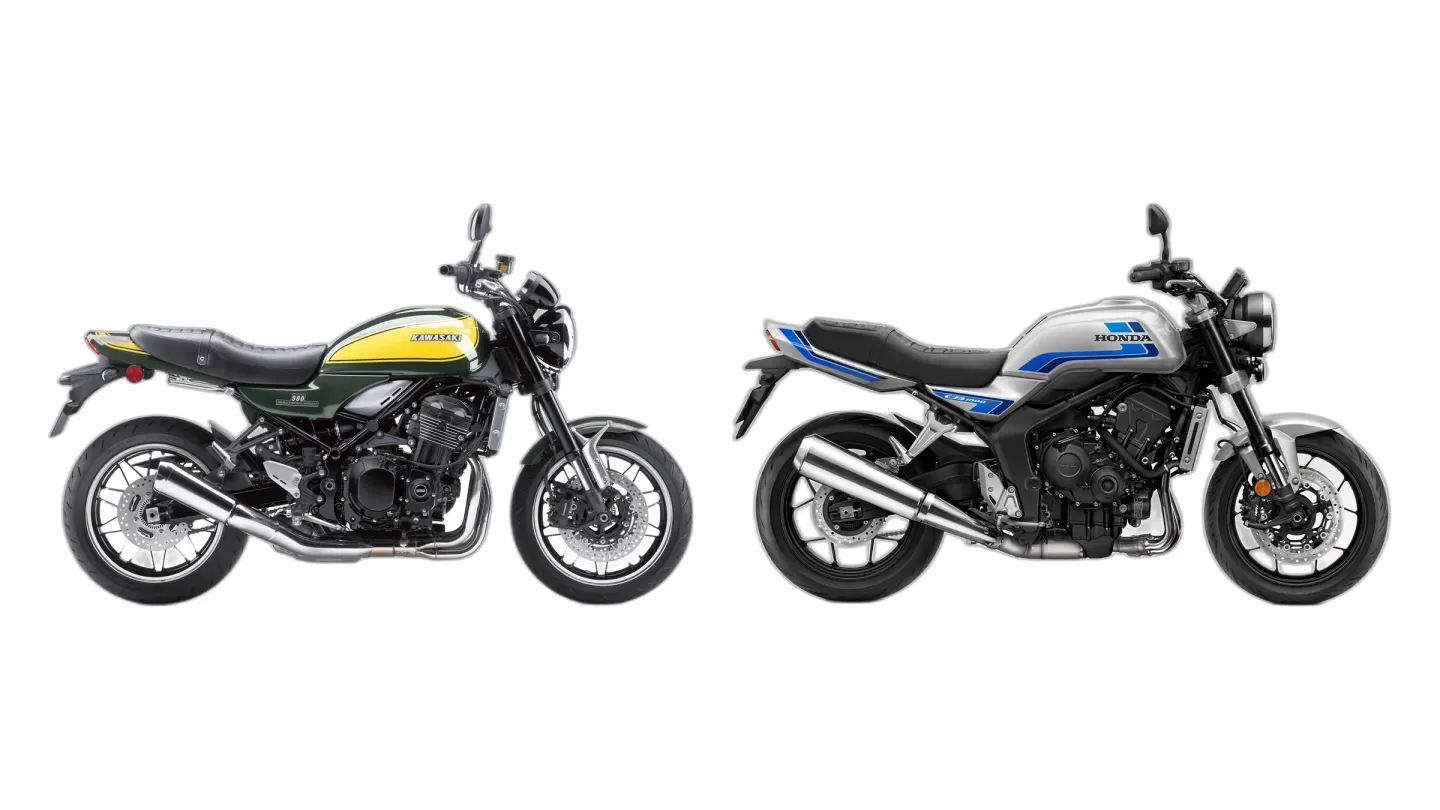
Kawasaki Z 900 RS (MY2018) vs Honda CB1000F (MY2026)
Kawasaki Z 900 RS vs Honda CB1000F: where they split, and which one to buy.
Tip the Kawasaki Z 900 RS into a fast bend and it's already hustling toward the apex. On the Honda CB1000F, the steel frame turns in without fuss and doesn't wander once it's leaned over. Mid-corner ripples disappear into the supple Showa suspension.
So which one do you buy?
Buy the Z 900 RS if…
Keeping running costs low
No contest: Z 900 RS
The Z 900 RS suits a tight running budget much better. The savings add up year after year.
The Z 900 RS has the edge if…
Traveling with luggage
Small edge: Z 900 RS
With bags on, the Z 900 RS edges ahead. What tips it: a better passenger seat. The gap is small enough that luggage options could flip it.
Sporty riding on twisty roads
Slight edge: Z 900 RS
The Z 900 RS is a touch more fun when the road starts bending. Just a touch.
What makes each one tick
Z 900 RS
Behind the retro bodywork, the Z 900 RS keeps pace with nakeds that look far meaner. Higher in the revs, the engine answers the throttle with an even pull that doesn't punish you for exploring. Wide bars and a tall perch don't pin you in place. Two-up over rocks, it steers clean.
Nils rode the Z 900 RS in Styria and Switzerland in 2018, and in Austria and Montenegro in 2024 (NastyNils Testride).
CB1000F
Through the middle revs, the CB1000F's retuned Fireblade four pulls hard, and it doesn't ask for the redline. Its induction note pulses off-beat. The chassis stays stable as the brake lever slows the bike from speed. Its round headlight won't blend into a hyper-naked crowd.
The Voice of Experience

What actually separates them
- The CB1000F has the lower seat: 31.3 in (795 mm) vs 32.9 in (835 mm).
- The CB1000F makes more peak power: 122 hp (90 kW) vs 111 hp (82 kW).
- The CB1000F has the larger engine: 1000 cc vs 948 cc.
Which one for the way you ride
A confidence-building first motorcycle
Both miss here
Learning on either of these is the hard way. A gentler bike will make you a better rider sooner.
Look at commuting and you'll find two bikes doing the same job equally well. Fit is what breaks the tie.
Who each one is built for
What's good, and what you'll live with
Z 900 RS
Strengths
- Torque from the basement
- Built for long days
- Tall-rider friendly ergonomics
- Fully adjustable at both ends
- Faster than it looks
Trade-offs
- Rear shock thumps sharp hits
- Loose through transitions
- No quickshifter offered
- No wind protection
- Stock seat uncomfortable on long rides
CB1000F
What owners say
Strengths
- Stunning neo-retro styling
- Rich, characterful mid-range torque
- Exceptional value for money
Known problems to check before you buy
Z 900 RS
- Front tire may develop internal blistering (Sumitomo manufacturing defect) Due to a defective manufacturing process during sidewall rubber installation, the front tire may develop blistering on the inner surface. A tire with internal blistering can fail and increase crash risk. Tire supplier: Sumitomo Rubber Industries, Ltd. Non-compliant with FMVSS 119. Affects only MY2024 Z900RS ABS, Z900RS Café ABS, and Z900RS SE ABS.
- ABS hydraulic unit contaminated with aluminum shavings The ABS hydraulic unit may have been contaminated with aluminum shavings during manufacturing (defective fixture shaving ABS pump housing). This can cause the front or rear wheel to lock up during braking despite ABS. Affects MY2019 Z900RS ABS and Z900RS Café ABS.
- Front brake lacks sharp initial bite, spongy lever feedback Despite radial-mount four-piston Nissin calipers, the front brake lacks direct, firm initial bite. The lever feel is indirect, especially during aggressive downhill braking. Braided steel lines and higher-performance brake pads significantly improve feel. The SE model (from MY2022) with Brembo M4.32 calipers and braided steel lines resolves this issue from the factory.
- ABS activates prematurely, especially on front brake The Nissin ABS unit activates prematurely, especially at the front brake during harder braking. The ABS is not deactivatable on any 2018–2024 model year. This reduces confidence during aggressive braking and trail braking. The ABS kicks in earlier than desired.
- Snatchy, on-off throttle response at low RPM (ECU mapping) The Z900RS exhibits abrupt, jerky throttle behavior at low RPM and low speeds, particularly when rolling on throttle from closed, departing from standstill, and during gentle gas application in corners. The fuel-cut programming (overrun fuel cutoff for emissions compliance) causes abrupt injection on/off behavior. The dual throttle valve system (sub-throttle servo) with cable-operated main throttle exacerbates the issue. The problem is most pronounced on MY2018–2019 models. Common remedies: ECU reflash (e.g., Ivan's Performance), throttle cable adjustment. Later model years show improvement according to multiple sources.
- Engine revs to 2,500–4,000 rpm on cold start On cold start, the engine revs up to 2,500–4,000 rpm to bring the catalytic converter to operating temperature faster (Euro 4/5 emissions compliance). This is particularly intrusive in residential areas. It is not a defect but a deliberate ECU calibration for emissions standards. Some owners report occasional stalling during warm-up phase.
- Clutch judder/shudder when cold during takeoff The clutch exhibits pronounced judder when cold during engagement into first gear. Multiple owners report the problem partially persists after warm-up. Some dealers consider this normal behavior. Possible remedies: soak clutch plates in oil overnight (dealer recommendation), use higher-quality engine oil. The clutch judder when cold is a widely documented complaint.
CB1000F
- Excessive oil consumption leading to engine damage The piston and top piston ring are poorly matched, leaving too much clearance between them. Repeated hard engine braking from high revs draws engine oil past the ring into the combustion chamber, where it burns off. The oil level drops noticeably between services, and if this goes unnoticed the resulting poor lubrication causes abnormal engine noise and can end in engine damage. Early-production bikes are affected.
What they share
- Engine
- Inline-four
- Cooling
- Liquid-cooled
- Gearbox
- 6-speed
- Final drive
- Chain
- Fork
- Upside-down (USD)
- Front tire
- 120/70-17
- Rear tire
- 180/55-17
Where the spec sheets split
| Z 900 RS | CB1000F | |
|---|---|---|
| Seat height | 32.9 in (835 mm) | 31.3 in (795 mm) |
| Wet weight | 474 lb (215 kg) | 472 lb (214 kg) |
| Z 900 RS | CB1000F | |
|---|---|---|
| Displacement | 948 cc | 1000 cc |
| Power | 111 hp (82 kW) | 122 hp (90 kW) |
| Peak power at | 8,500 rpm | 9,000 rpm |
| Torque | 73 lb-ft (98 Nm) | 76 lb-ft (103 Nm) |
| Peak torque at | 6,500 rpm | 8,000 rpm |
| Z 900 RS | CB1000F | |
|---|---|---|
| Fuel economy | 44 mpg (US) / 5.3 L/100 km | 42 mpg (US) / 5.6 L/100 km |
| Fuel capacity | 4.5 US gal (17 L) | 4.2 US gal (15.9 L) |
What comes fitted, what costs extra
| Z 900 RS | CB1000F | |
|---|---|---|
| Cornering ABS | Not offered | Standard |
| Ride Modes | Not offered | Standard |
| Quickshifter | Not offered | Option |
| TFT Display | Not offered | Standard |
| Smartphone Connectivity | Not offered | Standard |
| USB Charging Port | Option | Standard |
Head to head, area by area
Both bikes on the same scale, one area at a time.