By NastyNils·
Motorcycle comparison · Naked Bike vs Supermoto
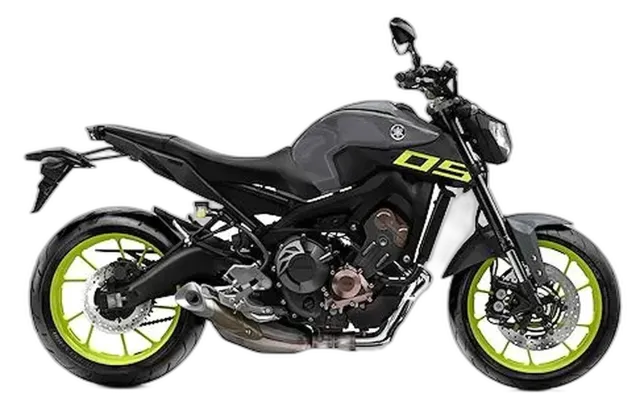
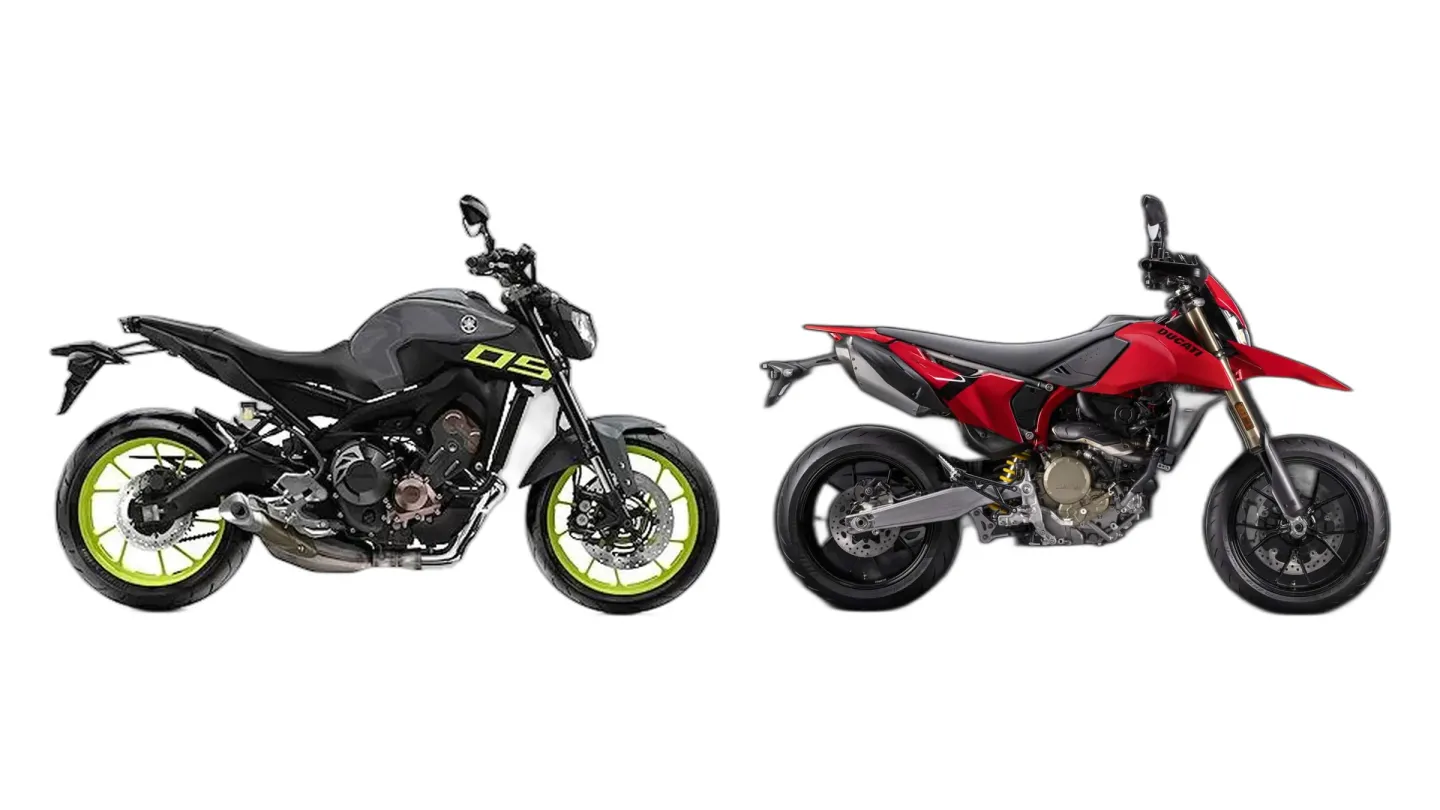
Yamaha MT-09 (RN29) vs Ducati Hypermotard 698 Mono (MY2024)
Yamaha MT-09 vs Ducati Hypermotard 698 Mono: no fairing, no excuses. Here's how to pick.
Roll on the Yamaha MT-09's throttle and the engine doesn't warn you: speed arrives before your brain's caught up. The Ducati Hypermotard 698 Mono's big single wants to be wound up. Up top, it spins with barely a buzz.
So which one do you buy?
The MT-09 has the edge if…
Keeping running costs low
Small edge: MT-09
For the money you spend after the purchase, the MT-09 nudges ahead. The gap is too small to plan a budget around.
The Hypermotard 698 Mono has the edge if…
Daily commuting & city riding
Nose ahead: Hypermotard 698 Mono
On the way to work, the Hypermotard 698 Mono asks a little less of you. Most of that is easier maneuvering in tight spots. Close enough that the test ride should settle it.
Sporty riding on twisty roads
A touch ahead: Hypermotard 698 Mono
The Hypermotard 698 Mono is a touch more fun when the road starts bending. The reason: more feel through the bars and better suspension.
What makes each one tick
MT-09
On the Coronado Trail, the MT-09 snaps from one side to the other like a purpose-built supermoto, and the bars don't fight back. Long sweepers unsettle it. Under a hard pull on the brake lever, the stock fork and shock don't have the damping this engine asks for. Every on-ramp turns into an excuse to rev it out.
Nils rode the MT-09 in 2016 (NastyNils Testride).
Hypermotard 698 Mono
Wide motard bars and a short wheelbase mean the Hypermotard doesn't need more than the lightest nudge to swap direction. At corner entry, the front end reports exactly how much load the tire's carrying.
The Voice of Experience

What actually separates them
- The MT-09 has the lower seat: 32.1 in (815 mm) vs 35.6 in (904 mm).
- The Hypermotard 698 Mono has the lower wet weight: 355 lb (161 kg) vs 414 lb (188 kg).
- The MT-09 makes more peak power: 115 hp (85 kW) vs 77 hp (57 kW).
Which one for the way you ride
A confidence-building first motorcycle
Not its job: MT-09
Leave the MT-09 for your second or third bike. It's too much to learn on.
Who each one is built for
What's good, and what you'll live with
MT-09
Strengths
- Smooth, willing triple
- Serious low-end pull
- Flicks like a supermoto
- Surprising highway composure
- Flawless gearbox and finish
Trade-offs
- Not a comfort upgrade
- Supermoto-level touring comfort
- Nervous in fast sweepers
- Soft, underdamped stock suspension
- Snatchy throttle response
Hypermotard 698 Mono
What owners say
Strengths
- Class-leading electronics package
- Front brake feel and stopping power
- Razor-sharp handling at low weight
- Smoothness for a big single (above the powerband)
- Distinctive sound character
Trade-offs
- Tall seat height excludes shorter riders
- Dated and small instrument display for the price
- Heat on rider's right leg in stop-and-go
- Rough fuelling below 5,000 rpm in low gears
Known problems to check before you buy
MT-09
- Excessively aggressive throttle response causing jerky on/off transitions The ECU's fuel mapping creates abrupt power delivery during throttle transitions. In A and Standard modes, small throttle movements cause disproportionate power changes. Fuel cut functionality above ~4,500 rpm shuts off injectors during deceleration, then reapplies fuel abruptly when RPM drops — creating a pronounced jerk. Most problematic at low speeds in urban riding. Yamaha partially addressed this with a revised ECU map for 2015, and offered free reflash to 2014 owners. Some 2014 units shipped with improved mapping. Aftermarket ECU flashing (2 Wheel DynoWorks, vcyclenut, Ivan's Performance) available for ~$350 USD.
- Throttle position sensor malfunction causing hesitation, surging, or stalling TPS wiring or connectors may become damaged, loose, or corroded, sending faulty or no signals to the ECU. Symptoms include hesitation, surging, stalling, or poor performance. Can trigger fault codes.
- Intermittent engine cutout at idle and during low-speed deceleration Engine cuts out at traffic lights, during slow maneuvering, or when decelerating to a stop. The ECU reduces fuel supply too aggressively near idle. Related to throttle body synchronization issues in some cases. Problem can worsen in hot weather.
- Stock front fork and rear shock lack adequate damping for performance Front fork too soft in compression and rebound for the bike's power and weight. Rear shock loses damping control under aggressive use. Dive under braking is excessive. Rear end feels unsettled over bumps. Multiple aftermarket suspension companies (K-Tech, Öhlins, YSS, Nitron) offer complete replacement units, indicating strong market demand for upgrades.
- O2 sensor failures when exposed to heavy rain or pressure washing The O2 sensor is vulnerable to water ingress. Heavy rain, deep puddles, or pressure washing can cause sensor failure, triggering engine warning light and poor running. The sensor's position makes it susceptible to road spray. At low constant throttle, O2 sensor cycling between lean/rich creates lumpy engine running. Solutions include O2 sensor eliminator, Power Commander, or ECU flash that disables O2 sensor cycling at low RPM.
Hypermotard 698 Mono
- Assembly oversights on early-production bikes Multiple owner reports of small assembly misses on early MY2024 deliveries: (a) shipping plug left in the gas tank vent hose causing tank pressurisation on hot days, (b) gear shifter binding requiring a spacer washer, (c) rear seat alignment problems with bolt holes, (d) miscellaneous minor finish issues. Reportedly tapering off through 2025. Not a single root cause — a pattern of QC inconsistency on early production.
- Rough / surging fuelling below ~5,000 rpm in 1st and 2nd gear Owners and reviewers consistently report rough, surging, occasionally hesitant low-throttle behaviour in 1st and 2nd gear below approximately 5,000 rpm. Caused by Euro-5-driven lean low-load mapping combined with the low crank inertia. Above approximately 6,000 rpm the engine pulls cleanly. Closed-loop O2 feedback exacerbates the lean condition. Aftermarket workarounds (BoosterPlug, Shift-Tech "Quick Fuel Fix") are commonly discussed in owner forums.
- Heat on right leg in slow-moving traffic The 13.1:1 compression single combined with twin under-tail exhaust outlets close to the rider produces noticeable heat on the right leg / inner thigh in slow-moving traffic on warm days. Inherent to the layout, not a fault.
- Vibration below ~4,000 rpm under load Despite twin counterbalance shafts, reviewers report the single shudders noticeably below approximately 4,000 rpm under load. Above approximately 5,500 rpm vibration is well-managed; bar buzziness is reported between 3,000–5,500 rpm at sustained motorway speed. Inherent to engine architecture, not a fault.
What they share
- Cooling
- Liquid-cooled
- Gearbox
- 6-speed
- Final drive
- Chain
- Fork
- Upside-down (USD)
- Front tire
- 120/70-17
Where the spec sheets split
| MT-09 | Hypermotard 698 Mono | |
|---|---|---|
| Seat height | 32.1 in (815 mm) | 35.6 in (904 mm) |
| Wet weight | 414 lb (188 kg) | 355 lb (161 kg) |
| Dry weight | 379 lb (172 kg) | 333 lb (151 kg) |
| MT-09 | Hypermotard 698 Mono | |
|---|---|---|
| Displacement | 847 cc | 659 cc |
| Engine | Inline-three | Single-cylinder |
| Power | 115 hp (85 kW) | 77 hp (57 kW) |
| Peak power at | 10,000 rpm | 9,750 rpm |
| Torque | 65 lb-ft (88 Nm) | 46 lb-ft (63 Nm) |
| Peak torque at | 8,500 rpm | 8,000 rpm |
| MT-09 | Hypermotard 698 Mono | |
|---|---|---|
| Fuel economy | 48 mpg (US) / 4.9 L/100 km | 49 mpg (US) / 4.8 L/100 km |
| Fuel capacity | 3.7 US gal (14 L) | 3.2 US gal (12 L) |
| MT-09 | Hypermotard 698 Mono | |
|---|---|---|
| Front brake | 298 mm | 330 mm |
| Rear tire | 180/55-17 | 160/60-17 |
| Wheelbase | 56.7 in (1440 mm) | 56.8 in (1443 mm) |
| Ground clearance | 5.3 in (135 mm) | 7.3 in (185 mm) |
| Front travel | 5.4 in (137 mm) | 8.5 in (215 mm) |
What comes fitted, what costs extra
| MT-09 | Hypermotard 698 Mono | |
|---|---|---|
| ABS | Option | Standard |
| Quickshifter | Not offered | Option |
| Slipper Clutch | Not offered | Standard |
| LED Headlight | Not offered | Standard |
Head to head, area by area
Both bikes on the same scale, one area at a time.