By NastyNils·
Motorcycle comparison · Naked Bike
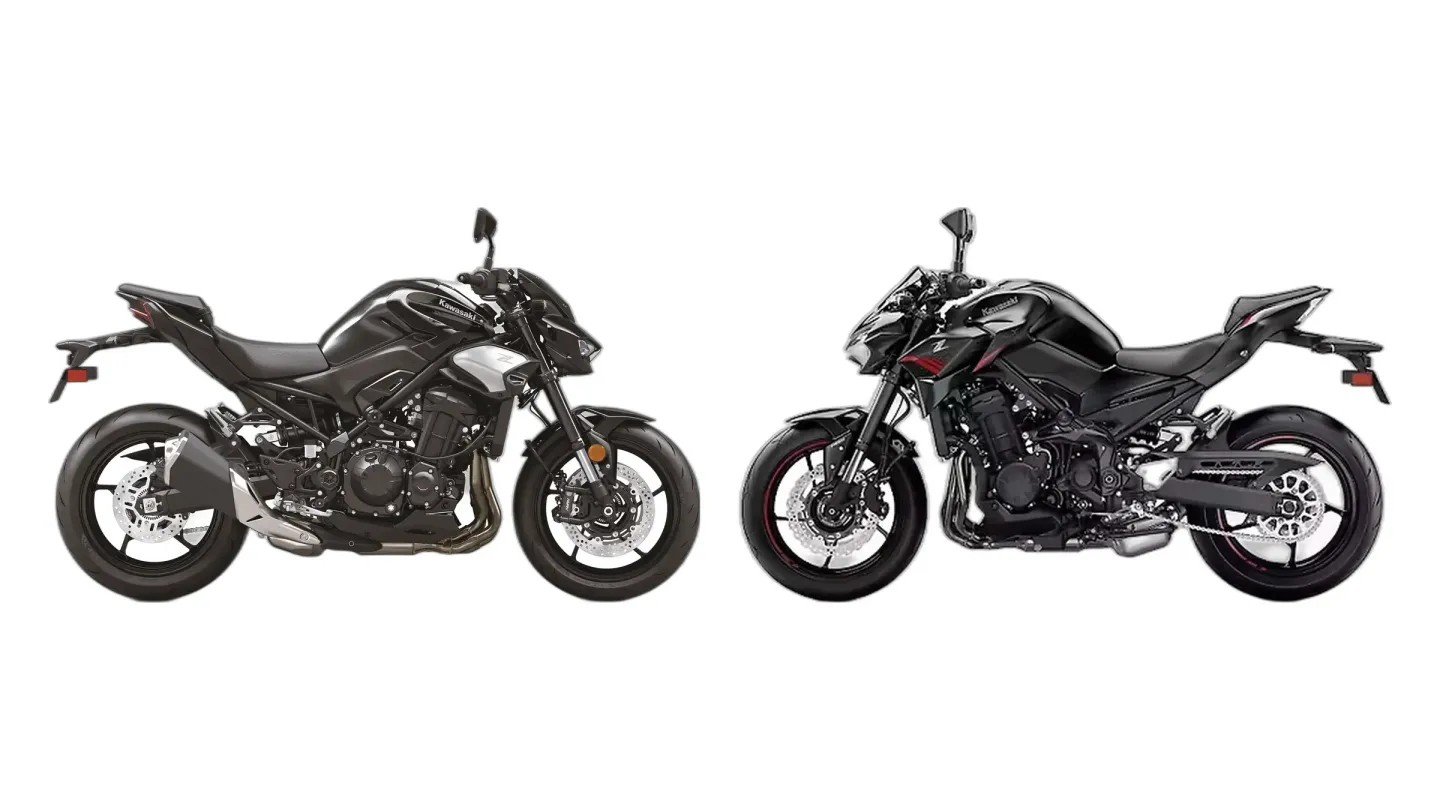
Kawasaki Z900 ABS (MY2022) vs Z900 (MY2017)
Kawasaki Z900 ABS vs 2017 Kawasaki Z900: which one's easier to live with every day.
Hit a rough stretch hard on the Kawasaki Z900 ABS and the soft fork runs out of travel, but the frame doesn't get knocked off line. The 2017 Kawasaki Z900 puts its soft spot at the back, in a shock that's short on adjustment range. With a heavy rider aboard, it bottoms out.
So which one do you buy?
The Z900 ABS has the edge if…
Daily commuting & city riding
Edges it: Z900 ABS
On the way to work, the Z900 ABS asks a little less of you. Close enough that the test ride should settle it.
What makes each one tick
Z900 ABS
There's one unbroken surge in the Z900 ABS's inline-four as the tach needle climbs. In first gear at walking pace, the engine jolts on and off with each twitch of the throttle, and it lurches again when you pick it up after a shift. On the Angeles Crest Highway, cold or slow corners leave the stock Dunlop front tire without grip you'd trust. The trellis holds each bend steady.
2017 Z900
Once the revs reach the middle of the band, the 2017 Z900 finds its stride, and its inline-four builds drive that's easy to meter. Below that, there's a jerk to the throttle in first and second gear. Stops at the brake lever pass through ABS. The hard, narrow seat won't stay kind on a long stint and keeps sliding you forward. Up top, the four howls.
Nils rode the 2017 Z900 in Switzerland in 2017, and in Spain in 2019 (NastyNils Testride).
The Voice of Experience

What actually separates them
- The 2017 Z900 has the lower seat: 31.3 in (795 mm) vs 32.3 in (820 mm).
- Cornering ABS: standard on the Z900 ABS, not offered on the 2017 Z900.
- Traction Control: standard on the Z900 ABS, not offered on the 2017 Z900.
Which one for the way you ride
Comfortable long-distance riding
Both miss here
For all-day comfort, both fall short. Keep the rides short and you'll get on fine with either.
A confidence-building first motorcycle
Not their thing
Learning on either of these is the hard way. A gentler bike will make you a better rider sooner.
Don't look for a gap on twisty roads and running costs: there isn't one. Go by how each one fits you.
Who each one is built for
What's good, and what you'll live with
Z900 ABS
What owners say
Strengths
- Smooth, linear inline-four engine
- Reliability and Japanese build quality
- SE upgrade represents strong value
- Aggressive Sugomi visual presence
Trade-offs
- Missing modern electronics (MY2022–2024)
- STD suspension under-damped for spirited riding
- Snatchy throttle response at low RPM
- OEM Dunlop Sportmax Roadsport 2 tires criticized
- (SE) Öhlins S46 arrives soft from the factory
2017 Z900
What owners say
Strengths
- Excellent value for money
- Linear, exhilarating engine
- Agile, intuitive handling
- Good fuel economy
- Low running costs
Trade-offs
- Jerky throttle response at low revs
- Cramped legroom for taller riders
- Lacks modern electronics
- No wind protection
- Soft shock struggles with heavier riders
Known problems to check before you buy
Z900 ABS
- STD KYB suspension soft / under-damped under spirited riding The standard suspension lacks sufficient damping, causing wallowing and reduced precision when riding aggressively.
- Stock Dunlop Sportmax Roadsport 2 tires lack wet-weather grip The original-equipment Dunlop tires offer limited grip on wet pavement and can feel slippery in the rain, which leads some owners to replace them early with better-performing rubber.
- Snatchy on/off throttle response at low RPM Abrupt fuel cut-on results in jerky behavior when transitioning from closed to open throttle in first and second gear.
- OEM final-drive chain shows wear at lower mileage than expected The original chain often needs replacement between 9,300–12,000 mi (15,000–20,000 km) due to accelerated stretch and rust.
- Mirror blur and mild handlebar vibration at certain RPM bands Vibrations around 4,000–6,000 rpm can blur the mirrors and cause hand numbness on longer rides.
- Bluetooth pairing failures with Rideology app on iOS; isolated TFT Bluetooth chip failures Owners using iPhones have had trouble pairing the bike with the Kawasaki Rideology smartphone app. The cause was how the app handled short pairing PIN codes. Kawasaki later released a software update that fixed this, so affected bikes should get the latest app and instrument-cluster software. In rare cases, the Bluetooth module inside the TFT instrument cluster has failed and the dealer had to replace the cluster.
2017 Z900
- Rear Shock Mounting Bore Becomes Oval The mounting holes of the rear shock linkage on the frame can elongate and become oval under load when the shock absorber bottoms out. This compromises damping function and can cause riding instability. Root cause: insufficient material thickness at the linkage mounting point, combined with the stock shock absorber's tendency to bottom out when loaded.
- Rear Brake Line and ABS Sensor Cable May Chafe Against Tire During factory assembly, the rear brake line and wheel speed sensor cable may be incorrectly routed, causing them to chafe against the rear tire. This can damage the brake line (reduced braking performance) or sever the ABS sensor cable (ABS failure).
- ABS Hydraulic Unit Contaminated with Aluminum Shavings The ABS hydraulic unit may become contaminated with aluminum shavings during manufacturing due to a defective machining fixture that shaves the ABS pump housing. This can cause the front or rear wheel to lock up during braking.
- Front ABS Engages Too Early The Nissin ABS unit activates prematurely, particularly on the front brake, during hard braking. The ABS cannot be disabled on 2017–2019 models. This reduces rider confidence during aggressive braking and trail-braking maneuvers. Multiple professional testers and owners confirm the issue.
- False Neutrals, Especially Between 5th and 6th Gear The transmission occasionally misses shifts, especially during rapid upshifts above approximately 6,000 rpm. Most commonly reported between 5th and 6th gear, but also between 2nd and 3rd gear. Incomplete clutch disengagement exacerbates the problem. Downshifts are described as "clunky." Design-related, not an isolated defect.
- Snatchy Throttle Response / Jerky low-RPM fueling The Z900 exhibits jerky, on-off throttle response at low RPMs and speeds, particularly in 1st and 2nd gear. The bike bucks and surges when holding a constant low speed. The cause is emissions-compliant ECU tuning, not a mechanical defect. The problem is exacerbated by the closed secondary throttle plates at low RPMs.
- Ticking Noise from Timing Chain Area Audible ticking from the timing chain area, particularly noticeable because the Z900 is a naked bike. Slight ticking is considered normal (metal-to-metal contact from the automatic timing chain tensioner). In rare cases, the automatic tensioner fails and the noise becomes pronounced. The very quiet stock exhaust makes mechanical engine noises more prominent.
- Turn Signal Bracket Rubber Inserts Become Brittle and Break The rubber inserts that hold the stock turn signals in the body become brittle and break, causing the turn signals to hang loose on their wires. Vibration and UV radiation accelerate the wear. OEM replacement turn signals also fail within 1-2 years. Affects multiple Kawasaki models, not just the Z900.
- Handlebar Vibrations at Highway Speeds Noticeable handlebar vibrations at higher speeds cause hand numbness on longer rides. The bike's unfaired design and inline-four engine contribute to this issue. The stock handlebar is considered undersized for the motorcycle. Numerous aftermarket handlebar weight solutions are available.
- Surface Rust on Stock Steel Fasteners Stock steel fasteners and hardware develop surface rust, especially brake caliper bolts and exposed hardware. Kawasaki uses standard steel fasteners instead of stainless steel or coated alternatives.
What they share
- Displacement
- 948 cc
- Engine
- Inline-four
- Cooling
- Liquid-cooled
- Power
- 125 hp (92 kW)
- Peak power at
- 9,500 rpm
- Torque
- 73 lb-ft (99 Nm)
- Peak torque at
- 7,700 rpm
- Top speed
- 149 mph (240 km/h)
- Fuel capacity
- 4.5 US gal (17 L)
- Gearbox
- 6-speed
- Final drive
- Chain
- Front tire
- 120/70-17
- Rear tire
- 180/55-17
Where the spec sheets split
| Z900 ABS | 2017 Z900 | |
|---|---|---|
| Seat height | 32.3 in (820 mm) | 31.3 in (795 mm) |
| Wet weight | 467 lb (212 kg) | 463 lb (210 kg) |
| Z900 ABS | 2017 Z900 | |
|---|---|---|
| Fuel economy | 36 mpg (US) / 6.5 L/100 km | 43 mpg (US) / 5.5 L/100 km |
| Z900 ABS | 2017 Z900 | |
|---|---|---|
| Wheelbase | 57.3 in (1455 mm) | 57.1 in (1450 mm) |
What comes fitted, what costs extra
| Z900 ABS | 2017 Z900 | |
|---|---|---|
| Cornering ABS | Standard | Not offered |
| Traction Control | Standard | Not offered |
| Ride Modes | Standard | Not offered |
| TFT Display | Standard | Not offered |
| Smartphone Connectivity | Standard | Not offered |
| LED Headlight | Standard | Not offered |
Head to head, area by area
Both bikes on the same scale, one area at a time.