By NastyNils·
Motorcycle comparison · Naked Bike
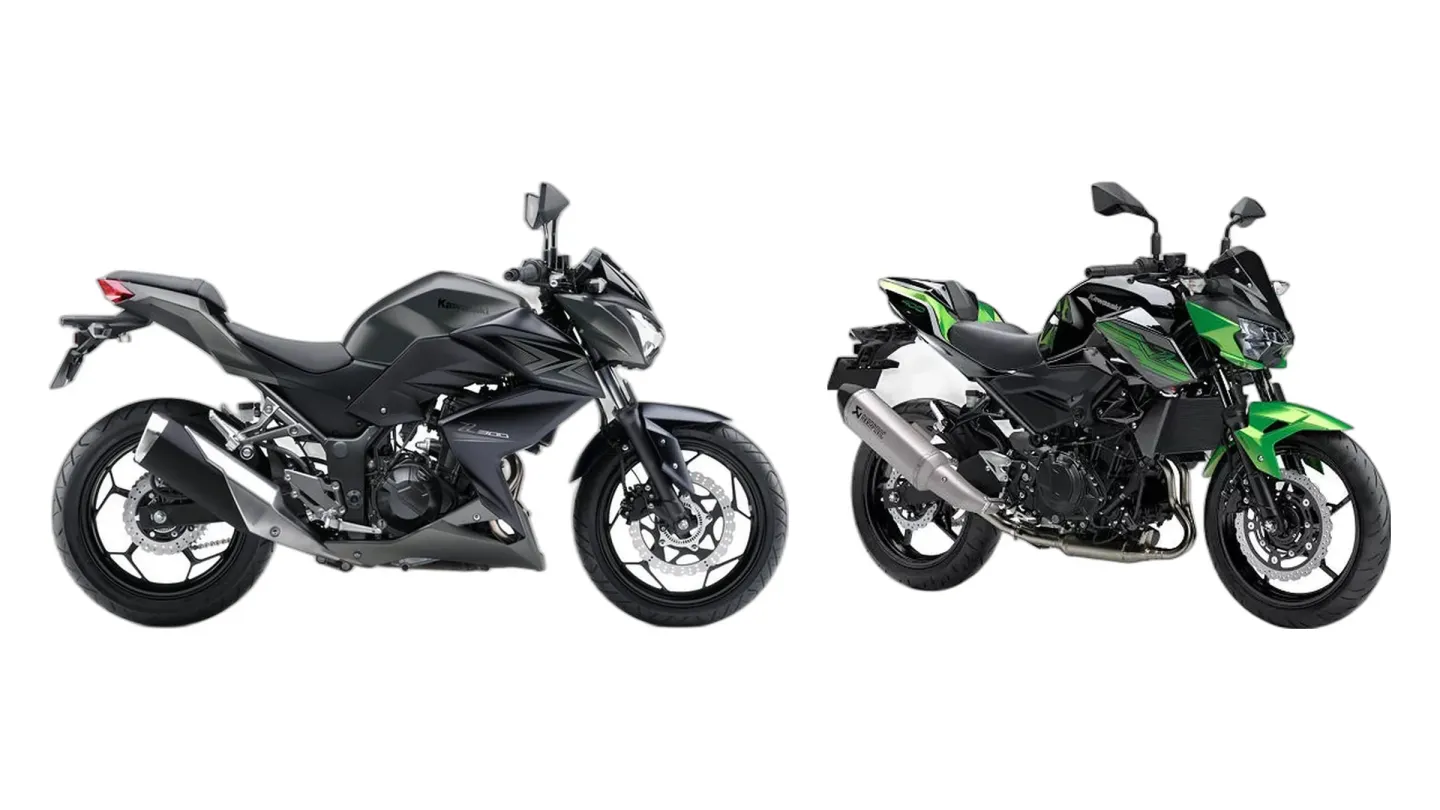
Kawasaki Z 300 (MY2015) vs Z 400 (MY2019)
Kawasaki Z 300 vs Z 400: which one to buy, and what actually separates them.
Roll on the Kawasaki Z 300 at low revs and it won't really pull until the needle swings high. The Kawasaki Z 400 pulls predictably from that same roll-on.
So which one do you buy?
The Z 400 has the edge if…
Sporty riding on twisty roads
Inches ahead: Z 400
On a tight back road, the Z 400 is slightly more fun to wring out. The difference is lighter steering and more feel through the bars.
What makes each one tick
Z 300
Its twin's earned a name for piling up big miles on nothing but routine service. The engine doesn't hand out its shove early: it feels flat low down and saves its punch for the top of the tach. The shift lever never rests.
Z 400
There's almost a bicycle's ease to the Z 400 at walking pace, where it turns tight and stays easy to shuffle around. At corner entry, that wide bar steers the bike in quickly and doesn't ask for muscle. The twin's begging to be wrung.
The Voice of Experience

What actually separates them
- The Z 400 makes more peak power: 45 hp (33 kW) vs 39 hp (29 kW).
- The Z 400 makes more peak torque: 28 lb-ft (38 Nm) vs 20 lb-ft (27 Nm).
- The Z 400 has the larger engine: 399 cc vs 296 cc.
Which one for the way you ride
Comfortable long-distance riding
Wrong job for both
Neither one is built for long-haul comfort. For big miles, look at a proper tourer or sport tourer.
Traveling with luggage
Neither one fits
Neither is a natural luggage carrier, so a trip with bags means a compromise either way.
They come out level on commuting and a first bike. The better-kept used example is the smarter money.
Who each one is built for
What's good, and what you'll live with
Z 300
What owners say
Strengths
- Agile and fun handling in the urban jungle
- Legendary reliability on a proven platform
Trade-offs
- Peaky power delivery demands high revs
Z 400
What owners say
Strengths
- Exceptionally lightweight and agile
- Approachable for new riders
Known problems to check before you buy
Z 300
No confirmed faults on file yet. That's not the same as fault-free.
Z 400
- Cylinder coolant seal leak The rubber seal around the coolant passage between the cylinder block and crankcase can deform and cause an external coolant leak.
- Clutch slippage and false neutrals Some owners report clutch slippage under hard acceleration and occasional false neutrals or jerky shifting, potentially related to weak clutch springs or improper adjustment.
What they share
- Seat height
- 30.9 in (785 mm)
- Engine
- Parallel twin
- Cooling
- Liquid-cooled
- Gearbox
- 6-speed
- Final drive
- Chain
- Fork
- Telescopic
- Front tire
- 110/70-17
Where the spec sheets split
| Z 300 | Z 400 | |
|---|---|---|
| Wet weight | 375 lb (170 kg) | 368 lb (167 kg) |
| Z 300 | Z 400 | |
|---|---|---|
| Displacement | 296 cc | 399 cc |
| Power | 39 hp (29 kW) | 45 hp (33 kW) |
| Peak power at | 11,000 rpm | 10,000 rpm |
| Torque | 20 lb-ft (27 Nm) | 28 lb-ft (38 Nm) |
| Peak torque at | 10,000 rpm | 8,000 rpm |
| Z 300 | Z 400 | |
|---|---|---|
| Fuel capacity | 4.5 US gal (17 L) | 3.7 US gal (14 L) |
| Z 300 | Z 400 | |
|---|---|---|
| Rear tire | 140/70-17 | 150/60-17 |
What comes fitted, what costs extra
| Z 300 | Z 400 | |
|---|---|---|
| ABS | Standard (from 2016) | Standard |
Head to head, area by area
Both bikes on the same scale, one area at a time.