By NastyNils·
Motorcycle comparison · Naked Bike
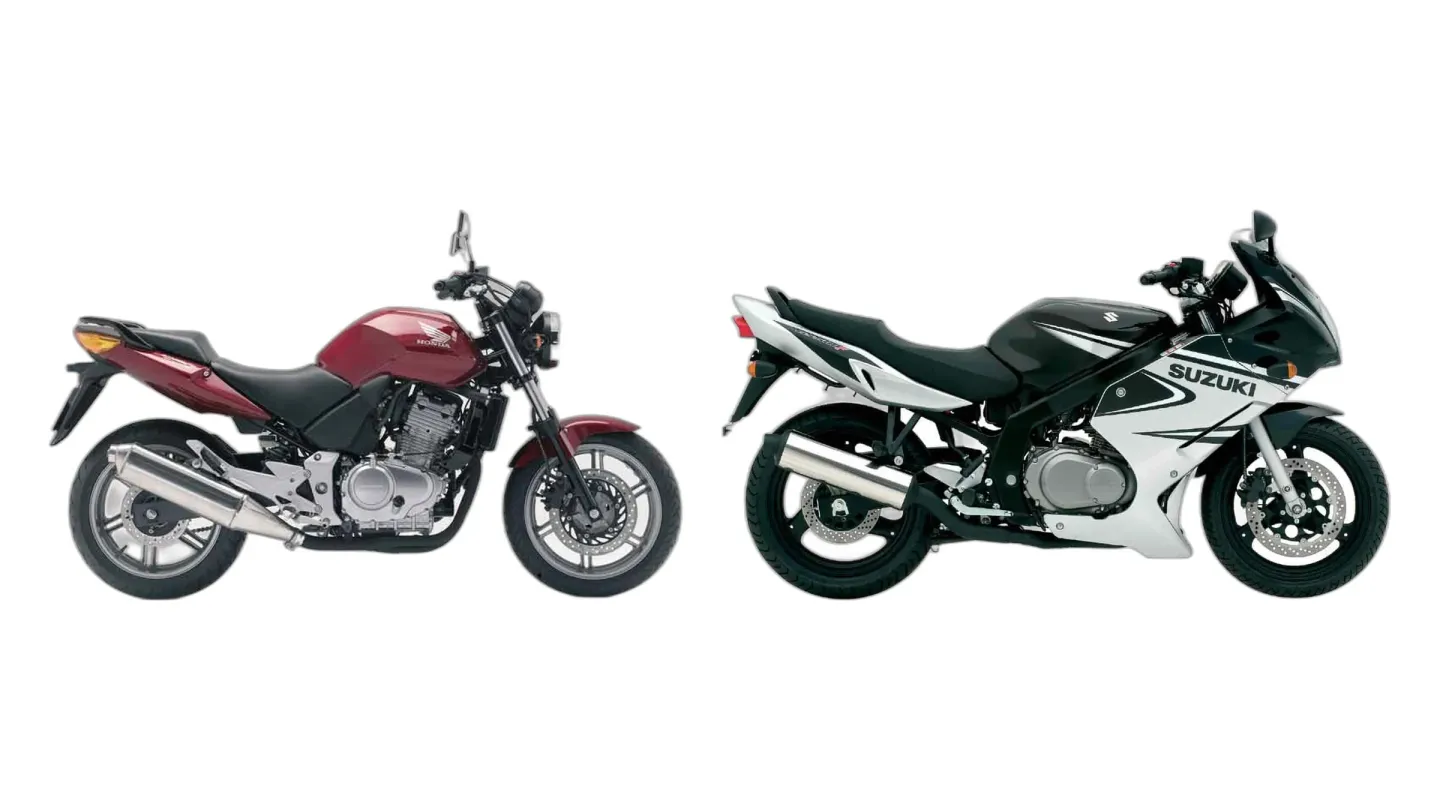
Honda CBF 500 (MY2005) vs Suzuki GS 500 (MY2005)
Honda CBF 500 vs Suzuki GS 500: which one to buy, and what actually separates them.
You'll find the Honda CBF 500 tips into a bend and doesn't budge off its line. The Suzuki GS 500 snaps from one lean to the next.
So which one do you buy?
The CBF 500 has the edge if…
Daily commuting & city riding
By a nose: CBF 500
For the ride to work, the CBF 500 noses ahead. Don't let that alone make the call.
What makes each one tick
CBF 500
There's nothing on the CBF 500 that hurries you, from a twin that won't buzz the bars to a steel spine frame that stays settled. Corner entry is where the neutral steering shows, since the front turns in on a gentle push and doesn't need a second correction. The levers don't fight back. Up in the revs, there's still a pull from the twin.
GS 500
The GS 500 stays nimble when traffic bunches up, since it's only 423 lb (192 kg) wet. A crack of throttle from low revs gets real grunt from the air-cooled twin, which doesn't ask for a downshift every time the light changes. The twin doesn't mind racking up miles. Its plush seat carries a passenger and luggage without complaint.
The Voice of Experience

What actually separates them
- The CBF 500 has the lower seat: 30.3 in (770 mm) vs 31.1 in (790 mm).
- The GS 500 has the lower wet weight: 423 lb (192 kg) vs 454 lb (206 kg).
- The CBF 500 makes more peak power: 57 hp (42 kW) vs 45 hp (33 kW).
Which one for the way you ride
Comfortable long-distance riding
Not built for this
Neither one is built for long-haul comfort. For big miles, look at a proper tourer or sport tourer.
For twisty roads, a first bike, and trips with luggage, you won't find daylight between them. Let the test ride settle it.
Who each one is built for
What's good, and what you'll live with
CBF 500
What owners say
Strengths
- Excellent value and low running costs
- Smooth and forgiving engine
GS 500
What owners say
Strengths
- Light and easy to maneuver
- Proven, durable engine
- Budget-friendly to own and run
- Strong low-end torque
Known problems to check before you buy
CBF 500
No confirmed faults on file yet. That's not the same as fault-free.
GS 500
- Non-compliant rear reflector (recall, NHTSA Recall 07V-515) Recall 07V515000 The rear reflector does not meet FMVSS 108 standards, reducing nighttime visibility to following drivers. Affected units need reflector replacement.
- Carburetor flooding and fuel smell Worn float needle seats or failing petcock diaphragm can cause fuel to overflow or leak, leading to a strong fuel odor and potential safety risk.
What they share
- Engine
- Parallel twin
- Peak power at
- 9,500 rpm
- Gearbox
- 6-speed
- Final drive
- Chain
Where the spec sheets split
| CBF 500 | GS 500 | |
|---|---|---|
| Seat height | 30.3 in (770 mm) | 31.1 in (790 mm) |
| Wet weight | 454 lb (206 kg) | 423 lb (192 kg) |
| CBF 500 | GS 500 | |
|---|---|---|
| Displacement | 499 cc | 487 cc |
| Cooling | Liquid-cooled | Air-cooled |
| Power | 57 hp (42 kW) | 45 hp (33 kW) |
| Torque | 33 lb-ft (45 Nm) | 30 lb-ft (40 Nm) |
| Peak torque at | 8,000 rpm | 7,400 rpm |
| Top speed | 125 mph (201 km/h) | 107 mph (173 km/h) |
| CBF 500 | GS 500 | |
|---|---|---|
| Fuel capacity | 5.0 US gal (19 L) | 5.3 US gal (20 L) |
| CBF 500 | GS 500 | |
|---|---|---|
| Front tire | 120/70-17 | 110/70-17 |
| Rear tire | 160/60-17 | 130/70-17 |
What comes fitted, what costs extra
| CBF 500 | GS 500 | |
|---|---|---|
| ABS | Option | Not offered |
Head to head, area by area
Both bikes on the same scale, one area at a time.