By NastyNils·
Motorcycle comparison · Naked Bike
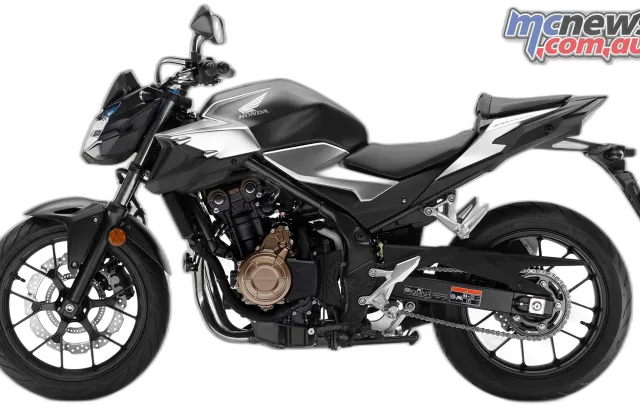
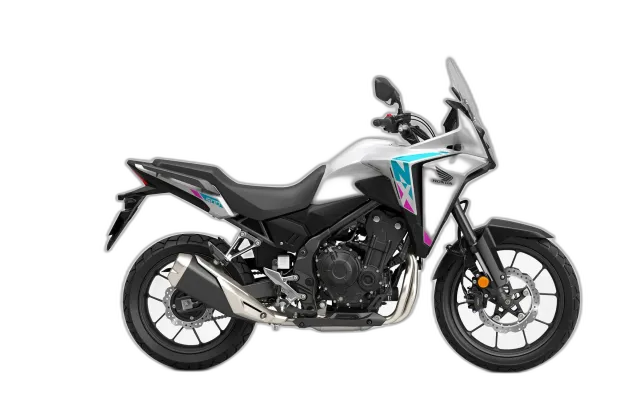
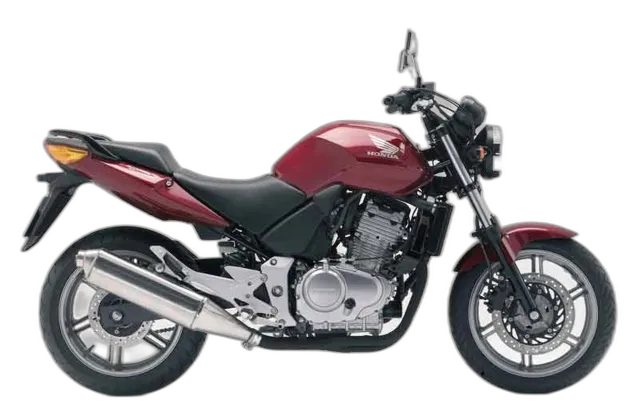
Honda CBF 500 (MY2005) vs CB500 Hornet (MY2024)
Honda CBF 500 vs CB500 Hornet: which one's easier to live with every day.
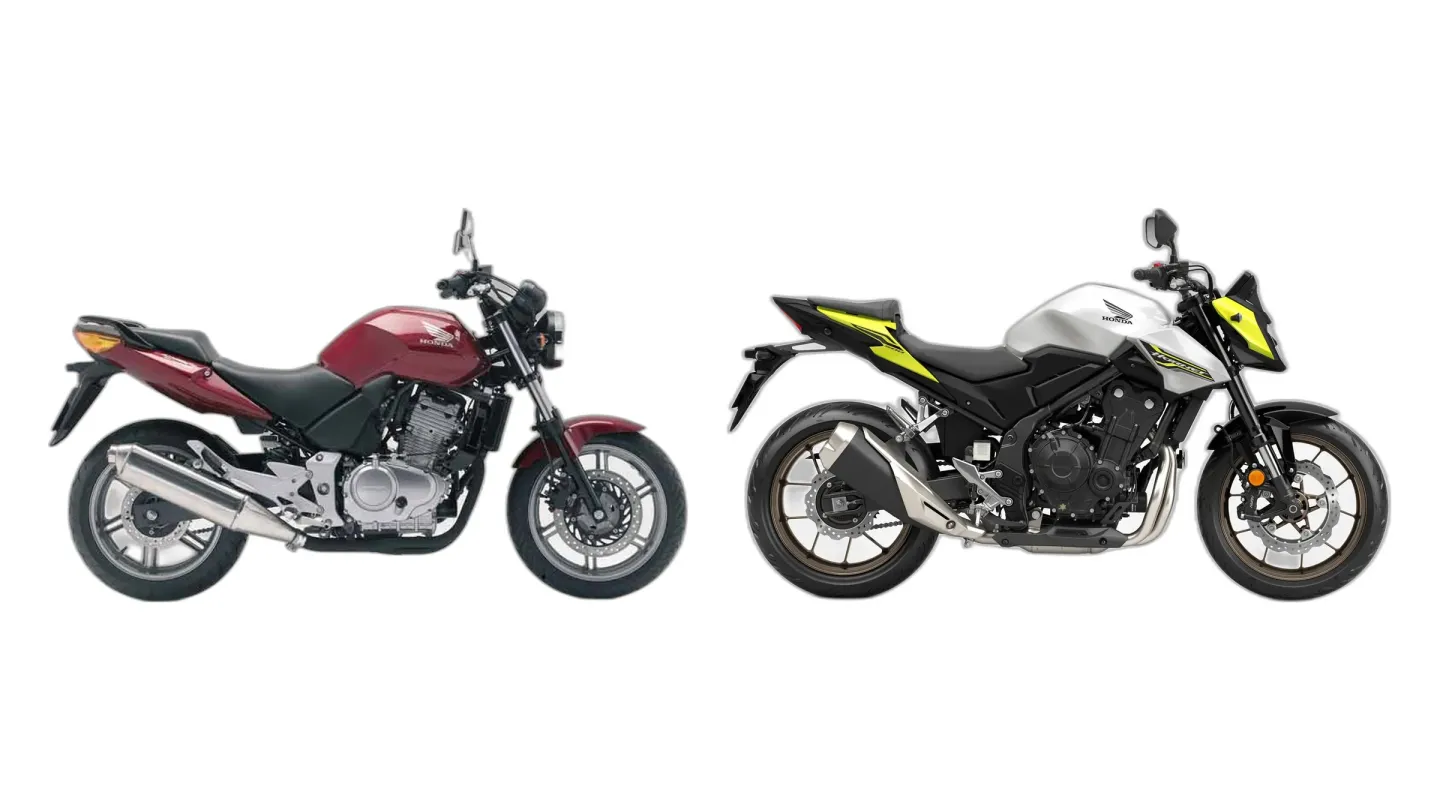
At the turn-in point, the Honda CBF 500 tips in on neutral steering and doesn't stray off its line. The Honda CB500 Hornet lets you arrive carrying more speed. Its front still bites and tucks in clean.
So which one do you buy?
The CB500 Hornet has the edge if…
Traveling with luggage
Slight edge: CB500 Hornet
The CB500 Hornet carries a touring load slightly better. It's down to more range per tank and a better reliability record.
Daily commuting & city riding
Narrow edge: CB500 Hornet
Your daily ride leans slightly toward the CB500 Hornet. That comes from friendlier manners and simpler maintenance. Fit and price can easily outweigh that.
A confidence-building first motorcycle
Edges it: CB500 Hornet
For a new rider, the CB500 Hornet noses ahead. How it fits you counts for more than this gap.
Sporty riding on twisty roads
Nose ahead: CB500 Hornet
In the twisties, the CB500 Hornet asks a bit less of you to go quickly. Call it a modest edge.
What makes each one tick
CBF 500
There's no shudder in the CBF 500's twin, just a steady pull that sits calm at commuting pace and gets eager high in the revs. You sit upright behind the bars, with the seat at 30.3 in (770 mm) putting both boots down at a stop. The brake lever pulls light, and the steel spine frame doesn't squirm as the bike sheds speed. The twin runs on basic care.
CB500 Hornet
Walking-pace work isn't a wrestling match on the CB500 Hornet: its 414 lb (188 kg) pivot through a parking lot without a death grip. The twin answers the throttle hardest near 6,500 rpm, where it makes peak torque. By Saturday, it's running credible laps.
The Voice of Experience

What actually separates them
- The CBF 500 has the lower seat: 30.3 in (770 mm) vs 30.9 in (785 mm).
- The CB500 Hornet has the lower wet weight: 414 lb (188 kg) vs 454 lb (206 kg).
- The CBF 500 makes more peak power: 57 hp (42 kW) vs 48 hp (35 kW).
Which one for the way you ride
Comfortable long-distance riding
Both miss here
Both of these get tiring on a long day. A proper tourer will treat you better on big miles.
Who each one is built for
What's good, and what you'll live with
CBF 500
What owners say
Strengths
- Legendary Honda reliability
- Excellent value and low running costs
- Smooth and forgiving engine
CB500 Hornet
Strengths
- Brakes lead the class
- Light where it counts
- Composed over rough roads
- Refined, vibration-free twin
- Built above its price
Trade-offs
- Wants revs to come alive
- Rear suspension runs short
- Soft seat, narrow bar
- Modest power for highway cruising and two-up riding
What they share
- Engine
- Parallel twin
- Cooling
- Liquid-cooled
- Gearbox
- 6-speed
- Final drive
- Chain
- Front brake
- 296 mm
- Front tire
- 120/70-17
- Rear tire
- 160/60-17
Where the spec sheets split
| CBF 500 | CB500 Hornet | |
|---|---|---|
| Seat height | 30.3 in (770 mm) | 30.9 in (785 mm) |
| Wet weight | 454 lb (206 kg) | 414 lb (188 kg) |
| CBF 500 | CB500 Hornet | |
|---|---|---|
| Displacement | 499 cc | 471 cc |
| Power | 57 hp (42 kW) | 48 hp (35 kW) |
| Peak power at | 9,500 rpm | 8,600 rpm |
| Torque | 33 lb-ft (45 Nm) | 32 lb-ft (43 Nm) |
| Peak torque at | 8,000 rpm | 6,500 rpm |
| CBF 500 | CB500 Hornet | |
|---|---|---|
| Fuel economy | 38 mpg (US) / 6.27 L/100 km | 67 mpg (US) / 3.5 L/100 km |
| Fuel capacity | 5.0 US gal (19 L) | 4.5 US gal (17.1 L) |
| CBF 500 | CB500 Hornet | |
|---|---|---|
| Fork | Telescopic | Upside-down (USD) |
| Wheelbase | 58.3 in (1480 mm) | 55.5 in (1410 mm) |
What comes fitted, what costs extra
| CBF 500 | CB500 Hornet | |
|---|---|---|
| ABS | Option | Standard |
| Traction Control | Not offered | Standard |
| Smartphone Connectivity | Not offered | Standard |
Head to head, area by area
Both bikes on the same scale, one area at a time.