By NastyNils·
Motorcycle comparison · Naked Bike
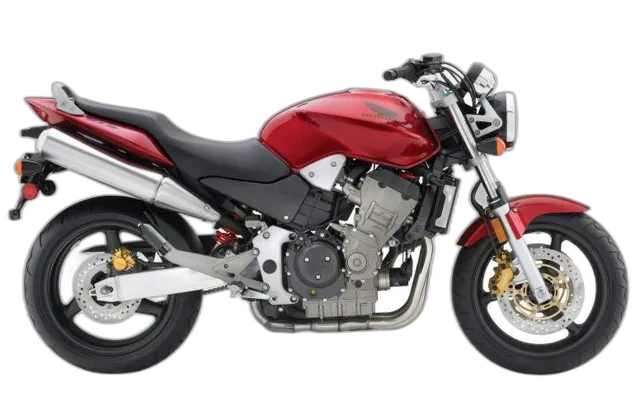
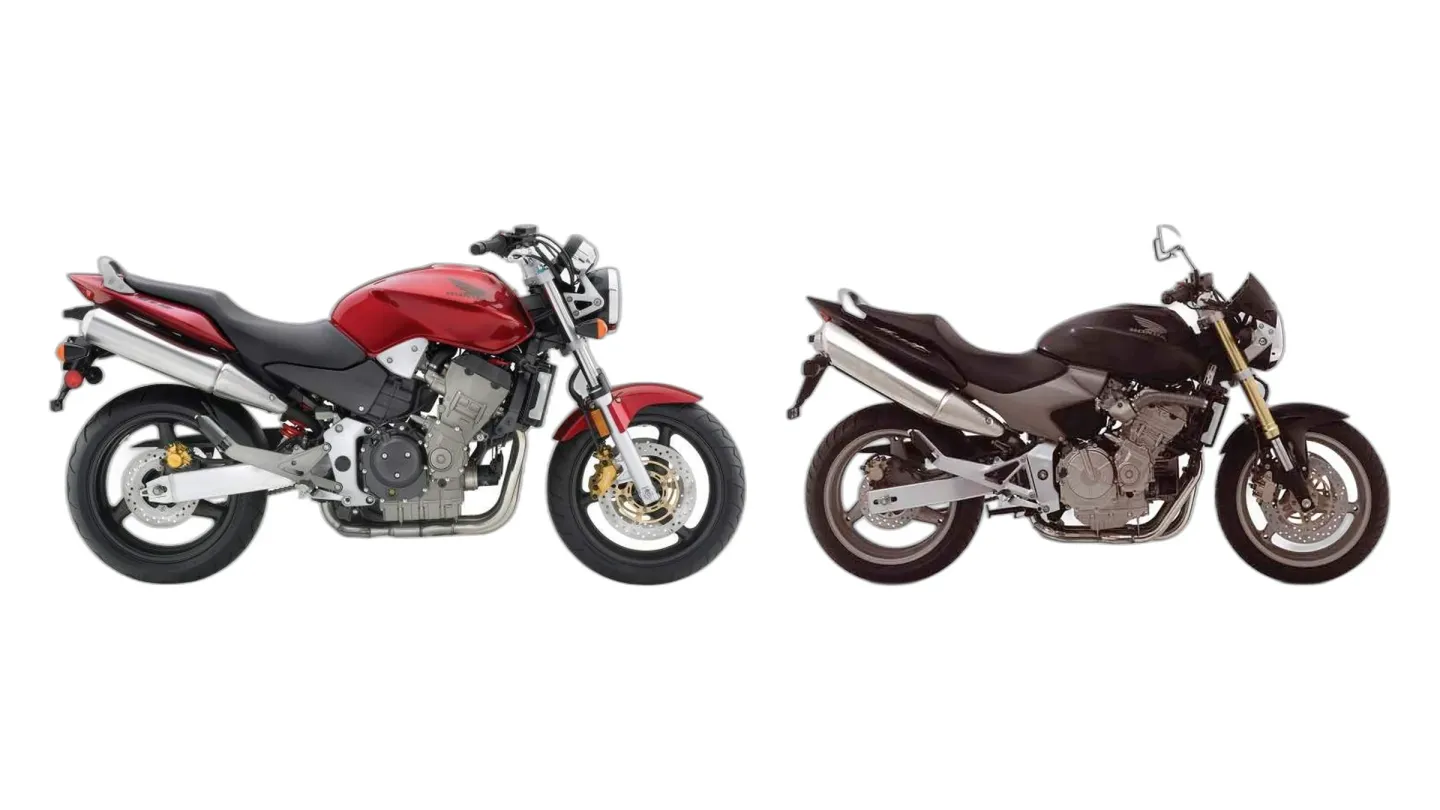
Honda CB 900 F Hornet (CB900F 2nd Gen) vs CB600F Hornet (PC36)
Honda CB 900 F Hornet vs CB600F Hornet: no fairing, no excuses. Here's how to pick.
Off a stoplight with a small twist of the throttle, the Honda CB 900 F Hornet pulls smoothly from low revs and doesn't ask for a downshift. The Honda CB600F Hornet's four feels lazy down there and won't wake up until the tach needle swings high. Then it snaps forward with real urgency.
So which one do you buy?
The CB 900 F Hornet has the edge if…
Sporty riding on twisty roads
Slight edge: CB 900 F Hornet
On a twisty road, the CB 900 F Hornet edges ahead. Not by enough to settle it alone.
The CB600F Hornet has the edge if…
Daily commuting & city riding
By a nose: CB600F Hornet
On the way to work, the CB600F Hornet asks a little less of you. The reason: friendlier manners. Close enough that the test ride should settle it.
What makes each one tick
CB 900 F Hornet
A steel spine frame keeps the CB 900 F Hornet's steering light at its wide bar. Its retuned FireBlade engine carries a broad spread of torque from low rpm, and picking a gear isn't critical. The brake lever's got a pair of front discs behind it. Those discs haul the bike down hard when it's needed.
CB600F Hornet
The CB600F Hornet's CBR600F-derived engine keeps its real shove for the stretch that's just short of the limiter. From 2005, an upside-down fork keeps it steadier through a bend. Corner entry doesn't demand much, and the chassis forgives a mistake. It'll tip in off a nudge.
The Voice of Experience

What actually separates them
- The CB 900 F Hornet makes more peak power: 109 hp (80 kW) vs 97 hp (71 kW).
- The CB 900 F Hornet makes more peak torque: 68 lb-ft (92 Nm) vs 46 lb-ft (63 Nm).
- The CB 900 F Hornet has the larger engine: 919 cc vs 599 cc.
Which one for the way you ride
Comfortable long-distance riding
Neither one fits
Neither of these is a mile-muncher. If big days are the plan, keep looking.
A confidence-building first motorcycle
Wrong job for both
Both of these ask too much of a rookie. Spend your first year on something lighter.
There's no real gap on trips with luggage. Sit on both and let fit and price decide.
Who each one is built for
What's good, and what you'll live with
CB 900 F Hornet
What owners say
Strengths
- Flexible, smooth inline-four
- Legendary Honda reliability
CB600F Hornet
What owners say
Strengths
- Rev-happy engine with sporty potential
- Low running costs
Trade-offs
- Low power at low RPM
- Basic suspension (2002–2004)
- Poor wind protection
Known problems to check before you buy
CB 900 F Hornet
- Fuel pump relay failure causing no-start Failure of the fuel pump relay or corrosion in the electrical connectors can prevent the fuel pump from priming, resulting in a no-start condition. Often occurs after long periods of storage.
CB600F Hornet
- Automatic cam chain tensioner failure The stock automatic cam chain tensioner can wear and fail. Symptom: rattling/clattering when closing the throttle while warm. Widely cited as the most well-known problem of the Hornet series. Aftermarket solutions (manual cam chain tensioners) are common.
- Radiator fan not engaging; overheating tendency The thermostat-controlled radiator fan can fail due to a blown fuse (10A under seat), temperature sensor defect, or fan motor failure. Leads to overheating in stop-and-go traffic. Low coolant from neglected maintenance exacerbates the problem.
- Voltage regulator/rectifier failure The regulator/rectifier can fail, causing charging problems (battery not charging or overcharging). Symptoms: dead battery, blown bulbs, fluctuating voltage. Heat-related, as it is mounted close to the engine. This is a known cross-generational Honda problem, not specific to the PC36 but documented for it.
- Sticking float needle valves in carburetors The float chamber needle valves can stick, causing excessive fuel consumption or fuel overflow. Occurs particularly after extended storage. Requires carburetor cleaning.
- Surface corrosion on lower triple clamp The lower triple clamp is prone to surface corrosion with year-round use and road salt exposure. Not a structural problem, but visually noticeable and progressive if maintenance is neglected.
What they share
- Engine
- Inline-four
- Cooling
- Liquid-cooled
- Gearbox
- 6-speed
- Final drive
- Chain
- Front brake
- 296 mm
Where the spec sheets split
| CB 900 F Hornet | CB600F Hornet | |
|---|---|---|
| Seat height | 31.3 in (795 mm) | 31.1 in (790 mm) |
| CB 900 F Hornet | CB600F Hornet | |
|---|---|---|
| Displacement | 919 cc | 599 cc |
| Power | 109 hp (80 kW) | 97 hp (71 kW) |
| Peak power at | 9,000 rpm | 12,000 rpm |
| Torque | 68 lb-ft (92 Nm) | 46 lb-ft (63 Nm) |
| Peak torque at | 6,500 rpm | 9,500 rpm |
| Top speed | 146 mph (235 km/h) | 142 mph (229 km/h) |
| CB 900 F Hornet | CB600F Hornet | |
|---|---|---|
| Fuel economy | 31 mpg (US) / 7.6 L/100 km | 36 mpg (US) / 6.5 L/100 km |
| Fuel capacity | 5.0 US gal (19 L) | 4.5 US gal (17 L) |
| CB 900 F Hornet | CB600F Hornet | |
|---|---|---|
| Front tire | 120/70-17 | 120/70-ZR17 |
| Rear tire | 180/55-17 | 180/55-ZR17 |
Head to head, area by area
Both bikes on the same scale, one area at a time.