By NastyNils·
Motorcycle comparison · Hyper Naked vs Supersport
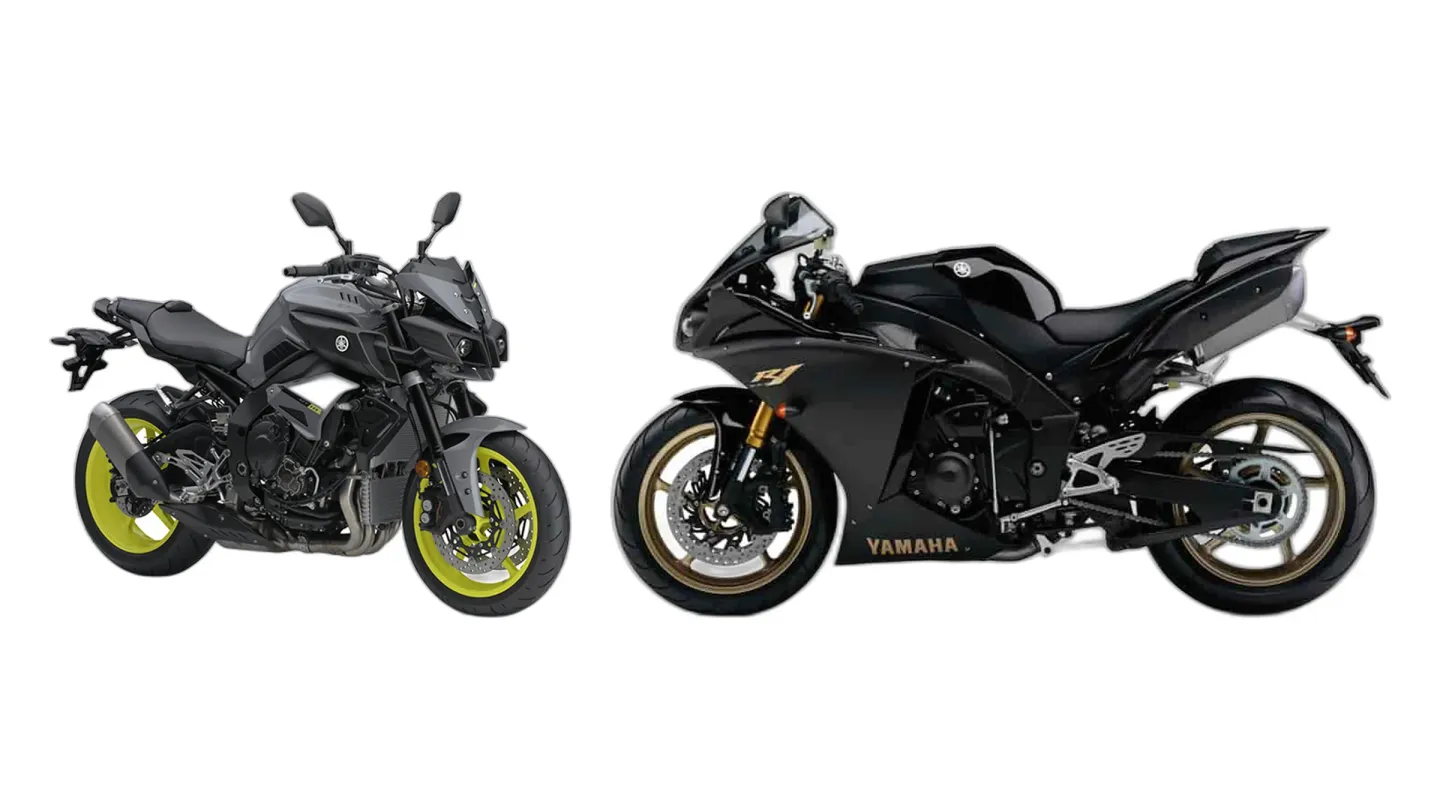
Yamaha MT-10 (RN45) vs YZF-R1 (RN22)
Yamaha MT-10 vs YZF-R1: different classes, one choice. Here's how to make it.
You'll sit tall on the Yamaha MT-10 while it's slicing into the corner with a superbike's bite. Miss your entry on the Yamaha YZF-R1 and it'll let you tidy the line mid-arc. Through quick switchbacks, it takes a beat longer to flip.
So which one do you buy?
Buy the MT-10 if…
Daily commuting & city riding
Clearly ahead: MT-10
As a daily commuter, the MT-10 gets the nod, and it isn't close.
The MT-10 has the edge if…
Sporty riding on twisty roads
Inches ahead: MT-10
Back-road fun leans slightly toward the MT-10. Put it down to better suspension. It's a narrow call, so trust your test ride.
The YZF-R1 has the edge if…
Racetrack use
Small edge: YZF-R1
For a day at the track, the YZF-R1 makes slightly more sense. Thank more lean clearance for that. Tires and suspension setup can easily flip a gap like that.
What makes each one tick
MT-10
An off-beat crossplane howl leaves the MT-10's exhaust, and the engine pulls hard well before there's any need to chase the redline. On the Angeles Crest Highway, the Deltabox frame carves with superbike precision while the high bar keeps you sitting upright. Around town the bike doesn't fuss: each squeeze of the brake lever finds the chassis composed. The front wheel's always ready to climb.
Nils rode the MT-10 in Austria in 2017 (NastyNils Testride).
YZF-R1
Every scrap of rear-tire traction comes back through the YZF-R1's throttle grip, and you'll read what that rubber's doing as you wind out of a fast bend. Snap down two or three gears into a slow corner and the R1 doesn't fight you. There's real compliance in the soft suspension as the bike turns in on public roads. Under track loads it goes vague. The bars sit right where you'd reach for them.
Nils rode the YZF-R1 in Australia in 2009, in 2010, in Spain in 2011, and in Portugal in 2012 (NastyNils Testride).
The Voice of Experience

What actually separates them
- The YZF-R1 makes more peak power: 182 hp (134 kW) vs 160 hp (118 kW).
- The YZF-R1 has the larger fuel tank: 4.8 US gal (18 L) vs 4.5 US gal (17 L).
- ABS: standard on the MT-10, not offered on the YZF-R1.
Which one for the way you ride
Comfortable long-distance riding
Neither is a natural fit
Both of these get tiring on a long day. A proper tourer will treat you better on big miles.
Don't look for a gap on running costs: there isn't one. Go by how each one fits you.
Who each one is built for
What's good, and what you'll live with
MT-10
What owners say
Strengths
- Incredible crossplane engine sound and character
- Monster midrange torque
- Excellent electronic package for the price
- Strong standard equipment and build quality
- Superbike handling with everyday comfort
Trade-offs
- Uncomfortable stock seat
YZF-R1
From Nils' own saddle time
Strengths
- Crossplane Voice, No Equal
- Forgiving, Planted Chassis
- Rear-Wheel Feel You Can Trust
- Crisp, Willing Gearbox
Trade-offs
- Top-End Trails The Class
- Suspension Too Soft For Track
- No ABS On Offer
Known problems to check before you buy
MT-10
No confirmed faults on file yet. That's not the same as fault-free.
YZF-R1
- Regulator/rectifier failure The factory regulator/rectifier is known to overheat and fail, leading to either a flat battery or, in worse cases, fried wiring at the connector.
- Cam chain tensioner wear and rattle Original spring-loaded cam chain tensioners can lose tension, causing a top-end rattle at idle and on overrun. The aftermarket APE manual tensioner is a popular fix.
- Stator failure The charging stator can fail prematurely, sometimes related to or causing R/R failure; symptoms include erratic voltage and progressive electrical issues.
- Fuel pump failure Some owners report fuel pump degradation leading to power loss at higher rpm or stalling; usually requires pump replacement.
- Snatchy fuelling at low rpm in STD/A mode Abrupt throttle response just off closed makes smooth low-speed riding difficult; many owners default to the softer B-map for town use.
What they share
- Displacement
- 998 cc
- Engine
- Inline-four
- Cooling
- Liquid-cooled
- Gearbox
- 6-speed
- Final drive
- Chain
- Fork
- Upside-down (USD)
- Front tire
- 120/70-17
- Rear tire
- 190/55-17
Where the spec sheets split
| MT-10 | YZF-R1 | |
|---|---|---|
| Seat height | 32.5 in (825 mm) | 32.9 in (835 mm) |
| Wet weight | 463 lb (210 kg) | 454 lb (206 kg) |
| MT-10 | YZF-R1 | |
|---|---|---|
| Power | 160 hp (118 kW) | 182 hp (134 kW) |
| Peak power at | 11,500 rpm | 12,500 rpm |
| Torque | 82 lb-ft (111 Nm) | 85 lb-ft (116 Nm) |
| Peak torque at | 9,000 rpm | 10,000 rpm |
| Top speed | 152 mph (245 km/h) | 182 mph (293 km/h) |
| MT-10 | YZF-R1 | |
|---|---|---|
| Fuel capacity | 4.5 US gal (17 L) | 4.8 US gal (18 L) |
| MT-10 | YZF-R1 | |
|---|---|---|
| Front brake | 320 mm | 310 mm |
| Wheelbase | 55.1 in (1400 mm) | 55.7 in (1415 mm) |
What comes fitted, what costs extra
| MT-10 | YZF-R1 | |
|---|---|---|
| ABS | Standard | Not offered |
| Traction Control | Standard | Standard (from 2012) |
| Cruise Control | Standard | Not offered |
| Quickshifter | Standard | Not offered |
| Heated Grips | Option | Not offered |
| LED Headlight | Standard | Not offered |
Head to head, area by area
Both bikes on the same scale, one area at a time.