By NastyNils·
Motorcycle comparison · Hyper Naked
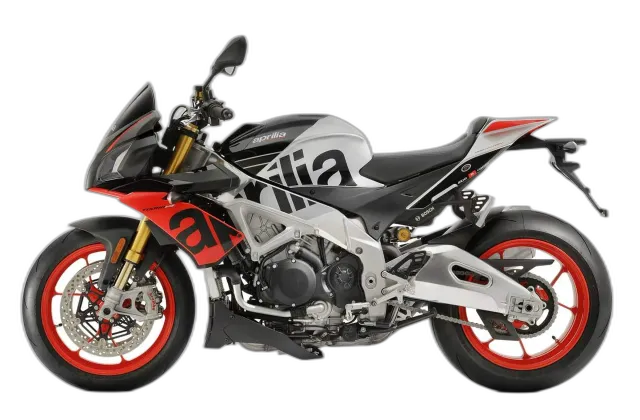
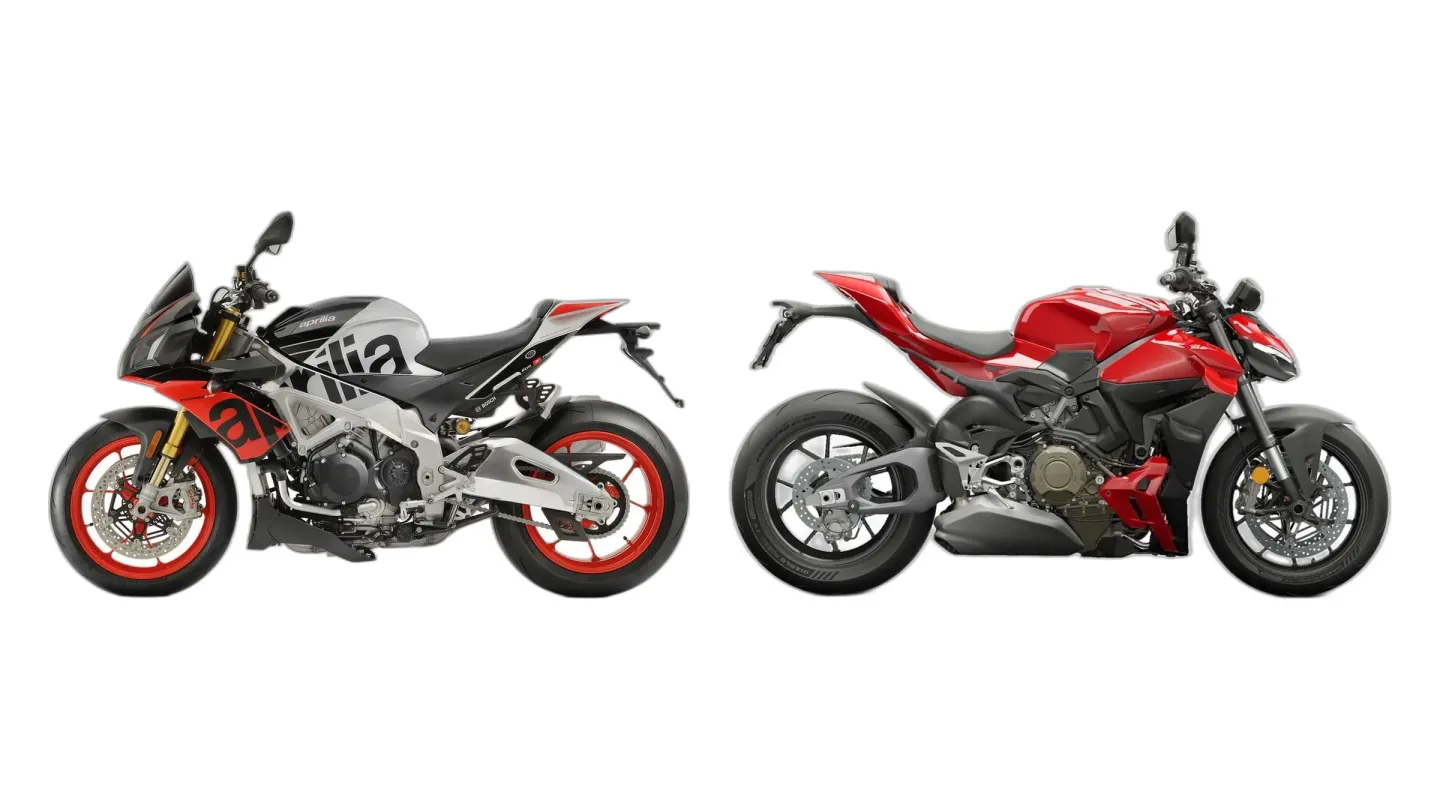
Aprilia Tuono V4 1100 (ZD4KZ-Factory) vs Ducati Streetfighter V4 (MY2020)
Roll on from a closed throttle and the Aprilia Tuono V4 1100 hangs right on your wrist, yet it'll still take fine inputs in its sharpest map. On the Ducati Streetfighter V4, that roll-on wakes an engine that's still building as the tach swings round. Its best work doesn't arrive until the revs climb high.
So which one do you buy?
Which one's the smarter buy
Depends what you want it for
The Tuono V4 1100 costs less, but that gap doesn't make it the better buy. Neither bike is the clear winner on value.
What makes each one tick
Tuono V4 1100
On the Tuono, the electronics don't make you fight for the V4's pull. Average riders find themselves quicker almost immediately. The V4 hangs directly on the gas right off closed throttle, yet in Race mode you can still meter torque precisely with wrist pressure. Through the fast sweepers of the Angeles Crest Highway, the chassis picks a line and holds it. Mid-corner ripples don't set the fork wallowing. The slim tank leaves room to shift across the seat.
Nils rode the Tuono V4 1100 in Hungary and Italy in 2021 (NastyNils Testride).
Streetfighter V4
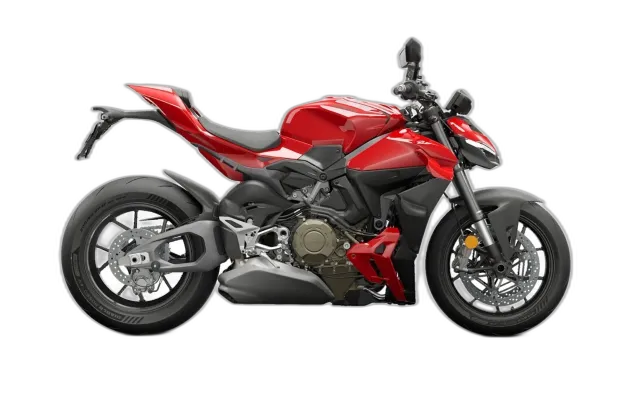
The Streetfighter bolts a single-piece dirt-bike bar onto a superbike's unchanged V4 and front frame, with a shorter final drive packing the gears closer. There's a counter-rotating crank and a wet clutch inside, and they keep the bike easygoing on everyday pavement. Into corners, it keeps folding over.
Nils rode the Streetfighter V4 in Austria in 2020 (NastyNils Testride).
The Voice of Experience

What actually separates them
- The Tuono V4 1100 has the lower seat: 32.5 in (825 mm) vs 33.3 in (845 mm).
- The Streetfighter V4 has the lower wet weight: 443 lb (201 kg) vs 461 lb (209 kg).
- The Streetfighter V4 makes more peak power: 208 hp (153 kW) vs 175 hp (129 kW).
Which one for the way you ride
Comfortable long-distance riding
Both fall short
For all-day comfort, both fall short. Keep the rides short and you'll get on fine with either.
Don't look for a gap on track days, character, commuting, and twisty roads: there isn't one. Go by how each one fits you.
Who each one is built for
What's good, and what you'll live with
Tuono V4 1100
Strengths
- Throttle You Can Actually Feel
- Rear Steers You To The Apex
- Faster Without More Horsepower
- Slim Tank, Real Room
- Planted Through Fast Sweepers
Trade-offs
- Too Loud For Long Days
- More Plastic Than A Naked Wants
- Runs Hot In City Traffic
- Soft, Uneven Low-Rpm Power
- Build quality below class standard
Streetfighter V4
What owners say
Strengths
- Class-leading peak power and track pace (V4 S)
- Surprising street civility for the spec sheet
Trade-offs
- Tall seat height
- Throttle abruptness in Sport / Race modes
Known problems to check before you buy
Tuono V4 1100
- High coolant temperatures and overheating tendency at low speeds The Euro 5 Tuono runs very hot in slow city traffic and when idling at traffic lights, because the radiator and fan cannot shed enough heat without steady airflow. Coolant temperature climbs into the warning range and stays high until the bike is moving at a sustained pace again. Owners report having to switch the engine off during long stops to keep temperatures under control.
- Dog wear in 3rd and 4th gear with intensive quickshifter use With frequent quickshifter use under full throttle and high rpm, the dogs in 3rd and 4th gear wear faster than normal. False neutrals then occur between 3rd/4th and 4th/5th gear. Aprilia has hardened replacement parts available for 3rd and 4th gear. The problem has been documented since the V4 platform and is also confirmed for Euro 5.
- Valve guide failure requiring cylinder head replacement An exhaust valve guide in the rear cylinder can work loose or detach, resulting in substantial loss of cylinder compression during leak-down testing and severe engine power loss resembling an electronic limp mode.
- Noticeable power deficit and uneven throttle response in the lower rpm range The Euro 5 mapping causes a measurable power gap below 5,500 rpm. Throttle response at 4,000-5,500 rpm feels uneven/pulsating. When transitioning from 5-15% throttle to closed throttle, the engine can react jerkily. An Aprilia Race Map or Rapid Bike tuning kit largely resolves the problem.
- Soft paintwork, scratch-prone surfaces, corroding fasteners The paintwork is described as extremely scratch-prone — without adequate clear coat. Graphics/decals in some areas have no clear coat and are quickly damaged by stone chips. Fasteners and washers (particularly mudguard mountings) are not stainless and show early corrosion. Body panels do not fit precisely and have visible panel gaps.
Streetfighter V4
- Quickshifter (DQS) missed upshifts and Gear Position Sensor failure Two related symptoms reported across MY2020–2024 units. (a) The DQS misses upshifts intermittently — most often 3→4 and 4→5 — and occasionally finds neutral on a missed shift. (b) The Gear Position Sensor (GPS, mounted on the engine case) can fail under heat exposure, requiring replacement and a Ducati Diagnostic System (DDS) relearn procedure. Downshift function intermittently fails when the GPS is degraded. Quickshifter problems are among the predominant issues reported by owners of MY2023 units. Service-bulletin DDS updates reportedly improve part-throttle quickshifter feel.
- Rear wheel axle recall (NHTSA 25V570) Recall 25V570000 The rear wheel axle could lose its structural integrity and break, leading to a loss of motorcycle control. A safety recall was issued covering 2020-2022 Streetfighter V4 motorcycles; dealers replace the rear wheel axle free of charge.
- Water pump shaft seal weeping coolant via designed external "weep hole" The water pump shaft seal weeps coolant via a designed external weep hole in the V of the engine — early-2020-build pumps channelled this leak into the V (risking oil contamination), and a later revision adds tubing routing the drip out below the bike. Multiple owners report onset within the first months or first 600 miles (1,000 km) of use. Pump replacement has been reported within the first month of ownership on MY2021 units. Replaced under warranty when reported in time.
- Twitchy / abrupt initial throttle pickup in Sport and Race ride modes Sport mode (medium power, progressive ride-by-wire) and especially Race mode (full power, direct ride-by-wire) produce an abrupt initial throttle pickup — owners describe a small dead-band followed by a surge in the first inch of throttle travel. More noticeable on the Streetfighter than on the Panigale V4 because of the upright posture (rider's mass over the bars amplifies any abruptness). Common owner mitigation: select Sport-with-Low power mode for street, custom ECU flash (Woolich), or aftermarket exhaust + remap. Not a defect — a calibration trait.
- Rear-cylinder heat radiating into rider's thigh and seat area Heat from the rear cylinder bank radiates through slits beside the seat. Owners report calf and inner-thigh discomfort, and in extreme cases burns, in stop-and-go traffic and ambient temperatures above 77°F (25 °C). Some owners report symptoms after a 20-minute ride. Cylinder deactivation at standstill helps at sustained idle (long red lights) but not in slow-rolling stop-and-go. Mitigations cited in the community: aftermarket frame heat covers (Lieb-Speed), heat-shield tape under exhaust covers, full Akrapovič exhaust (better airflow).
- Battery drain when DDA stick or tracker module is left connected during parking The Ducati Data Analyser USB stick, when left plugged in, draws current during parking and drains the battery within 1–2 weeks of inactivity. Aftermarket trackers / alarm modules add to drain. Ducati issued an internal dealer-bulletin email instructing owners to remove the DDA when not riding. A trickle charger or a battery tender is required for storage longer than approx. one week with DDA installed.
What they cost used
These prices compare a 5-year-old Tuono V4 1100 with a 5-year-old Streetfighter V4.
- Tuono V4 1100
- $13,300
- Streetfighter V4
- $17,000
At five years old, the Aprilia Tuono V4 1100 sits around $13,300 while the Ducati Streetfighter V4 runs about $17,000. That's a $3,700 gap in the Tuono's favor. These figures come from earlier US market records, not live listings.
What they share
- Engine
- V4
- Cooling
- Liquid-cooled
- Service interval
- 7,456 mi (12,000 km)
- Gearbox
- 6-speed
- Final drive
- Chain
- Fork
- Upside-down (USD)
- Front tire
- 120/70-17
Where the spec sheets split
| Tuono V4 1100 | Streetfighter V4 | |
|---|---|---|
| Seat height | 32.5 in (825 mm) | 33.3 in (845 mm) |
| Wet weight | 461 lb (209 kg) | 443 lb (201 kg) |
| Tuono V4 1100 | Streetfighter V4 | |
|---|---|---|
| Displacement | 1077 cc | 1103 cc |
| Power | 175 hp (129 kW) | 208 hp (153 kW) |
| Peak power at | 11,350 rpm | 12,750 rpm |
| Torque | 89 lb-ft (121 Nm) | 91 lb-ft (123 Nm) |
| Peak torque at | 9,000 rpm | 11,500 rpm |
| Tuono V4 1100 | Streetfighter V4 | |
|---|---|---|
| Fuel capacity | 4.7 US gal (17.9 L) | 4.2 US gal (16 L) |
| Tuono V4 1100 | Streetfighter V4 | |
|---|---|---|
| Rear tire | 200/55-17 | 200/60-17 |
| Wheelbase | 57.5 in (1460 mm) | 58.6 in (1488 mm) |
What comes fitted, what costs extra
| Tuono V4 1100 | Streetfighter V4 | |
|---|---|---|
| Electronic Suspension | Standard | Option |
| Cruise Control | Standard | Not offered |
| USB Charging Port | Option | Not offered |
| Tire Pressure Monitoring (TPMS) | Not offered | Option |
| Heated Grips | Not offered | Option |
Head to head, area by area
Both bikes on the same scale, one area at a time.