By NastyNils·
Motorcycle comparison · Cruiser
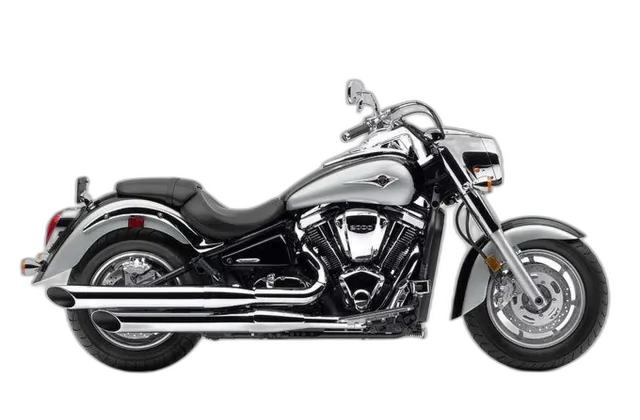
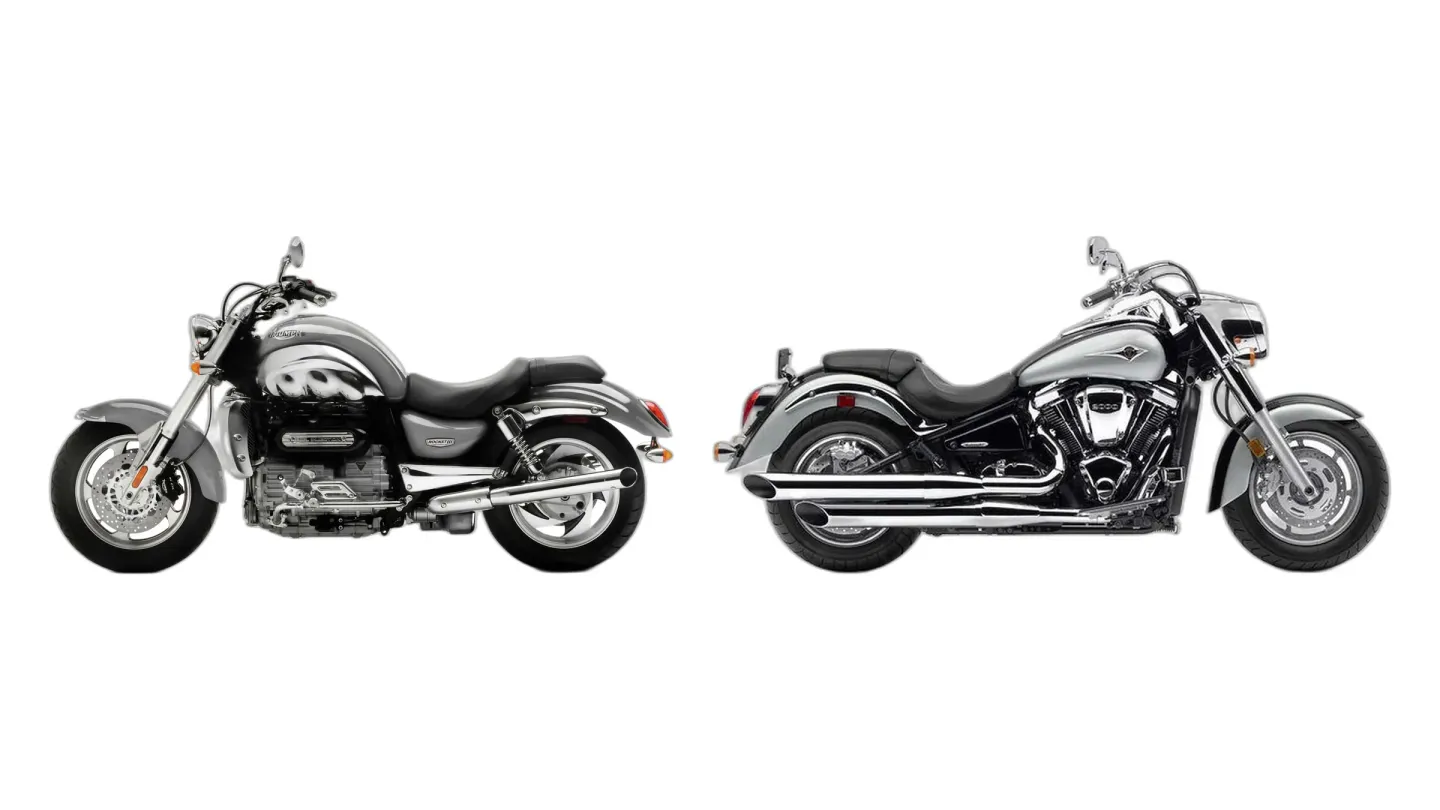
Triumph Rocket III (MY2004) vs Kawasaki VN 2000 (VN2000-MY2005)
Triumph Rocket III vs Kawasaki VN 2000: which one to buy once you're past the looks.
You'll feel the Triumph Rocket III's weight push back at the bars as you steer into a slow bend, and it won't tip in without a deliberate hand. The Kawasaki VN 2000 rolls into a flowing sweeper and doesn't fight you on the way in. It'll take hairpins too, once you've practiced a few.
So which one do you buy?
The Rocket III has the edge if…
Sporty riding on twisty roads
Slight edge: Rocket III
In the twisties, the Rocket III asks a bit less of you to go quickly. What tips it: harder acceleration and stronger brakes. Call it a modest edge.
The VN 2000 has the edge if…
Character, looks and sound
Inches ahead: VN 2000
On character, the VN 2000 edges it. Most of that is a purer look and more retro style. Your eyes get the final say.
Keeping running costs low
By a nose: VN 2000
The VN 2000 comes out a little ahead on upkeep. Only a little.
What makes each one tick
Rocket III
There's torque piling out of the Rocket III's triple from barely above idle, and it never seems to run dry. Up front, Daytona superbike brakes bite hard enough to haul all that bulk down. It's part dragster, part handler.
VN 2000
There's a huge V-twin thudding away low in the VN 2000's frame, its pistons the biggest any production motorcycle carried at launch. Crack the grip even slightly and something enormous responds. Handling in open, flowing corners is surprisingly straightforward given the mass. Through tight turns, a light trail of rear brake and a steady throttle keep the bike settled. A jerky throttle wobbles its line. The engine's still pulling well past highway pace.
The Voice of Experience

What actually separates them
- The VN 2000 has the lower seat: 26.8 in (680 mm) vs 29.1 in (740 mm).
- The Rocket III makes more peak power: 140 hp (104 kW) vs 116 hp (85 kW).
- The Rocket III has the larger engine: 2294 cc vs 2053 cc.
Which one for the way you ride
Daily commuting & city riding
Not suited: VN 2000
There's no daily-ride verdict for the VN 2000. Getting to work isn't its job.
Comfortable long-distance riding
Neither is a natural fit
Neither one is built for long-haul comfort. For big miles, look at a proper tourer or sport tourer.
Who each one is built for
What's good, and what you'll live with
Rocket III
What owners say
Trade-offs
- Excessive weight hampers low-speed agility
VN 2000
Strengths
- Startup Is An Event
- Real Pushrod V-Twin
- The Radiator Disappears
- Rock-Steady At Speed
- A Magnet In Every Lot
Trade-offs
- Not A Twisties Weapon
- Wide At Walking Pace
- Thirsty For Oil
- No ABS Fitted
- Extremely heavy at low speed
Known problems to check before you buy
Rocket III
- Final drive oil seal leak and potential lockup (recall) Recall 05V004000 Early production bikes up to 2005 suffered from an improperly installed oil seal in the final drive unit, causing oil leakage. If undetected, the unit could run dry and seize, locking the rear wheel. Addressed under NHTSA recall 05V-004.
- Engine stalling when returning to idle (recall) Recall 07V455000 Affected 2004-2007 bikes may stall while returning to idle due to incorrect fuel-injection mapping. Covered by NHTSA recall 07V455000; dealers reflash the ECU free of charge.
VN 2000
- Rear belt pulley bearing failure (single‑bearing hub) Early production models feature a single-bearing rear belt pulley hub that is prone to premature wear and failure under engine torque, causing excessive pulley wobble, drive belt tracking issues, or potentially locking the rear wheel.
- Drive pulley and output shaft spline stripping On early models (2004–2005), the splines on the drive pulley and transmission output shaft can wear or strip, leading to failure. Kawasaki issued a fix from 2006 onwards.
- Excessive oil consumption Many VN2000 engines consume up to half a quart of oil every 1,000 miles despite normal compression and clean spark plug readings. The cause is not widely agreed upon, but regular top‑ups are required.
- Hydraulic lifter noise (HLA ticking) Some owners report a ticking noise from the hydraulic lifters. Often considered normal but can be annoying.
What they share
- Cooling
- Liquid-cooled
- Gearbox
- 5-speed
Where the spec sheets split
| Rocket III | VN 2000 | |
|---|---|---|
| Seat height | 29.1 in (740 mm) | 26.8 in (680 mm) |
| Dry weight | 705 lb (320 kg) | 750 lb (340 kg) |
| Rocket III | VN 2000 | |
|---|---|---|
| Displacement | 2294 cc | 2053 cc |
| Engine | Inline-three | 52° V-twin |
| Power | 140 hp (104 kW) | 116 hp (85 kW) |
| Peak power at | 5,750 rpm | 5,000 rpm |
| Torque | 147 lb-ft (199 Nm) | 141 lb-ft (191 Nm) |
| Peak torque at | 2,500 rpm | 3,000 rpm |
| Top speed | 135 mph (217 km/h) | 120 mph (193 km/h) |
| Rocket III | VN 2000 | |
|---|---|---|
| Fuel economy | 36 mpg (US) / 6.6 L/100 km | 35 mpg (US) / 6.72 L/100 km |
| Fuel capacity | 6.6 US gal (25 L) | 5.5 US gal (21 L) |
| Rocket III | VN 2000 | |
|---|---|---|
| Final drive | Shaft | Belt |
| Front brake | 320 mm | 300 mm |
| Front tire | 150/80-17 | 150/80-16 |
| Rear tire | 240/50-16 | 200/60-16 |
What comes fitted, what costs extra
| Rocket III | VN 2000 | |
|---|---|---|
| Heated Grips | Option | Not offered |
Head to head, area by area
Both bikes on the same scale, one area at a time.