By NastyNils· ·
Motorcycle comparison · Cruiser vs Retro Classic
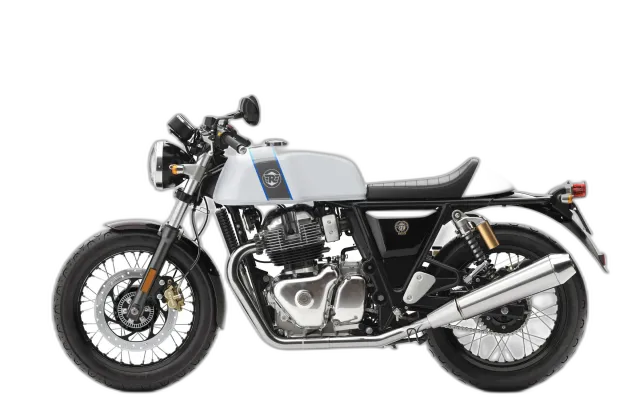
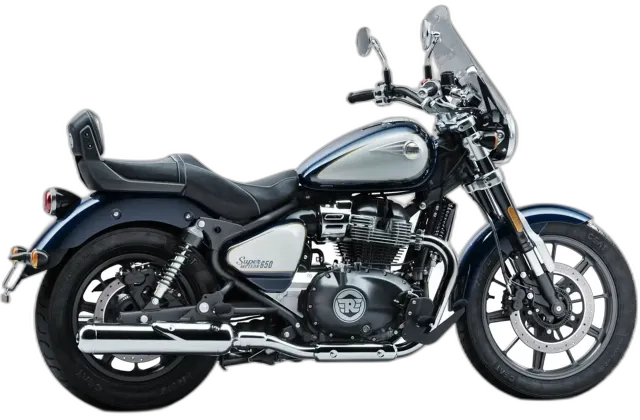
Royal Enfield Super Meteor 650 (MY2023) vs Interceptor 650 (MY2018)
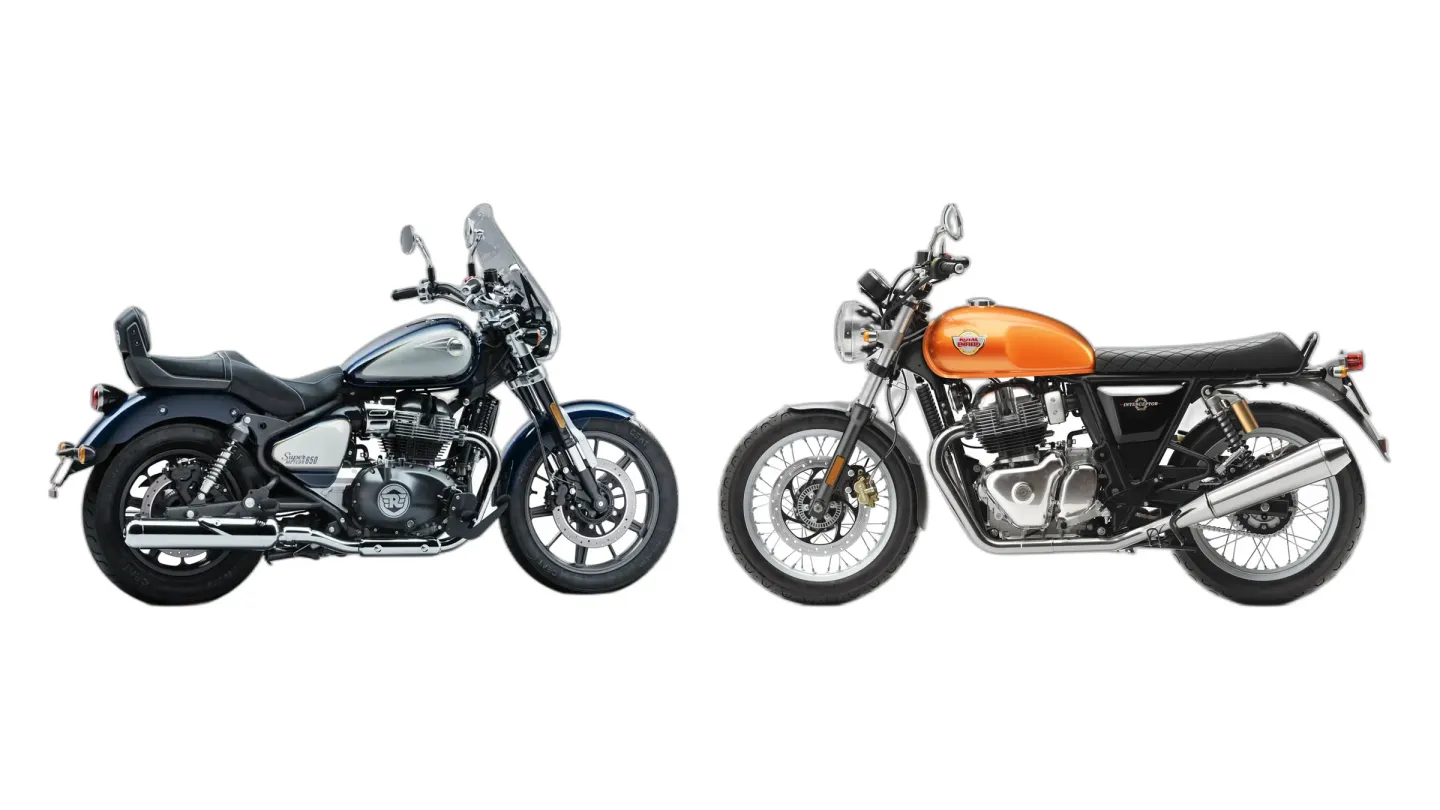
At a stoplight, the Royal Enfield Super Meteor 650 doesn't leave your boots hunting for pavement. On the Royal Enfield Interceptor 650, you're up on your toes. It rocks back upright with less heft to haul.
So which one do you buy?
The Interceptor 650 has the edge if…
Daily commuting & city riding
Narrow edge: Interceptor 650
Your daily ride leans slightly toward the Interceptor 650. It's down to lighter steering. Fit and price can easily outweigh that.
What makes each one tick
Super Meteor 650
Down low in the revs, the Super Meteor's twin pulls hard and doesn't shake the bars. There's no lurch when the throttle opens, only a smooth shove. At a crawl the bike feels cumbersome, and in corners the pegs and exhaust scrape early.
Interceptor 650
With its odd firing order, the Interceptor's twin pulses unevenly and punches hard in the middle revs. The engine isn't snappy. On the Blue Ridge Parkway, its stout pull and relaxed nature invite a lazy rhythm. The off-beat twin keeps thumping along.
The Voice of Experience

What actually separates them
- The Super Meteor 650 has the lower seat: 29.1 in (740 mm) vs 31.7 in (806 mm).
- The Interceptor 650 has the lower wet weight: 470 lb (213 kg) vs 531 lb (241 kg).
- The Super Meteor 650 has the larger fuel tank: 4.1 US gal (15.6 L) vs 3.6 US gal (13.7 L).
Which one for the way you ride
Comfortable long-distance riding
Neither one fits
Big miles aren't where either one shines. You'll be watching for the next rest stop.
A confidence-building first motorcycle
Not built for it: Super Meteor 650
Leave the Super Meteor 650 for your second or third bike. It's too much to learn on.
Sporty riding on twisty roads
Not built for this
Canyon roads don't bring out the best in either bike. Cruise them, don't race them.
Nothing splits them on running costs. Ride both back to back and the decision usually makes itself.
Who each one is built for
What's good, and what you'll live with
Super Meteor 650
What owners say
Strengths
- Classic cruiser styling with modern finish
- Excellent value for money
- Torquey, unstressed engine
Trade-offs
- Heavy for its engine size
- Budget switchgear and no tachometer
- Limited ground clearance
Interceptor 650
What owners say
Strengths
- Torquey and characterful parallel-twin
- Classic, timeless styling
- Outstanding value for money
Known problems to check before you buy
Super Meteor 650
- Sixth gear engagement difficulty A few riders note that engaging sixth gear can be notchy, especially when the engine is cold, occasionally resulting in false neutrals or dropping back to fifth.
Interceptor 650
- Brake caliper corrosion (recall SC-14) Recall 21V045000 Non-anodized calipers can corrode when exposed to road salt, causing brake drag or reduced performance. Royal Enfield recalled 2018-2020 models to replace front and rear calipers with anodized units.
- Rectifier-regulator failure The rectifier-regulator unit malfunctions, causing battery drainage, blown relay fuses, and warning lights on the instrument cluster.
What they cost used
These prices compare a 3-year-old Super Meteor 650 with a 3-year-old Interceptor 650.
- Super Meteor 650
- about $5,300
- Interceptor 650
- about $4,300
At three years old, the Super Meteor 650 sits around $5,300 while the Interceptor 650 lands near $4,300. That's a $1,000 gap in the Interceptor's favor. These are US market estimates, not live listings.
What they share
- Displacement
- 648 cc
- Engine
- Parallel twin
- Cooling
- Air/oil-cooled
- Torque
- 39 lb-ft (52 Nm)
- Gearbox
- 6-speed
- Final drive
- Chain
Where the spec sheets split
| Super Meteor 650 | Interceptor 650 | |
|---|---|---|
| Seat height | 29.1 in (740 mm) | 31.7 in (806 mm) |
| Wet weight | 531 lb (241 kg) | 470 lb (213 kg) |
| Super Meteor 650 | Interceptor 650 | |
|---|---|---|
| Power | 47 hp (35 kW) | 48 hp (35 kW) |
| Peak power at | 7,250 rpm | 7,150 rpm |
| Peak torque at | 5,650 rpm | 5,250 rpm |
| Super Meteor 650 | Interceptor 650 | |
|---|---|---|
| Fuel economy | 55 mpg (US) / 4.3 L/100 km | 56 mpg (US) / 4.21 L/100 km |
| Fuel capacity | 4.1 US gal (15.6 L) | 3.6 US gal (13.7 L) |
| Super Meteor 650 | Interceptor 650 | |
|---|---|---|
| Front tire | 100/90-19 | 100/90-18 |
| Rear tire | 150/80-16 | 130/70-18 |
What comes fitted, what costs extra
| Super Meteor 650 | Interceptor 650 | |
|---|---|---|
| Smartphone Connectivity | Standard | Not offered |
Head to head, area by area
Both bikes on the same scale, one area at a time.