By NastyNils·
Motorcycle comparison · Adventure vs Scrambler
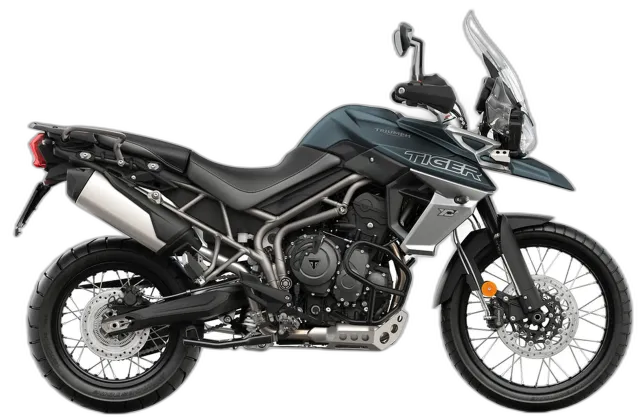
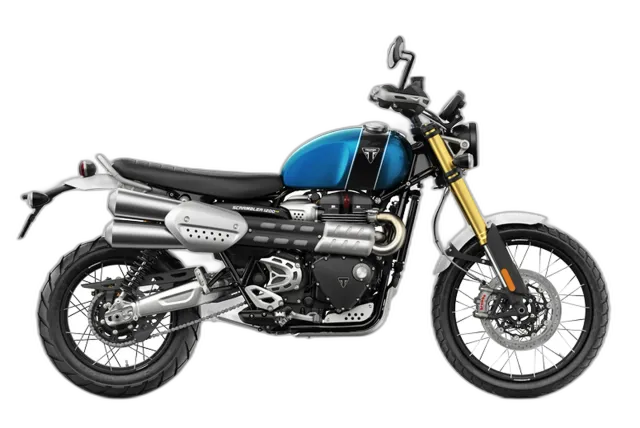
Triumph Tiger 900 (C701) vs Scrambler 1200 XC (DS01)
Triumph Tiger 900 vs Scrambler 1200 XC: where they split, and which one to buy.
Rolling the throttle open off idle, the Triumph Tiger 900 thumps like a twin, then it's all triple up top. The Triumph Scrambler 1200 XC pulls from low revs to redline.
So which one do you buy?
Buy the Scrambler 1200 XC if…
Daily commuting & city riding
The pick: Scrambler 1200 XC
The Scrambler 1200 XC suits a daily commute clearly better. In traffic, it's simply less work.
Keeping running costs low
Clear winner: Scrambler 1200 XC
On running costs, the Scrambler 1200 XC pulls clearly ahead. It's the easier one to own on a tight budget.
Which one's the smarter buy
Two different jobs
These bikes sit in different classes, so there's no clear better buy for the money. The Scrambler 1200 XC costs less, but that doesn't make it the value winner.
What makes each one tick
Tiger 900
On the Tiger 900, the front wheel picks the bike: the cast-wheel GT stays a road machine, and the spoked Rally doesn't act like the same motorcycle once the trail starts. Mid-bend, the brake lever still slows it, since there's an IMU telling the ABS how far it's leaned. The seat's hard on long days. A flat on the Rally's sealed spokes just takes a plug.
Scrambler 1200 XC
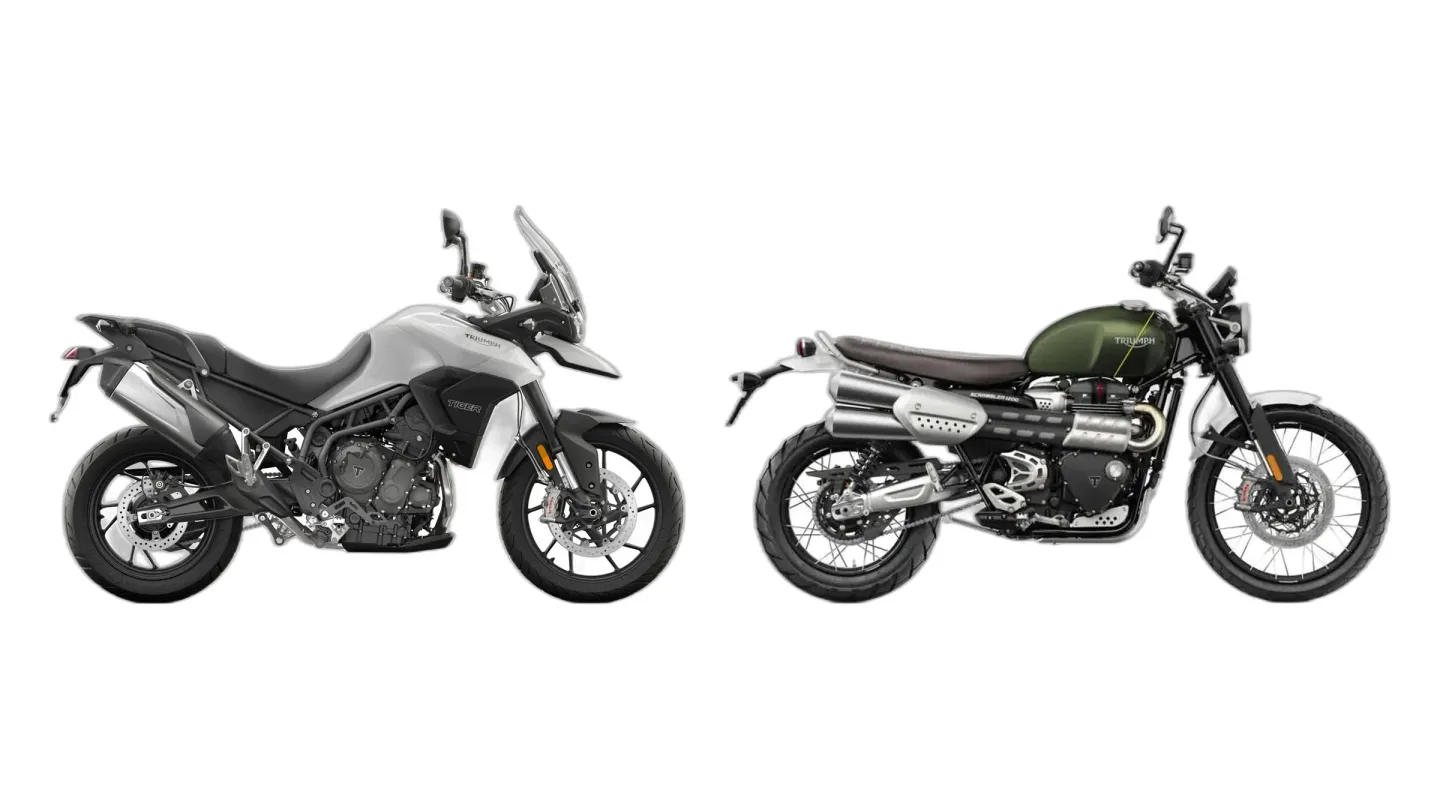
Gravel and fire roads don't faze the Scrambler 1200 XC, whose long-travel suspension keeps the tall spoked front tracking on mild single-track. There's torque aplenty low down, which keeps slow trail work easy. On the Blue Ridge Parkway, the tapered aluminum bar turns the big front wheel into each bend, and there's no slack in the steering.
The Voice of Experience

What actually separates them
- The Tiger 900 has the lower seat: 31.9 in (810 mm) vs 33.1 in (840 mm).
- The Tiger 900 has the lower wet weight: 472 lb (214 kg) vs 507 lb (230 kg).
- The Tiger 900 makes more peak power: 94 hp (70 kW) vs 89 hp (66 kW).
Which one for the way you ride
Comfortable long-distance riding
Not its job: Scrambler 1200 XC
Mile-munching sits outside what the Scrambler 1200 XC is for, so it sits out.
A confidence-building first motorcycle
No verdict: Scrambler 1200 XC
The Scrambler 1200 XC isn't a first bike. Learn on something gentler and come back to it later.
They come out level on twisty roads. The better-kept used example is the smarter money.
Who each one is built for
What's good, and what you'll live with
Tiger 900
What owners say
Strengths
- T-plane engine character
- Brembo Stylema front brake performance
- Clear variant differentiation (road vs. off-road)
- Strong electronics package on Pro variants
- Tubeless spoked wheels on Rally / Rally Pro
Trade-offs
- Handlebar vibration at highway speed
- Hard seat on long days
- Wind buffeting at the helmet
Scrambler 1200 XC
What owners say
Strengths
- Confident, stable on-road handling
- High standard equipment level
- Surprisingly capable off-road performance
- Torque-rich engine with broad, flexible powerband
Known problems to check before you buy
Tiger 900
- Engine stalling on 3rd-to-2nd downshift or low-rpm clutch-up, particularly in Rain mode Stalling reported on closed-throttle downshifts and at low-rpm clutch-up, more frequently in Rain ride mode (different fuel map). Anti-stall logic occasionally fails to intervene; some cases require dealer ECU reflash.
- Rear brake caliper sticks; pads and disc overheat Rear caliper sticks; disc and pads overheat after relatively short rides; weak pad-spreader spring identified as a recurring cause; pads wear quickly. Resolved by caliper rebuild and spring replacement.
- Front brake disc warping with judder under braking Pulsing / judder felt through the front brake lever and bars under braking. Some owners measure runout exceeding the factory limit, with one detailed report citing a significant amount at 7,500 mi (12,000 km). The judder can return after disc machining, suggesting heat-cycle sensitivity rather than mounting issues. Multiple fleet operators report all bikes returning under warranty for warped discs.
- Intermittent no-start due to faulty right-side switch block Pressing the start button does not prime the fuel pump or initiate cranking. Right-side switch block recognised by Triumph dealers as a known faulty assembly; full switchblock replaced under warranty.
- Quickshifter intermittent or fails after wet conditions or pressure-washing The shift-rod sensor on the up/down quickshifter is sensitive to water ingress; quickshifter becomes intermittent or non-functional. Heat-related intermittents reported separately. Multiple replacements under warranty are common (one detailed report cites three replacements within 2,750 miles). Affects only `[GT-Pro]` and `[Rally-Pro]` (variants with Triumph Shift Assist standard).
- TFT display corruption or failure after water exposure TFT shows blue or hexadecimal corruption in heavy rain; in some cases the dash becomes loose due to faulty mounting screws. Recovery after drying is possible but not consistent — replacement under warranty is common. Affects the 7-inch TFT fitted to all marketed variants.
- Bluetooth module pairing unresponsive or unstable The Bluetooth module on Pro variants sometimes ships not enabled, or the pairing menu is unresponsive; iOS pairing requires two simultaneous Bluetooth connections (music and navigation) which is fragile. Dealer-side software fixes (including VIN-entry corrections in the ECU) are commonly required. Affects only `[GT-Pro]` and `[Rally-Pro]`.
- Front fork seal leaks at relatively low mileage Left fork seal leaks reported at relatively low mileage; Triumph treats as a wear item rather than warranty. Dust/sand ingress accelerates the failure; aftermarket fork-leg protectors can in some cases trap debris and worsen the problem.
- TPMS false low-pressure warnings and sensor battery failures Tight pressure tolerances trigger low-pressure warnings even at correct cold pressures (warnings reported at 39–44 PSI). Sensor battery failures reported after several years of use. TigerTool reset sometimes works; aftermarket 433 MHz-compatible sensors are now available as out-of-warranty replacements. Affects only `[GT-Pro]` and `[Rally-Pro]`.
- Oil seep at alternator-cover wire-harness exit Engine oil seeps from the alternator/stator cover at the point where the wire harness exits, travelling down the cable and pooling at the connector. Triumph has issued a redesigned cover as a service replacement. Generally addressed under warranty as a good-will repair. Cross-platform Triumph issue but documented for the Tiger 900 specifically.
- Heated grips heat briefly then shut off; switch unresponsive Grips heat for a few seconds then shut off; control switch becomes unresponsive. Common cause is a chafed positive wire at the bar exit; fuse #4 (10A) protects the circuit.
- Water condensation builds inside indicator lenses Condensation accumulates inside all four indicator lenses after rain or pressure-washing; lens seal weak with no weep hole. Cosmetic but consistently reported; some dealers replace under warranty.
Scrambler 1200 XC
- Cracked frame at kickstand mount Reports of the frame cracking near the kickstand bracket; potentially caused by vibration or overloading, and can compromise structural integrity.
- Radiator fan bracket failure The bracket holding the radiator fan can snap, leading to the fan loosening or detaching; may cause overheating if not addressed.
- Chain adjuster bolts seizing Chain adjuster bolts are prone to corrosion and seizing, making chain tension adjustments difficult and potentially requiring bolt replacement.
What they cost used
These prices compare a 6-year-old Tiger 900 with a 6-year-old Scrambler 1200 XC.
- Tiger 900
- $9,500
- Scrambler 1200 XC
- $8,500
At six years old, the Triumph Tiger 900 sits around $9,500 while the Triumph Scrambler 1200 XC lands near $8,500. That's a $1,000 gap in the Scrambler's favor. These figures come from earlier US market records, not live listings.
What they share
- Cooling
- Liquid-cooled
- Gearbox
- 6-speed
- Final drive
- Chain
- Front brake
- 320 mm
- Rear tire
- 150/70-17
Where the spec sheets split
| Tiger 900 | Scrambler 1200 XC | |
|---|---|---|
| Seat height | 31.9 in (810 mm) | 33.1 in (840 mm) |
| Wet weight | 472 lb (214 kg) | 507 lb (230 kg) |
| Dry weight | 428 lb (194 kg) | 452 lb (205 kg) |
| Tiger 900 | Scrambler 1200 XC | |
|---|---|---|
| Displacement | 888 cc | 1200 cc |
| Engine | Inline-three | Parallel twin |
| Power | 94 hp (70 kW) | 89 hp (66 kW) |
| Peak power at | 8,750 rpm | 7,400 rpm |
| Torque | 64 lb-ft (87 Nm) | 81 lb-ft (110 Nm) |
| Peak torque at | 7,250 rpm | 3,950 rpm |
| Top speed | 127 mph (205 km/h) | 124 mph (200 km/h) |
| Tiger 900 | Scrambler 1200 XC | |
|---|---|---|
| Fuel capacity | 5.3 US gal (20 L) | 4.2 US gal (16 L) |
| Tiger 900 | Scrambler 1200 XC | |
|---|---|---|
| Front tire | 100/90-19 | 90/90-21 |
| Wheelbase | 61.3 in (1556 mm) | 60.2 in (1530 mm) |
| Ground clearance | 8.3 in (210 mm) | 6.7 in (170 mm) |
| Rear travel | 6.7 in (170 mm) | 7.9 in (200 mm) |
What comes fitted, what costs extra
| Tiger 900 | Scrambler 1200 XC | |
|---|---|---|
| Cornering ABS | Standard | Not offered |
| Electronic Suspension | Option | Not offered |
| Manually Adjustable Front Suspension | Not offered | Standard |
| Quickshifter | Option | Not offered |
| Tire Pressure Monitoring (TPMS) | Standard | Option |
| Adjustable Windscreen | Standard | Not offered |
| Adjustable Seat Height | Standard | Not offered |
Head to head, area by area
Both bikes on the same scale, one area at a time.