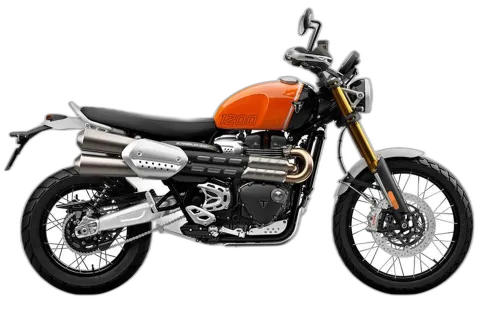


Triumph Scrambler 1200 XE (DS01) — Scrambler
NastyNils / Triumph Press

2019–2020 · Scrambler · Buyer's Guide

Scrambler 1200 XE (DS01)

Scrambler That Actually Delivers

The Machine's Character

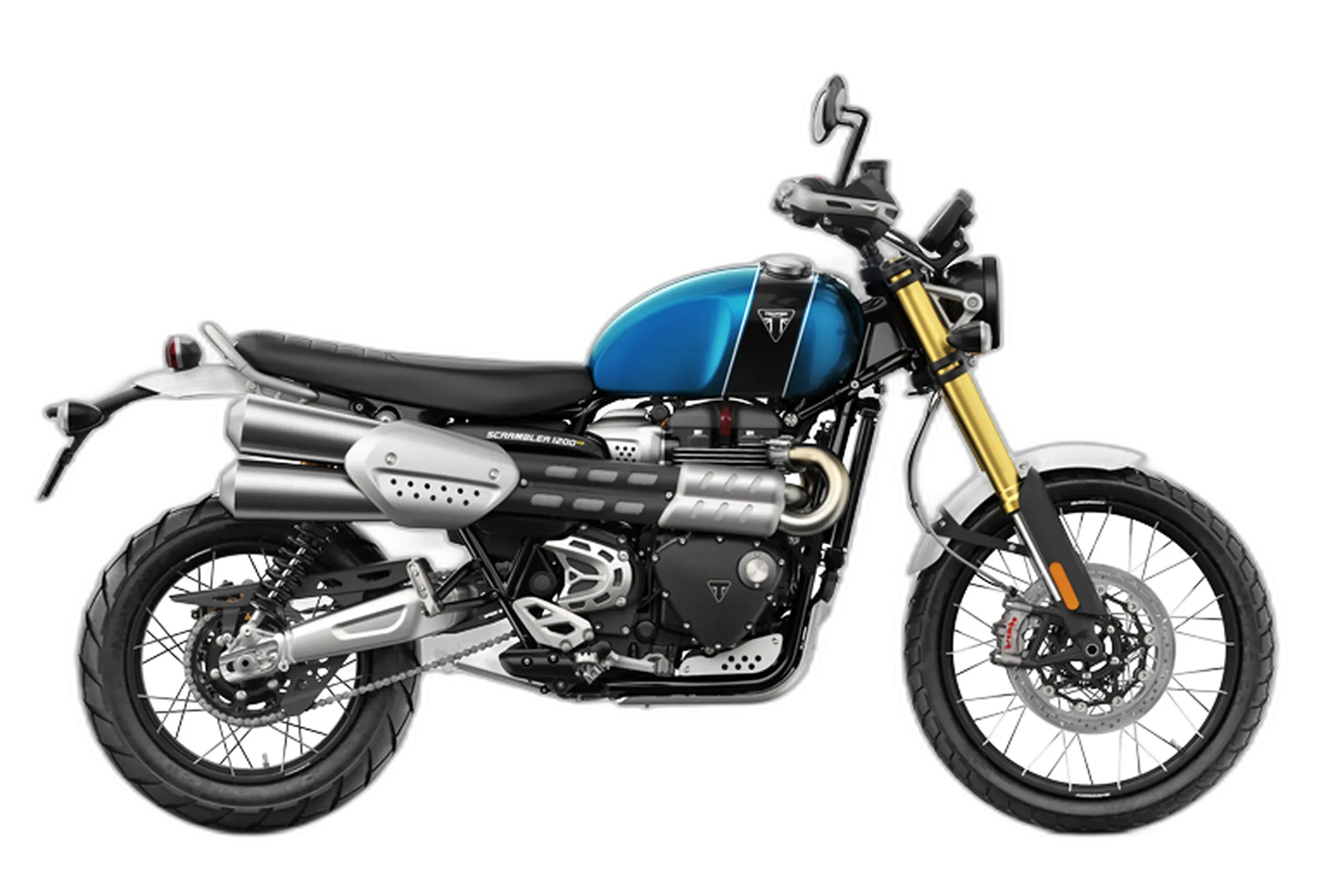
The XE is the version that finally let a big scrambler mean it off-road. Triumph stretched 9.8 inches (250 mm) of travel into both ends, hung fully-adjustable Öhlins shocks off the back, and wrapped the whole thing in a six-axis IMU running six ride modes, including a dedicated Off-Road Pro setting that hands you full control. The 1,200cc parallel twin makes 89 hp and a thick 81 lb-ft, tuned to pull from low in the range where loose surfaces actually live. It looks like a showpiece and carries the hardware most scramblers only imply.

It rides like a premium object — every switch, every weld, every piece of suspension reads like someone cared, and that quality holds up the longer you own it. But this is a 456 lb machine with a 34.3 inch (870 mm) seat and a tall, torquey character, and it asks for a rider who can manage all three. If you're coming back after a layoff or still building seat time, there are friendlier options wearing the same badge. Earn it, and the XE gives you a span from freeway to field track that little else in its class can match.

Hard Numbers

Spec sheets don't ride bikes, but they set the baseline.

Show full specs & equipment Hide specs & equipment
Key specifications
Power 89 hp (66 kW) @ 7,400 rpm
Torque 81 lb-ft (110 Nm) @ 3,950 rpm
Displacement 1200 cc
Engine Parallel twin
Bore × stroke 97.6 × 80 mm
Compression 11:1
Cooling Liquid-cooled
Fuel system EFI, ride-by-wire
Gearbox 6-speed
Final drive Chain
Frame Steel double cradle
Fork Upside-down (USD)
Front brake 320 mm
Rear brake 255 mm
Front tire 90/90-21
Rear tire 150/70 R17
Wheelbase 61.8 in (1570 mm)
Ground clearance 9.8 in (250 mm)
Front travel 9.8 in (250 mm)
Rear travel 9.8 in (250 mm)
Seat height 34.3 in (870 mm)
Wet weight 456 lb (207 kg)
Fuel capacity 4.2 gal (16 L)
Fuel economy 43 mpg (US)

Equipment check

Chassis

  • Front Suspension Adjustable Standard
  • Rear Suspension Adjustable Standard
  • Cruise Control Standard

Comfort

  • Heated Grips Optional
  • Luggage System Optional

Connectivity

  • TFT Display Standard
  • Smartphone Connectivity Optional
  • USB Charging Port Optional
  • Keyless System Standard

Drivetrain

  • Slipper Clutch Standard

Lighting

  • LED Headlight Standard

Safety

  • ABS Standard
  • Cornering ABS Standard
  • Traction Control Standard
  • Ride Modes Triumph Ride-by-Wire Throttle Maps Selectable ride modesRefined throttle response Standard

The Voice of Experience

Portrait of NastyNils

The test ride

Settle in and the 270-degree twin serves up that uneven, premium thump that never gets old. The riding triangle is the standout: open knee angle, wide bar, a seat you can forget about for a full day whether you're sitting or standing on the pegs. The side exhaust is the price of the look — it cooks your right calf in traffic, and shorts in stop-and-go are a genuinely bad idea. With no fairing the wind loads straight onto your chest at highway pace, and the pegs don't let you brace, so you slide back on the flat seat and lean into it. Lean on it hard on pavement and the long travel and wide bar bring a loose, supermoto-style physicality — communicative rather than surgical, with the pegs grazing tarmac sooner than the upright stance suggests. At a crawl, the high center of mass means slow maneuvering is something you actively work at.

Rated point by point — where it earns its keep

My own 0–100 score for this bike against the class, area by area — the marker on each bar is the class average.

The brake hardware is seriously overbuilt for a scrambler — the kind of caliper you'd expect on a track-focused sportbike. What makes it work is that Triumph matched it with a pad compound that lets you modulate precisely, so you can meter the bite finely. Grab a fistful, though, and the deceleration is brutal, with the chassis staying exactly where you put it.

Nothing in the package looks like a corner got cut. Backlit switches, a proper display, fine suspension hardware, quality brakes — the execution is thorough enough that the whole bike reads as genuinely premium the longer you look at it, and that impression holds up where it counts.

The riding triangle is what I keep coming back to. Standing or sitting, it doesn't fight you — the open knee angle and wide bar relax the upper body enough to forget about fatigue on road, and the same geometry lets you move around freely when the surface changes underfoot. Everything else is a series of consequences you have to accept. An hour in stop-and-go traffic and the exhaust cooks your right foot to where shorts are a genuinely bad idea; that's how the bike has to be built, not an oversight. The engine sits high and the seat follows, so at walking pace it turns unwieldy fast, especially if you can't flat-foot it. With no fairing the wind loads straight onto your chest at speed, and the pegs don't let you brace — sliding back on the flat seat and leaning in is the only move you've got. Weight, seat height, and engine character all add up to a bike that asks for experience, not one for rusty or new riders.

Here's what surprised me first: no fairing, no wind management, a stance this tall and this much travel, and yet at highway speed it never wanders or feels nervous. It just settles in, tracks straight, and lets you run. The Öhlins units turn potholes, curbs, and rough field tracks into non-events — you point, you go — and the reserves outlast your nerve. Hit a rough section with real commitment and the bang you're bracing for never comes. On pavement the chassis holds together at serious pace too, pegs grazing the asphalt as you get on the gas early. But it's no lightweight, and dirt physics remind you fast: lean into a fast gravel corner and it pushes wide. Push it hard on road and the front-end read goes vague, the long travel and wide bar bringing a loose, supermoto-style physicality. On steep descents the mass is always there, waiting for the moment you stop managing the front deliberately.

The torque is the whole story, and it's properly addictive. Pull out of a long uphill dirt corner on that low-end shove alone and going back to anything smaller feels like a step backward you didn't plan for. What I value just as much is how accessible it makes the off-road riding — you don't need to wind it out. Stay in a calm rev range, ride the torque, and the delivery stays smooth and predictable enough that riders still building their dirt skills can get the rear moving without it ever getting away from them.

This is where the XE earns its keep. Every component feels like someone actually cared when they specified it — there's no point where you sense a cost-cutting decision, and the detail work holds up in the saddle as well as the showroom. Better still, it delivers on both ends of its promise: blast down the freeway, then peel off onto a rutted dirt road without a second thought, where most bikes that look like this make you pick one. In technical terrain it shrinks around you in a way nothing else this large does, putting itself places you don't expect a heavy motorcycle to belong, with a cohesive quality feel through every input.

Two things will trip up the pragmatic buyer. The side-exit pipe looks right and sounds premium, but it eats into your freedom of movement and gets uncomfortably warm against your right calf even at moderate ambient temperatures — some riders simply won't get past it. And there's no quickshifter, which anyone stepping off a big-travel enduro will notice the moment they reach for a shift assist that isn't there.

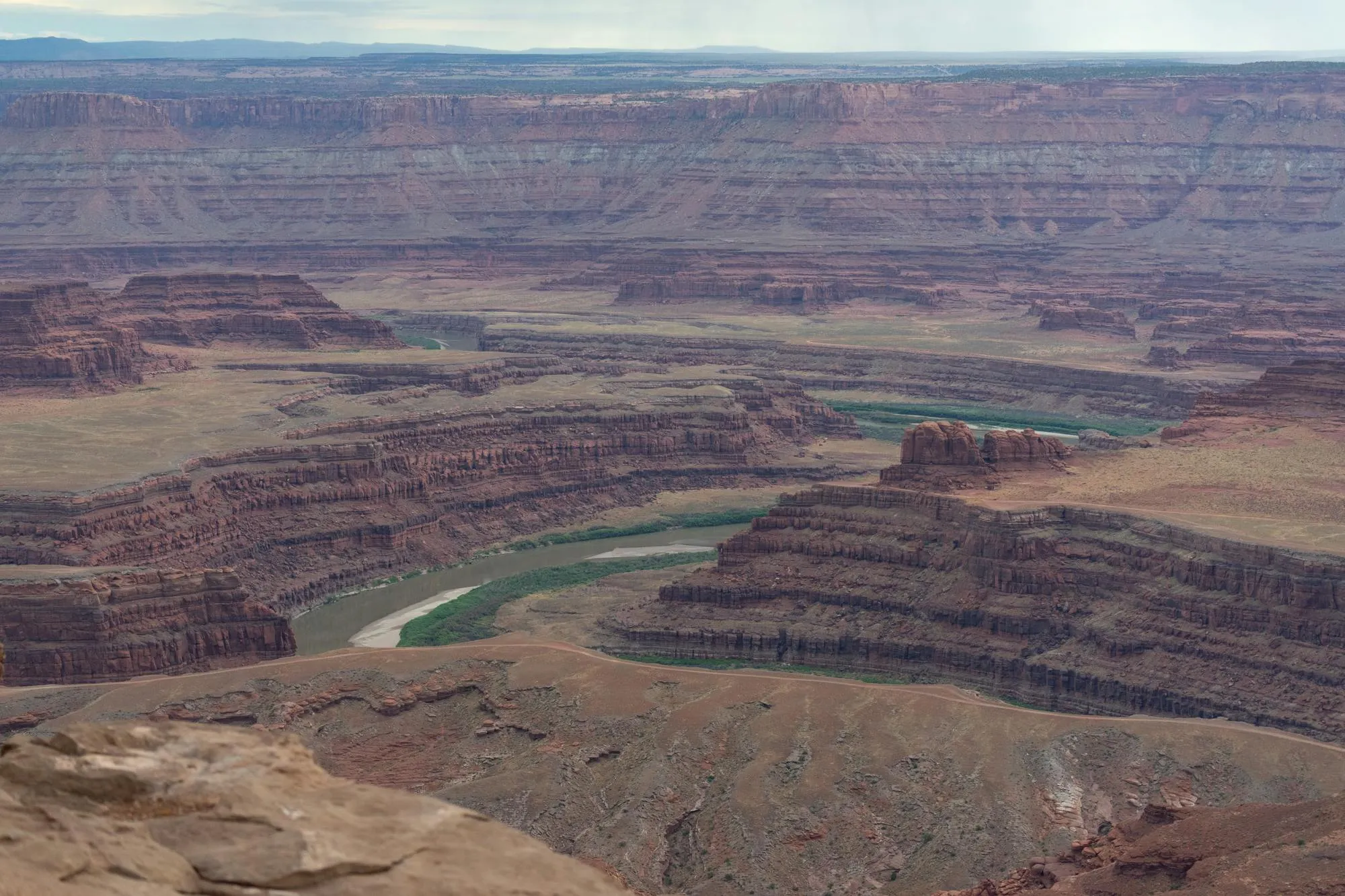
Aerial panoramic view of Dead Horse Point State Park near Moab, Utah. The Colorado River winds through deeply layered red-rock canyons and mesas characteristic of the high desert terrain. The arid landscape extends toward distant mountains under a partly cloudy sky. No motorcycle or rider visible. Daylight conditions, good visibility. Stock photograph by Drew Burks from Pexels.
Drew Burks / Pexels

The Truth on the Street

Two decades of reading the comments under our videos, following the forum threads, talking with owners at events, and answering the emails and messages riders send me directly have given me a clear read on this one. The pattern on the Scrambler 1200 XE is consistent: riders treat it as a genuine dual-purpose machine wrapped in hardware they trust, and the gripes cluster around its size and a few comfort compromises rather than anything fundamental.

The hardware riders keep praising

The praise lands hardest on the parts package. Riders consistently call out a combination they rarely find together at this level — Showa upside-down forks, fully-adjustable Öhlins rear shocks, and Brembo M50 front calipers — and the genuine off-road ability that pairing buys, which owners note no mainstream scrambler rival matched in its day. The six-axis electronics, with cornering ABS, cornering traction control, and six ride modes, come up often as something they actually use rather than spec-sheet filler. The 270-degree twin draws steady praise for a meaty midrange that pulls cleanly from low revs on road and trail alike. And a point that surfaces again and again from riders who take it off pavement: the standing position. The braced aluminium bar, wide rubber-mounted pegs, and flat bench seat make it easy to ride on the pegs over rough ground.

Where the size and comfort bite

The recurring gripes circle the bike's dimensions. The 34.3-inch (870 mm) seat draws the most comment — riders point out it sits noticeably taller than the XC's 33.1-inch (840 mm) perch and gets challenging for shorter riders, loaded or on uneven ground. Close behind is the weight: at 456 lb (207 kg) wet, owners find the mass shows itself in tight, technical terrain even with the off-road geometry helping. The high-mounted twin exhausts come up for the heat they throw onto the right leg in traffic and warm weather. On comfort, two patterns repeat: the naked styling leaves no wind protection for sustained highway runs, and many owners end up fitting an accessory screen; and the clutch pull is firm enough that stop-and-go traffic gets tiring despite the slip-assist.

Known issues

  • Clutch slave cylinder seal leak

    drivetrainoccasional

    Some owners report hydraulic fluid weeping from the clutch slave cylinder, sometimes causing soft lever or clutch slip; usually addressed under warranty with seal or unit replacement.

  • TFT display readability in direct sunlight

    electricscommon

    The full-colour TFT instrument can wash out in bright direct sunlight, particularly with the lighter display theme.

  • Headlight bracket / mounting vibration on rough surfaces

    bodyworkoccasional

    On heavy off-road or washboard surfaces, headlight assembly and surrounding brackets can develop loosened fasteners; routine torque checks recommended.

  • Spoke tension on tubeless wheels requires monitoring

    chassisoccasional

    The tubeless spoked wheels, while excellent for off-road use, can develop loose spokes after sustained rough riding; periodic spoke tension checks are recommended in the owner's manual.

  • Rear shock preload adjuster access difficult

    suspensioncommon

    The Öhlins piggyback shocks are fully adjustable but preload adjustment requires C-spanner and removal of side panels for proper access, complicating quick load changes.

The Expert Benchmark

Where this Triumph Scrambler 1200 XE pulls ahead of — or falls behind — its rivals on the numbers, and the typical bike in its class on character.

What kind of bike this is — character vs. the class

This bike Class average

The numbers vs the class

This bike Class average

The 'Should I Buy It?' Score

Forget spec-sheet bragging. Here's who the Scrambler 1200 XE is actually built for.

A scenic view of Angeles Crest Highway winding through rugged Southern California canyon terrain. Rocky mountainsides with golden earth tones frame the asphalt road with tight sweeping curves. Double yellow center line visible, sparse vegetation along the shoulders, clear blue sky with white clouds. Daylight, dry conditions. No motorcycle or rider visible. Iconic location for canyon-road enthusiasts.
Josh Sorenson / Pexels

Best retro motorcycle for road trips?

Your eye for classic style gets rewarded — this is a genuine showpiece with the character to back it. Just know it's a tall 456 lb machine, so plan your flat-foot stops and you've got one of the most distinctive road-trip bikes going.

Made for Acadia National Park · Austin / Handbuilt Motorcycle Show · Blue Ridge Parkway
Best cruiser for Sturgis?

Straight talk: this isn't a cruiser. You'll get the sound, the character, and the brand presence you want, but you sit tall and upright, not low and laid back. If that posture's a dealbreaker, this isn't your bike.

Made for A1A — Florida Atlantic Coast · Black Hills / Sturgis Rally Hub · Daytona Main Street / Bike Week

Best motorcycle for Texas Hill Country?

It carves the Hill Country harder than its looks suggest — pegs down, early gas. Push to the real limit and it turns loose and physical rather than surgical, but for spirited weekend miles with style, it fits.

Made for Austin / Texas Hill Country · Twisted Sisters · Austin / Handbuilt Motorcycle Show