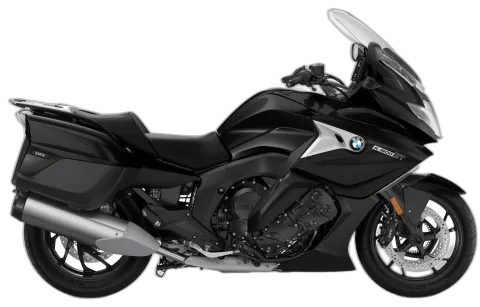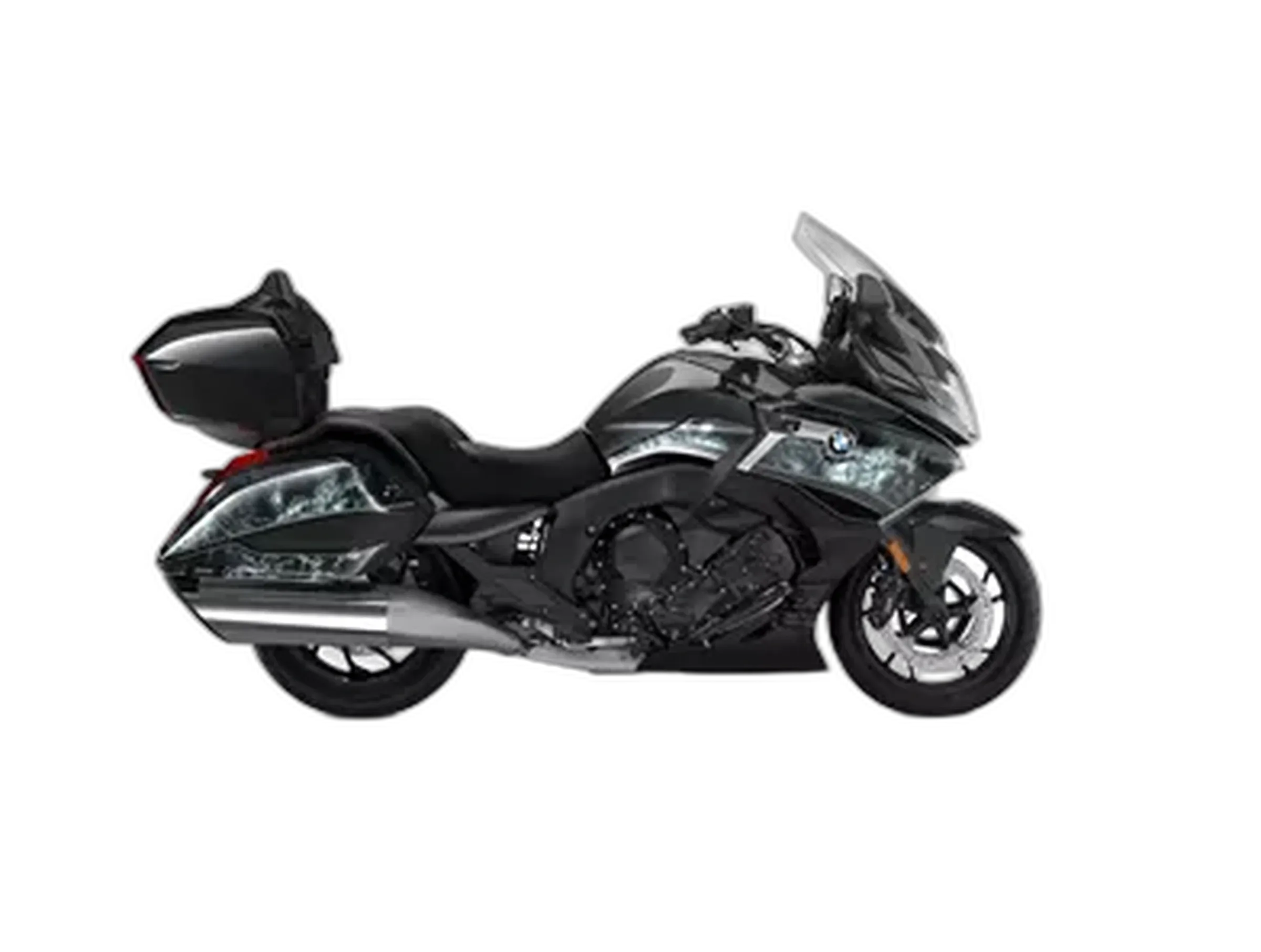
BMW K 1600 Grand America (MY2022) — Tourer
BMW Press

2022 · Tourer · Buyer's Guide

K 1600 Grand America (MY2022)

Six Cylinders, Zero Complaints

The Machine's Character

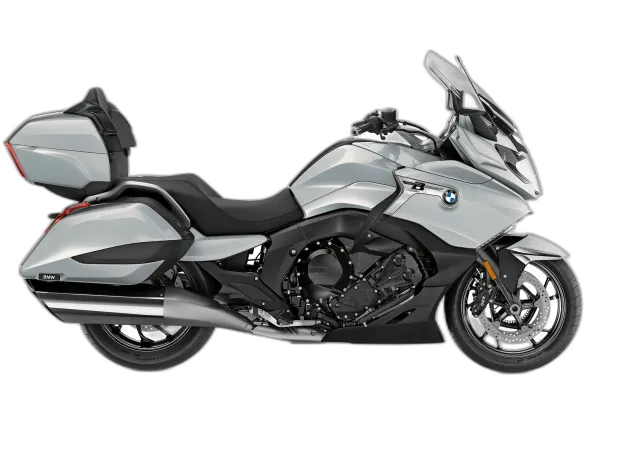
The K 1600 Grand America is built around an inline-six that makes 160 hp and 133 lb-ft from 1649 cc, and the point of that engine isn't the number. It's the way six cylinders erase the vibration that every other configuration leaves behind. Around it sits the full BMW touring apparatus: Duolever front end, Paralever shaft drive, BMW Dynamic ESA, Integral ABS Pro, and BMW Headlight Pro with adaptive cornering LED. The Grand America trim adds the top case with wraparound passenger backrest, so the second seat is a proper place to spend a day rather than an afterthought.

This is a two-up long-haul machine first, and it does that job about as completely as anything on two wheels. At 809 lb wet it never disguises its mass at a standstill, but rolling it carries the weight low enough that mountain roads stay enjoyable instead of becoming work. Owners who ride big weeks will get the most from it. The honest caveat: for a bike engineered around interstate miles, the wind protection leaves drafty patches no matter where you park the screen, and there's no adaptive cruise control on this trim.

Hard Numbers

Spec sheets don't ride bikes, but they set the baseline.

Show full specs & equipment Hide specs & equipment
Key specifications
Power 160 hp (118 kW) @ 6,750 rpm
Torque 133 lb-ft (180 Nm) @ 5,250 rpm
Displacement 1649 cc
Engine Inline-six
Cooling Liquid-cooled
Gearbox 6-speed
Final drive Shaft
Fork Duolever
Front brake 320 mm
Front tire 120/70-17
Rear tire 190/55-17
Wheelbase 63.7 in (1618 mm)
Seat height 29.5 in (749 mm)
Wet weight 809 lb (367 kg)
Fuel capacity 7.0 gal (26.5 L)

Equipment check

Chassis

  • Electronic Suspension BMW Dynamic ESA Realtime road adaptationAuto load leveling Standard
  • Front Suspension Adjustable Standard
  • Rear Suspension Adjustable Standard
  • Cruise Control Standard

Comfort

  • Heated Grips Standard
  • Adjustable Windscreen Standard
  • Electrically Adjustable Windscreen Standard
  • Luggage System Standard

Connectivity

  • TFT Display Standard
  • Smartphone Connectivity Standard
  • Navigation Standard
  • USB Charging Port Standard
  • Keyless System Standard
  • Tire Pressure Monitoring (TPMS) Standard

Lighting

  • LED Headlight Standard

Safety

  • ABS Standard
  • Cornering ABS BMW Integral ABS Pro Cornering brake safetyStronger consistent braking Standard
  • Traction Control Standard
  • Ride Modes Standard

Signature Tech

The named systems that set this bike apart — and what each one does for you.

Drivetrain

  • BMW Gear Shift Assistant Pro Optional
    • Clutchless riding
    • Seamless power shifts
    • Full throttle upshift
    • Auto blip downshift
  • BMW Paralever Standard
    • Acceleration stability
    • Brake dive control
    • High speed stability
    • Reduced unsprung rotating mass

Lighting

  • BMW Headlight Pro (Adaptive Cornering LED) Standard
    • Cornering light visibility

The Voice of Experience

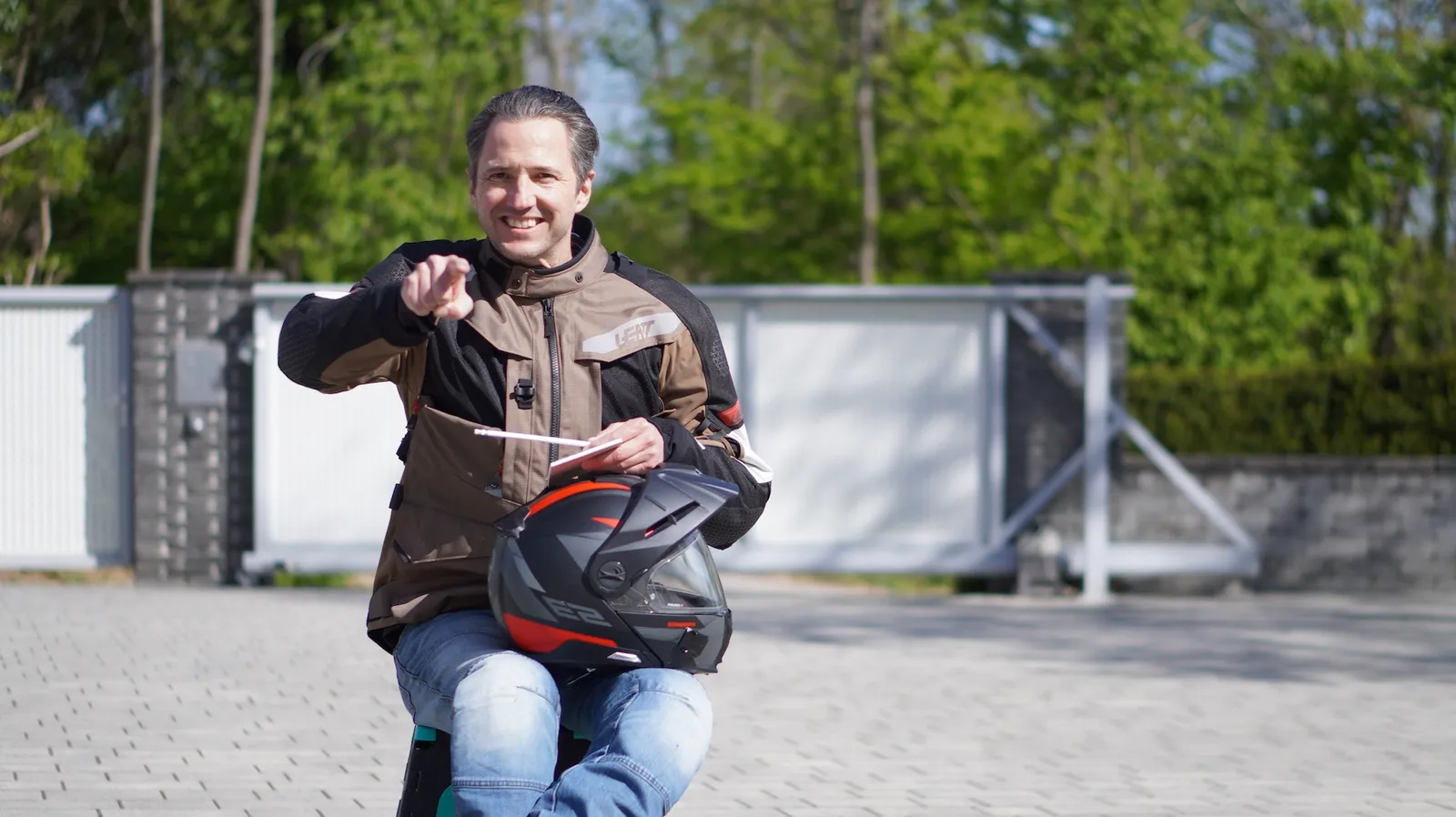
Portrait of NastyNils

The test ride

What stays with you is the absence of noise in the mechanical sense. Six cylinders in line means your hands and feet get almost nothing through the bars and pegs, just a low turbine hum under you that never becomes intrusive at any speed. The riding position is roomy and upright, the 29.5 in seat is reachable, and the reverse gear turns parking lots from a chore into a non-event. Seat and grip heating pull real warmth, with shortcut buttons that let you dial them without leaving the road with your eyes. The bike reads as enormous when you walk up to it, and the engine visually spills out past the frame, but the clutch has enough modulation to thread it through tight streets at walking pace. After dark, the switchgear goes completely unlit, which you notice on the first night stage.

Rated point by point — where it earns its keep

My own 0–100 score for this bike against the class, area by area — the marker on each bar is the class average.

Cold nights are where this bike quietly earns its keep. Seat and grip heating both run hot enough to change how a late run feels, and because the levels sit on their own buttons I never had to go hunting through a menu with the road moving under me. Size is the other thing you register immediately. The engine bulges out past the frame and nothing about the machine pretends to be compact, yet the clutch meters finely enough that walking pace through narrow streets becomes a question of aim rather than strength, and the reverse gear removes the one chore a bike this big would otherwise create. Against that, two things nag at me. However I set the screen, and the range is broad, some part of the airflow always found a way through on a long freeway run. And once it's dark, not a single switch lights up. Careful work in one place, none at all in another.

A single light pull is all the lever asks for, and there is plenty waiting behind it. I ran the pace well past what a bike like this normally sees, and the brakes never got flustered or turned vague on me as I leaned harder on them. Small effort at the hand, serious deceleration at the road. On a machine carrying this much, that combination counts for more than it would anywhere else.

Once it's rolling, the mass stops mattering. Turn-in is neutral, the suspension is properly sorted, and on a mountain road that usually catches touring bikes out I strung corner after corner together without working for it. The lines came out clean and repeatable rather than approximate. What I didn't expect was the clearance. It leans considerably further than a machine of this size has any business doing.

On paper that torque figure reads like something to treat carefully. In practice I could put it exactly where I wanted, delivered evenly and without a step anywhere in it, and spread wide enough that sixth gear coped with town speeds. The side effect is that it spoils you. I arrived at roundabouts in top because nothing ever complained, then had to grab two gears down to leave cleanly. That happened often enough to make an automatic sound like a reasonable idea.

I rode a hard mountain stage on it alongside riders who would normally pick something far sportier, and it came away with their respect. I won't dress it up as a canyon weapon, because it isn't one and never claims to be. What it does is hold together when the road stops being easy, and for something built to cross states, that is the part I'd bank on.

What surprised me most here is how little of this equipment feels bolted on to fill a spec sheet. Traction control intervened the moment I got greedy with the throttle, handed back a clean correction, and never made a production of it. The connectivity package is the only one I've used that behaves as a single system rather than three parts fighting each other, right down to the cooled phone bay that keeps the device alive instead of letting it overheat and take your route app down partway through the day. Set it up at home; it rewards patience and punishes a rushed attempt in a parking lot. Night riding is where the lighting justifies itself, reading both lean and pitch so the road ahead stays where you need it, which makes other cornering systems look like gestures. Two things fall short. Cruise holds a speed and nothing more, and once the pace rises the speakers all but vanish. A helmet unit covers that second one.

Sunset over the Adriatic Sea near Primosten, Croatia. Golden hour light bathes calm water in warm tones, with a small sailboat on the distant horizon. Rocky vegetation frames the right foreground. Clear skies and gentle conditions.

The Truth on the Street

None of this comes from my own logbook. It is what owners have told me over the years: club nights, paddock conversations, and the messages riders send me unprompted. What comes back on this one is a picture with very little disagreement in it.

What owners talk about first

The engine is where nearly every conversation begins. Riders describe torque sitting there from just off idle, a pull that keeps building all the way through, and a sound they say nothing else in the class produces. The passenger seat follows close behind, with owners pointing to the backrest and the rear seat heating and rating that accommodation above anything they have traveled on. Handling draws its own surprise: precise steering, real stability, less bulk through the bends than the size implies. The big display and the rider aids get steady approval, with less heat behind it.

The two standing complaints

Two complaints come back repeatedly. The first is low-speed weight: riders say tight turnarounds and backing it out of a space take deliberate effort. The second is what it costs to keep. The valve clearance check gets described as an expense to schedule for, and the amount of electronics on the bike feeds the same line.

Known issues

  • Reverse gear control unit fire risk (recall)

    drivetrain common Recall

    The seal for the reverse gear control unit may deteriorate, allowing moisture ingress that can cause overheating and, in extreme cases, a fire. NHTSA recall 26V214000 covers certain 2017-2025 K 1600 GT, GTL and B and certain 2018-2025 Grand America units; dealers replace the reverse gear control unit free of charge.

The Expert Benchmark

Where this BMW K 1600 Grand America pulls ahead of — or falls behind — its rivals on the numbers, and the typical bike in its class on character.

What kind of bike this is — character vs. the class

This bike Class average

The shape of the BMW K 1600 Grand America — numbers and character vs. the average Tourer

Head-to-head: BMW K 1600 Grand America vs. its rivals

The Long-Haul Verdict

Forget spec-sheet bragging. Here's who the K 1600 Grand America is actually built for.

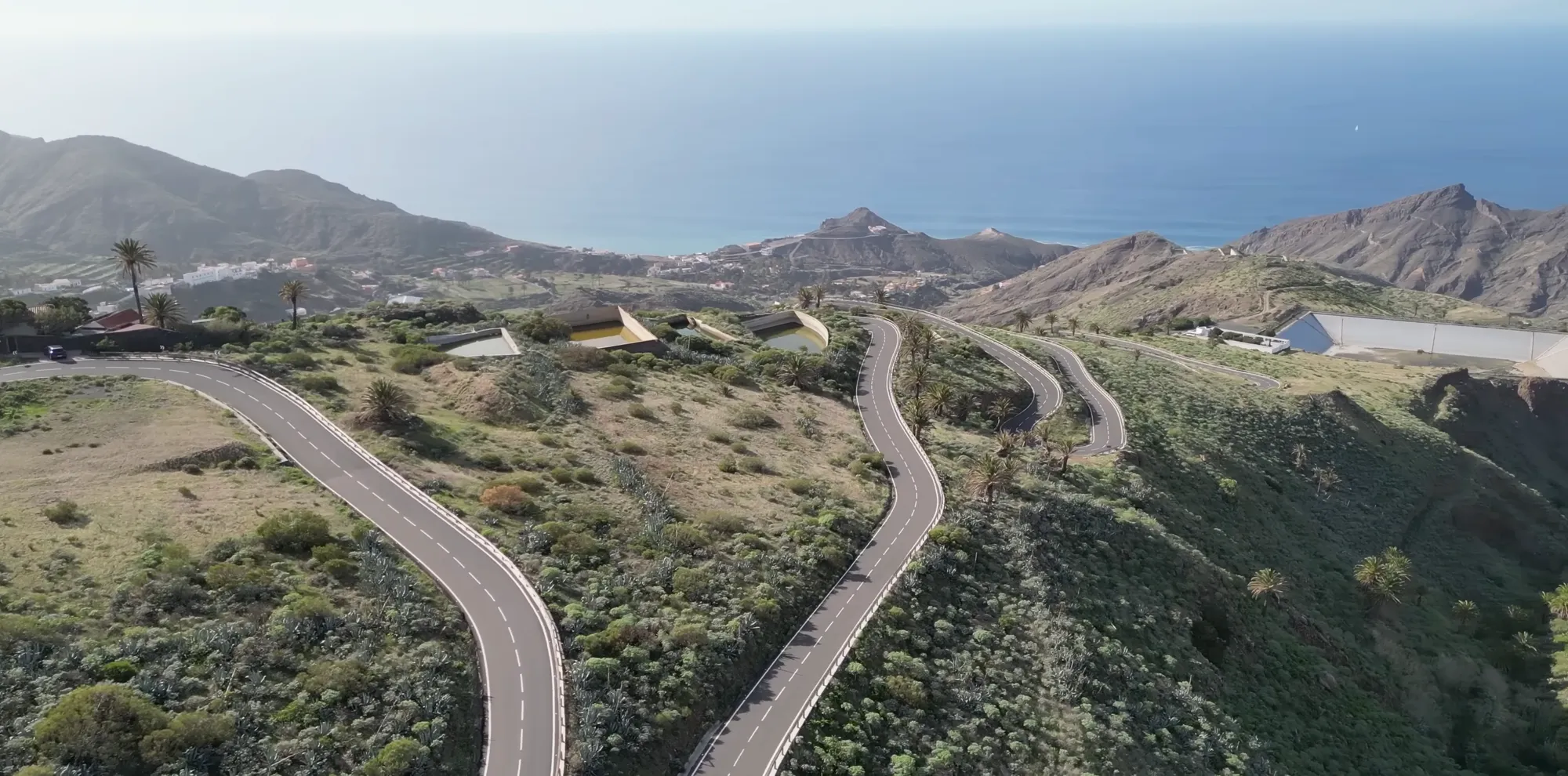
Aerial view of a winding asphalt road cutting through volcanic terrain on La Gomera, Canary Islands. The road curves through sparse green vegetation with rocky volcanic peaks visible in the background and a settled valley to the left. Clear lane markings, dry climate, partly cloudy sky.

Best touring motorcycle for long distance?

This is your bike. Trail Ridge, Going-to-the-Sun, Beartooth, loaded and two-up, and the passenger seat with its wraparound backrest is genuinely built for the whole day, not just the first hour.

Made for Beartooth Highway · Blue Ridge Parkway · Going-to-the-Sun Road
Best motorcycle for Highway 1?

It handles 200-400 mile days on Highway 1 or the Blue Ridge better than the size suggests, holding clean lines through corners. Accept the mass at parking speeds and it fits.

Made for Black Hills · Blue Ridge Parkway · Cherohala Skyway

Best cruiser for Sturgis?

It will carry you to Sturgis in more comfort than almost anything, but the inline-six sounds and feels nothing like the V-twin identity that usually pulls this crowd in.

Made for A1A — Florida Atlantic Coast · Black Hills / Sturgis Rally Hub · Daytona Main Street / Bike Week

What's new versus the previous generation

If you're cross-shopping the older generation, here's what changed.

BMW K 1600 Grand America (MY2018)

Previous generation · 2018–2020

BMW K 1600 Grand America (MY2018)

Six Cylinders, First-Class Silence

Compare to the previous model →

Alternatives to the BMW K 1600 Grand America

If this one isn't quite the fit, these are the bikes worth riding back-to-back against it.

Any price note compares both bikes at the same age — the youngest age both have on the used market — against this BMW K 1600 Grand America. “cheaper/pricier” is what that bike costs second-hand, not how worn it is.