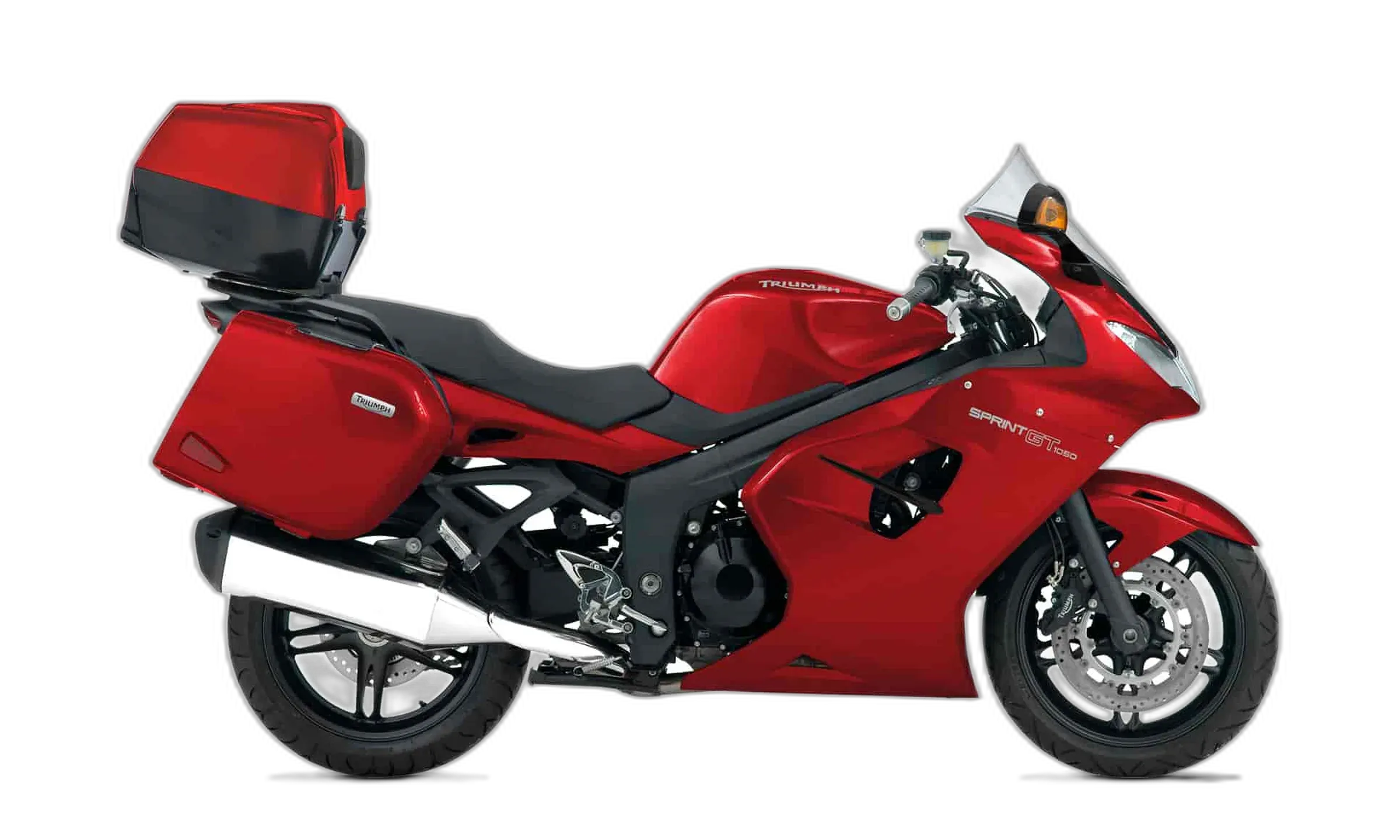


Triumph Sprint GT (MY2010-SE) — Sport Tourer
Triumph Press

2015–2016 · Sport Tourer · A variant of the Sprint GT

Sprint GT SE (MY2010-SE)

Differences between the standard Sprint GT and the SE

4 / 5 NastyNils Rating · against its class

The Hard-Case Triple Tourer

The Machine's Character

The Sprint GT SE is a sport-tourer built around Triumph's 1050 cc inline-three, and that engine sets the tone: 128 hp at 9,200 rpm and 80 lb-ft at 6,300 rpm, carried in an aluminum twin-spar frame with a single-sided swingarm. What sets this trim apart is how complete it is when you ride it out of the dealership. A luggage system, center stand, heated grips, adjustable suspension front and rear, and ABS all come standard, so the bike is ready to tour from day one. That's Triumph's character in practical form: a distinctive engine up front, real equipment behind it. Fully kitted!

Read the spec sheet and the job is obvious: big days on highways and back roads, with the luggage on and often a passenger behind you. The bike weighs 584 lb (265 kg) wet, carries 5.3 gal (20 L) of fuel, lists 40 mpg (US) and has a top speed of 160 mph (257 km/h). On paper, that weight is about stability under load rather than quick direction changes. Seat height is 32.1 in (815 mm), and both wheels are 17-inch, so the chassis stays road-focused. The rider this hardware points to covers serious miles and wants a triple doing the work. Long days, sorted.

Hard Numbers

Spec sheets don't ride bikes, but they set the baseline.

Show full specs & equipment Hide specs & equipment
Key specifications
Power 128 hp (96 kW) @ 9,200 rpm
Torque 80 lb-ft (108 Nm) @ 6,300 rpm
Displacement 1050 cc
Engine Inline-three
Cooling Liquid-cooled
Gearbox 6-speed
Front brake 320 mm
Front tire 120/70-17
Rear tire 180/55-17
Seat height 32.1 in (815 mm)
Wet weight 584 lb (265 kg)
Fuel capacity 5.3 gal (20 L)
Top speed 160 mph (257 km/h)
Fuel economy 40 mpg (US)

Equipment check

Chassis

  • Front Suspension Adjustable Standard
  • Rear Suspension Adjustable Standard

Comfort

  • Heated Grips Standard
  • Luggage System Standard

Safety

  • ABS Standard

What the Sprint GT SE Adds — Differences vs the Standard Sprint GT

The Sprint GT SE (MY2010-SE) builds on the standard Sprint GT: the upgraded hardware, the key spec changes and where its character shifts. The full ride, specs, scoring and verdict are all right here on this page.

Equipment the SE adds vs the standard Sprint GT

Now standard
Heated Grips
Sunset over the Adriatic Sea near Primosten, Croatia. Golden hour light bathes calm water in warm tones, with a small sailboat on the distant horizon. Rocky vegetation frames the right foreground. Clear skies and gentle conditions.

The Truth on the Street

Over the years I've heard a lot about the Sprint GT: in paddock conversations, in chats with owners on club nights, and in the emails and messages riders send me directly. Put together, the picture is consistent. Owners love the engine, the comfort and the used price. The gripes collect around the gearbox, the front brake and the steering.

The triple owners keep praising

Nearly every conversation starts with the engine. Riders describe the triple as smooth and tractable, with strong drive from low revs, a linear, free-revving top end and an exhaust note many call addictive. Owners also trust it. They report high mileage without major failures and say the simple electronics give them confidence. Few horror stories!

Room for two at a used price

Comfort comes up next. Riders mention plush suspension, a wide, well-cushioned seat, good wind protection and a relaxed position that lets them ride all day. Pillions get special praise: the passenger seat is roomy and well padded for a sport-tourer. Owners like the lockable, waterproof panniers because they're easy to use and hold a lot, and some add the optional powered topbox. Then there's the money. Depreciation has been steep, and owners consistently call a well-kept, low-mileage example a bargain: liter-bike performance for a fraction of what newer rivals cost.

Lazy steering, notchy shifts

The complaints are just as consistent. Handling tops the list: riders find the GT lazy on turn-in and reluctant to change direction on tight back roads, and those who know the Sprint ST say it has lost that bike's agility. Owners call the six-speed gearbox notchy and say it wants deliberate shifts. It rarely fails, but they feel the shift quality doesn't match the refined engine, and many find the clutch pull tiring in traffic. The front brakes are powerful, yet riders report a wooden initial bite and a long reach to the lever. You need a firm pull.

Known issues

  • Electrical issues (stator, sensors, wiring)

    electrics occasional

    Stator failures around 40,000 miles, occasional sensor faults, and wiring harness degradation (‘pudding cables’) have been reported, leading to charging system problems or erratic running.

  • Low-speed fuelling hesitation

    fuel system occasional

    Some owners experience hesitation and a snatchy throttle response at low rpm, especially during cold starts or with aftermarket exhausts. Stock tuning often resolves the issue.

  • Corrosion of rear hub and suspension linkages

    chassis occasional

    The rear hub and suspension linkage area is susceptible to corrosion, particularly on bikes used in winter conditions without regular cleaning.

  • Seized eccentric chain adjuster

    chassis occasional

    The single‑sided swingarm’s eccentric adjuster can seize if not regularly greased, making chain tensioning difficult. Preventive maintenance every 12,000–18,000 miles is advised.

  • Regulator/rectifier failures (less common than on ST)

    electrics rare

    Some owners report premature regulator‑rectifier failure causing charging system issues; the GT’s unit is improved over the ST, but occasional failures still occur.

The Expert Benchmark

Where this Triumph Sprint GT pulls ahead of — or falls behind — its rivals on the numbers, and the typical bike in its class on character.

What kind of bike this is — character vs. the class

This bike Class average

The shape of the Triumph Sprint GT — numbers and character vs. the average Sport Tourer

Head-to-head: Triumph Sprint GT vs. its rivals

The Long-Haul Verdict

Forget spec-sheet bragging. Here's who the Sprint GT is actually built for.

Aerial view of a winding asphalt road cutting through volcanic terrain on La Gomera, Canary Islands. The road curves through sparse green vegetation with rocky volcanic peaks visible in the background and a settled valley to the left. Clear lane markings, dry climate, partly cloudy sky.

Best motorcycle for Highway 1?

This is your best fit here: a strong triple, adjustable suspension and standard luggage built for 200 to 400 mile days of curves and scenery, without tipping into a full bagger.

Made for Highway 1 / Big Sur · Black Hills · Blue Ridge Parkway
Best motorcycle for Tail of the Dragon?

It works for your weekend runs to the twisties, with adjustable suspension and a strong triple. At 584 lb (265 kg), though, it's a tourer first and a tight-corner tool second.

Made for Tail of the Dragon · Back of the Dragon · Blue Ridge Parkway

Best touring motorcycle for long distance?

A strong match for long hauls, two-up or fully loaded: luggage, center stand and heated grips come standard for changing weather, and the triple's 80 lb-ft is there to carry the weight.

Made for Beartooth Highway · Blue Ridge Parkway · Going-to-the-Sun Road

What's new versus the previous generation

If you're cross-shopping the older generation, here's what changed.

Triumph Sprint GT (MY2010)

Previous generation · 2010–2016

Triumph Sprint GT (MY2010)

The Triple That Just Works

Compare to the previous model →

Alternatives to the Triumph Sprint GT

If this one isn't quite the fit, these are the bikes worth riding back-to-back against it.

Any price note compares both bikes at the same age — the youngest age both have on the used market — against this Triumph Sprint GT. “cheaper/pricier” is what that bike costs second-hand, not how worn it is.