

Yamaha Tricity 125 (SEC2) — Scooter
NastyNils / Yamaha Press

2014 · Scooter · Buyer's Guide

Tricity 125 (SEC2)

The Front That Never Lets Go

The Machine's Character

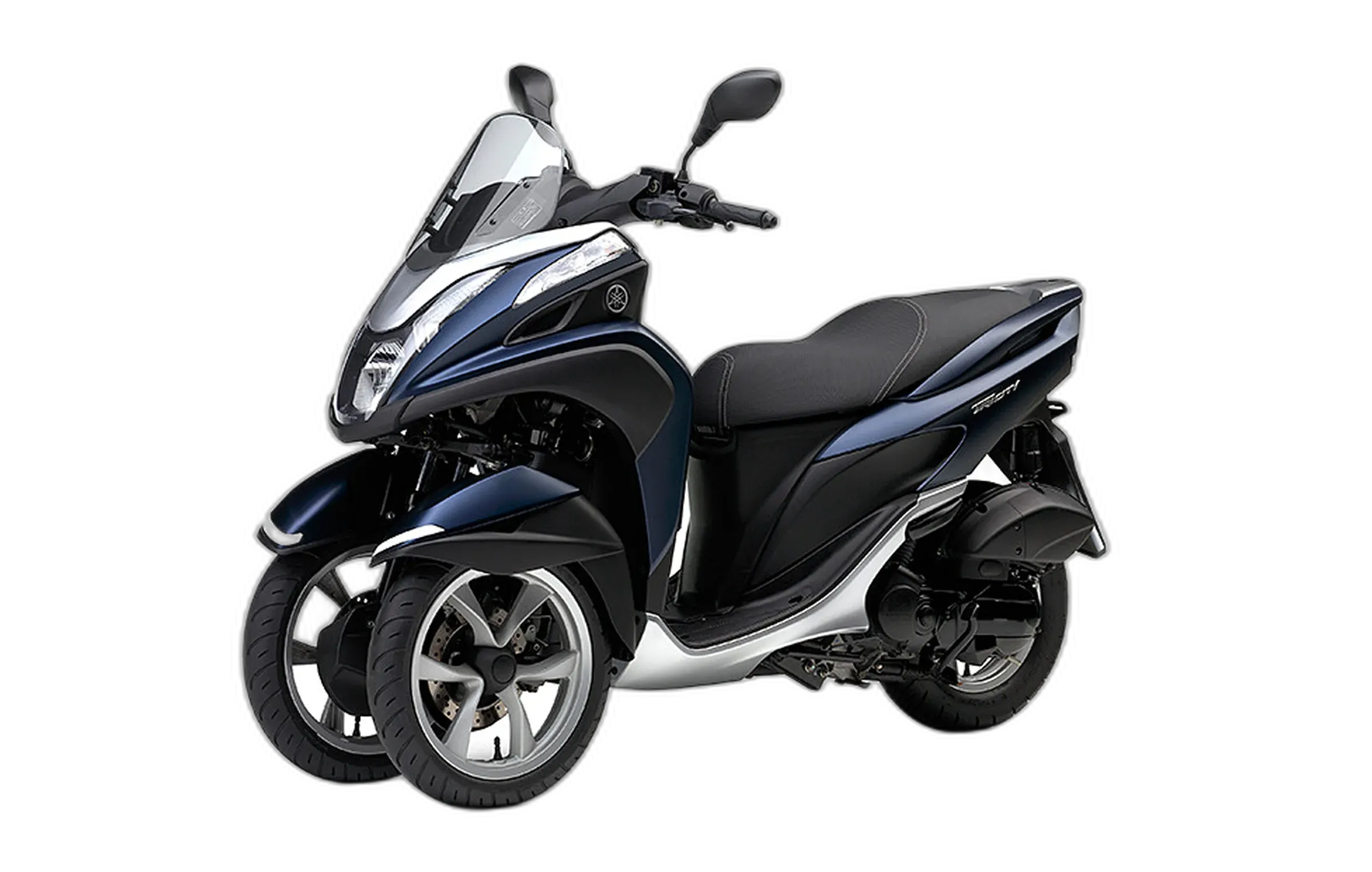
The Tricity 125 runs Yamaha's Leaning Multi-Wheel layout: two front wheels on a parallelogram linkage, each with its own telescopic fork, so the whole thing still leans and carves the way a scooter should. Underneath sits a liquid-cooled 125 cc single making 11 hp and 8 lb-ft through a CVT, tuned for smooth city pace rather than outright speed. ABS is standard. What you get is a compact urban commuter with far more front-end grip than the class norm, a low 30.7 in seat, and 79 mpg. It's a genuinely different answer to the daily-scooter question.

On the road that front grip changes how you ride in the wet and over broken pavement, and the confidence shows up fast. It's built for dense-city duty at 335 lb: easy to place, cheap to run, and honest about its limits. The 8 lb-ft motor is happy up to city speeds and then asks for patience. Push toward its 60 mph ceiling and the extra mass and wide nose blunt acceleration. Sharp hits like manhole covers reach your spine more than on a lighter scooter. Buy it for all-weather commuting and low stakes, not for covering big miles quickly.

Hard Numbers

Spec sheets don't ride bikes, but they set the baseline.

Show full specs & equipment Hide specs & equipment
Key specifications
Power 11 hp (8 kW) @ 9,000 rpm
Torque 8 lb-ft (11 Nm) @ 5,500 rpm
Displacement 125 cc
Engine Single-cylinder
Cooling Liquid-cooled
Fork Telescopic
Front tire 90/90-14
Rear tire 110/90-12
Seat height 30.7 in (780 mm)
Wet weight 335 lb (152 kg)
Fuel capacity 1.9 gal (7.2 L)
Top speed 60 mph (96 km/h)
Fuel economy 79 mpg (US)

Equipment check

Connectivity

  • TFT Display Standard
  • Smartphone Connectivity Standard
  • Keyless System Standard

Safety

  • ABS Standard

The Voice of Experience

Portrait of NastyNils

The test ride

Swing a leg over and the three-wheel nose looks like bulk, but the bars are no wider than any scooter in the class, so filtering feels normal from the first gap. Thread through stalled traffic with the visor cracked and it reads as riding, not chore-running. The broad front deflects spray off your feet and legs, and on gray, wet mornings this was the machine I kept reaching for out of a full test stable. Grit-covered corners, tram tracks, cobbles, wet crosswalks: you hold your line and stop picking your way across them. When the front does let go on a slick patch, you sit there and watch it gather itself back up. Newer riders squeeze the lever harder almost at once, because the stability quietly removes the fear that usually holds them back.

Rated point by point — where it earns its keep

My own 0–100 score for this bike against the class, area by area — the marker on each bar is the class average.

What the twin front does for braking is mental as much as mechanical. Grab a fistful on cobbles, grab it mid-corner, and the front holds where a normal scooter would protest. After a handful of hard stops you quit tiptoeing and start using the lever with genuine intent. I watched the same shift happen to cautious riders who normally won't fully commit: the stability quietly deletes the hesitation, and they're pulling real emergency effort from their very first attempt.

The practical case is almost boring to state and hard to poke holes in. It stayed in constant use straight through a wet, gray winter because the basics are covered: low stakes on a bad day, genuine all-weather ability, and a broad front that keeps road spray off your legs so light rain leaves you dry from the waist down. The one thing it asks back sits on the right side, where the wider front track costs you in a tight squeeze that a slim two-wheeler would clear without a second thought.

On three wheels the thing I kept testing was whether I could provoke it into letting go. I went looking for the limit on gravel, on greasy corners, on the slick stuff that normally has me backing off, and it simply held. The extra wheel doesn't hand you invincibility, but the cushion before anything starts to slide is real, and it takes a few rides to fully trust it. The steering underneath is pure scooter: it tips in on your input and comes back clean, and the only tell is a mild urge to correct your line in the first few corners of the day. Ride past that brief warmup and the sensation is gone. Give it a longer stretch of road and the third wheel stops registering at all, so you put the machine exactly where you want it without a thought for the hardware up front.

This is the one area where it asks you to take something in return. Sharp, sudden hits, a sunken cover or a drop-off at the edge of the lane, come through to your lower back more firmly than a conventional scooter of this size would pass along. On smooth or merely average roads none of that registers; it's only when the surface turns genuinely coarse that the damping runs short of patience. Add the optional windscreen and the weather side is effectively sorted, so a poor forecast no longer keeps it in the garage.

The motor is honest about what it is. Around town it's perfectly content and holds pace without fuss, but ask it for faster roads and you meet the wall quickly; keeping up on a real freeway run wants calm air or a flat, even road just to make headway, because the extra mass and the broad nose are more than this small engine can paper over. It's the slower starter, too. Line it up next to a standard 125 on clean tarmac and it lags off the line, and that deficit stays with you as the speed climbs.

Here's the part I didn't see coming. Nothing about a sensible three-wheeled scooter should translate into the feeling of actually riding a motorcycle, and yet moving through a packed morning commute on it does exactly that. It came into the fleet as the unsexy, practical pick, the one nobody chooses first, and within a few months it had quietly become the default; better-looking bikes stayed parked while people reached for this instead. What it can really do is best read in that reversal.

Elevated aerial view of Seattle's downtown skyline looking toward the city core along a dense urban street canyon. A mix of glass-and-steel skyscrapers and mid-rise residential towers fills the frame. A construction crane is active on the left. The street below carries light vehicle traffic flanked by mature street trees.
Josh Hild / Pexels

The Truth on the Street

None of this came off a spec sheet. I gathered it over years of listening: riders trading notes in parking lots, owners talking shop after a ride, and the steady run of messages that lands in my inbox. For the Tricity 125 the community keeps circling the same two poles, one warm and one sore.

What riders trust most

The praise clusters around the front end. Riders consistently describe the twin front as unusually sure-footed, holding its poise in the wet and over rough surfaces, steadying newer hands at low speed. Close behind, they credit the automatic drive with smooth, seamless pull that clears city traffic off the line, and they say the light steering makes filtering through gaps and tucking into a space almost effortless. Cheap running turns up nearly as often, with owners landing close to 79 mpg.

Where the grumbles start

The complaints run the other way. The recurring one is pace: riders say it strains to stay above roughly 60 mph, which turns a long haul on fast roads into hard work. Some push back on price, noting it costs more than a regular two-wheeled 125, and they wonder whether the added grip justifies paying up. A few say the front sits heavy on first acquaintance, a sense that eases once you settle into how it steers.

Known issues

  • Exhaust silencer rust

    exhaustoccasional

    The mild steel exhaust header and silencer can corrode, particularly on early bikes used through winter. Replacement parts are reasonably priced.

The Expert Benchmark

Where this Yamaha Tricity 125 pulls ahead of — or falls behind — its rivals on the numbers, and the typical bike in its class on character.

What kind of bike this is — character vs. the class

This bike Class average

Head-to-head: Yamaha Tricity 125 vs. its rivals

The 'Should I Buy It?' Score

Forget spec-sheet bragging. Here's who the Tricity 125 is actually built for.

Aerial photograph of downtown Austin, Texas, showing modern high-rise buildings against a clear blue sky. Urban infrastructure, highways, and parking structures visible in the foreground.
Thomas Balabaud / Pexels

Best scooter for NYC?

If your world is stop-and-go traffic, tight parking, and short hops in NYC or Miami Beach, this is close to ideal: cheap to run, easy to place, and steady when the roads turn wet or filthy.

Made for Austin · Los Angeles · Miami Beach / Miami

Best motorcycle for Bay Area?

For city runs and photogenic coffee stops it delivers, and the three-wheel grip flatters twisty back roads. Just know the 60 mph ceiling keeps the weekend ridge-road blast relaxed, not fast.

Made for Bay Area Ridge Roads · San Francisco / Bay Area · Skyline Boulevard / Alice's Restaurant