1987–2000 · Enduro · Buyer's Guide
TW200 (2JX)
Big Tires, Tiny Learning Curve
The Machine's Character
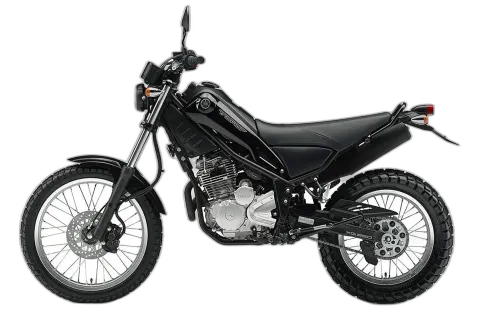
The TW200 built its whole identity around those oversized balloon tires, a 130/80-18 up front and a fat 180/80-14 out back that plant it on soft ground where skinnier bikes wash out. It leans on an air-cooled 196cc single making 16 hp, no radiator, no fuel pump, just a steel-cradle frame and a carburetor. At 278 lb wet with a 31.1-inch seat, it stays low and light enough that nobody feels outmatched swinging a leg over. This is honest, simple dual-sport hardware built to be understood and trusted rather than admired from a distance.
The TW rewards a slow, deliberate hand. It plonks happily along forest two-track and buzzes around town all day, and the reward comes from how little it asks of you rather than how hard it pushes. It ages the way a hand tool ages, and running costs stay low because there is so little to go wrong. Best suited to newer riders, campground explorers, and anyone who values reach-the-ground confidence over speed. The honest caveat: 16 hp and a 75 mph top speed mean sustained highway slabs are a chore, not a plan.
Hard Numbers
Spec sheets don't ride bikes, but they set the baseline.
Show full specs & equipment Hide specs & equipment
| Power | 16 hp (12 kW) @ 7,500 rpm |
|---|---|
| Torque | 11 lb-ft (15 Nm) @ 6,000 rpm |
| Displacement | 196 cc |
| Engine | Single-cylinder |
| Cooling | Air-cooled |
| Gearbox | 5-speed |
| Final drive | Chain |
| Fork | Telescopic |
| Front tire | 130/80-18 |
| Rear tire | 180/80-14 |
| Wheelbase | 52.8 in (1340 mm) |
| Ground clearance | 10.6 in (270 mm) |
| Front travel | 6.3 in (160 mm) |
| Rear travel | 5.9 in (150 mm) |
| Seat height | 31.1 in (790 mm) |
| Wet weight | 278 lb (126 kg) |
| Fuel capacity | 1.8 gal (6.8 L) |
| Top speed | 75 mph (120 km/h) |
The Truth on the Trail
For two decades I've kept an ear on what riders say about the TW200: the messages that land in my inbox, conversations in the paddock, and the long owner threads I read once the crowd moves on. The chatter is affectionate and consistent. People keep this bike because it asks so little of them, and they stay honest about where it falls short.
What owners keep coming back to
The praise clusters tightly. Riders describe a machine that shrugs off clumsy inputs and stays steady at a crawl, which is why so many hand it to newcomers without a second thought. Just as often they mention how a design left essentially untouched for years keeps parts easy to find and has let the styling settle into a quiet classic.
Where the complaints gather
The gripes are just as consistent. Braking draws the most talk: riders call the drums weak and vague, short on feedback, and say they want a firmer hand two-up or pointed downhill. The small tank comes up almost as often, cutting a day's exploring short before anyone's ready. Soft springs and a strained pace once the road opens up round out the usual list.
Known issues
-
Carburettor clogging and poor fuelling
The Teikei carburettor is prone to gumming from stale fuel, leading to hard starting, sputtering, and stalling. Regular cleaning and proper winter storage are essential. Many owners report recurrent issues after a few months of inactivity.
-
CDI ignition failure (early 2JX models)
The 1987–1989 TW200s had a unique AC-powered electrical system and a reputation for CDI unit failure. When the CDI dies, the engine cuts out abruptly and won’t restart. Later 2JX models received a more robust CDI, but replacement on early bikes is a known fix.
-
Soft suspension bottoming
The stock fork springs and shock are set for a lightweight rider or no cargo. Heavier riders or those carrying luggage experience frequent bottoming on modest bumps, compromising control.
The Expert Benchmark
Where this Yamaha TW200 pulls ahead of — or falls behind — its rivals on the numbers, and the typical bike in its class on character.
What kind of bike this is — character vs. the class
Head-to-head: Yamaha TW200 vs. its rivals
Power
Torque
Displacement
Wet weight
Top speed
Seat height
Alternatives to the Yamaha TW200
If this one isn't quite the fit, these are the bikes worth riding back-to-back against it.