
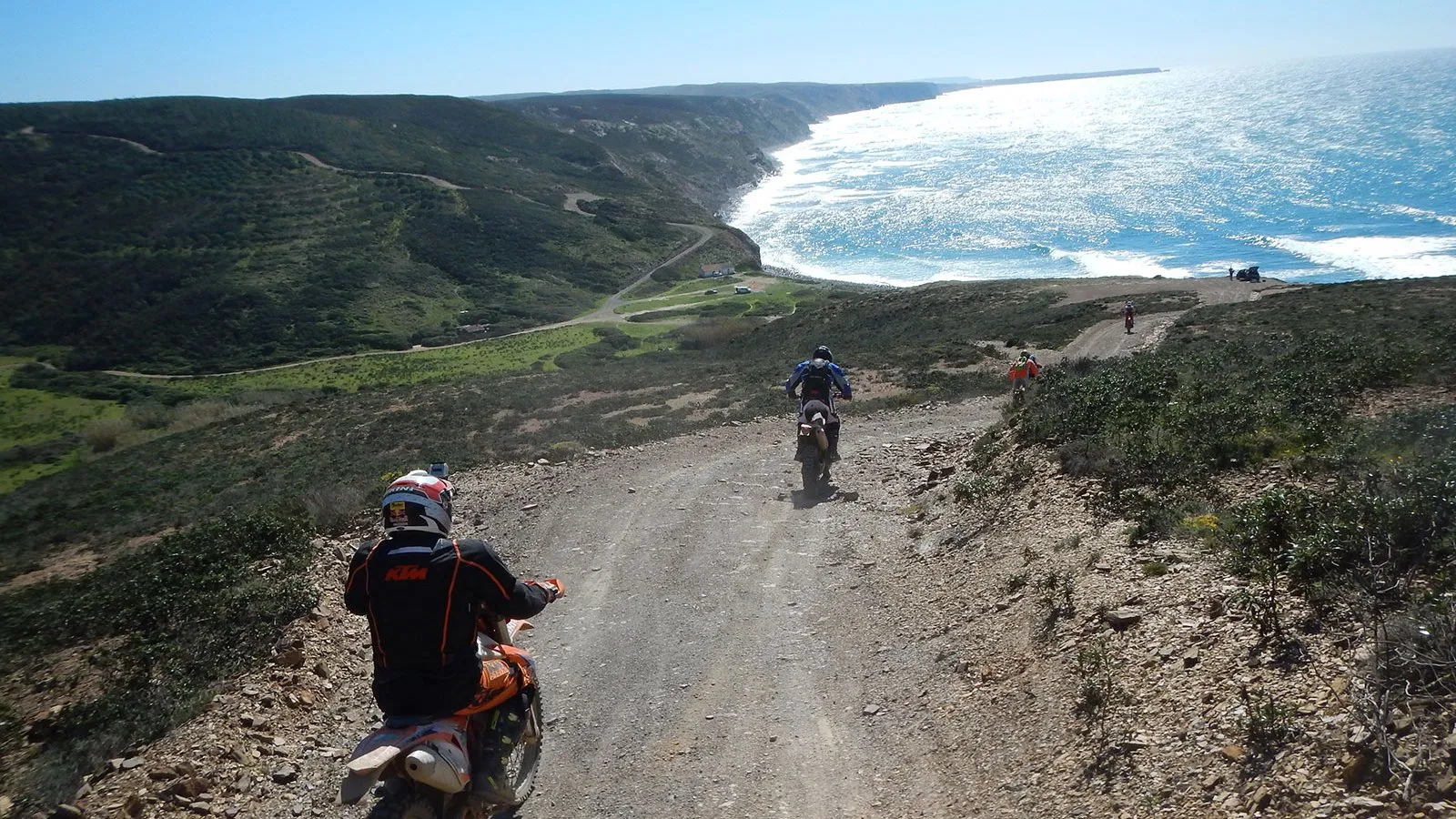
Every summer the Algarve’s south coast fills up, and from June through August the coastal roads are packed and often jammed. Point your front wheel at the hills behind it and the mood flips: quiet country, hardly any traffic. Truth be told, Portugal ranks among my favorite destinations anywhere in the world. Pleasant winters, intense nature off the tourist trail, and that mix of deep forest and rough Atlantic. So the real question is this: how much bite can a place this mild have?
Forest Above the Surf
The Algarve comes in three belts. The coast, the Litoral, runs along the sea. Behind it rolls the Barrocal, hilly limestone country with figs, almonds, carob, olives and holm oaks. Up north waits the Serra.
In the west rises the Serra de Monchique, the southwesternmost range on the Iberian Peninsula, with Fóia at about 2,960 feet, the Algarve’s highest point, and Picota at about 2,540 feet. Cork oaks, strawberry trees and rockrose share the slopes with pines, chestnuts and camellias, and since the 1970s large parts have been planted with eucalyptus. On a clear day Fóia hands you the whole map, from the Alentejo to Sagres and Faro.
In the northeast the Serra do Caldeirão stretches for roughly 43 miles as a schist ridge just under 1,940 feet high, all rounded domes, stream valleys and old cork forest. The bark gets stripped every nine to twelve years, and a fresh trunk glows red-brown, like the tree just stepped out of a sauna.
Then the edges. The west coast between the Alentejo and Sagres is protected as the Southwest Alentejo and Vicentine Coast Natural Park, one of Europe’s last wild coasts. At Cabo de São Vicente, the southwesternmost point of mainland Europe, the cliffs drop almost vertically about 245 feet into the Atlantic. North of the Algarve the Alentejo opens into the montado, a savanna-like pastureland under cork oaks, and in the east the Guadiana marks the border with Spain.
The Algarve’s DNA is a split personality with a long memory. It’s Portugal’s southernmost region, the country’s sunroom, and its name comes from the Arabic al-Gharb, “the west.” Over five centuries of Moorish rule shaped architecture, cooking and place names. Silves, then Xelb, was the Moorish capital, and its red castle counts as the finest Arab military architecture in Portugal. Look up at the farmhouses: the ornate white chimneys, the chaminés algarvias, once showed off the owner’s wealth, and no two were alike. Rooftop bragging rights. Portugal is also the world’s largest cork producer, with about a third of the world’s cork oak area, and riders call it an off-road paradise with countless tracks. Thanks to the mild winter, you can ride off-road here practically all year.
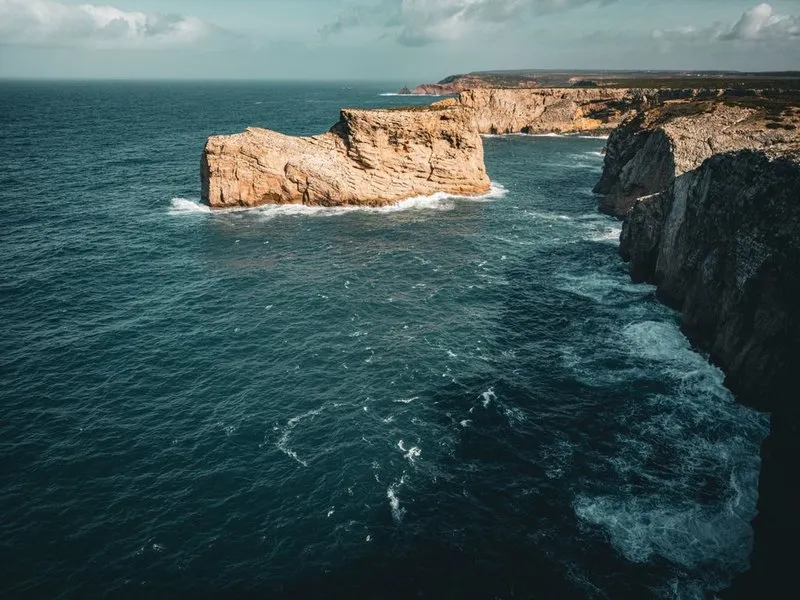
The Atlantic doesn’t do gentle here. Bring time to stop and stare.
Sand Clay and Donkey Paths
Away from the main roads, most Algarve tracks are easy sand, clay and gravel roads, often wide enough for a car, and an adventure bike handles them too. Between the wide stretches come short demanding spots. Sand. Riverbeds. Small water crossings. Mud. Around Vila do Bispo and Carrapateira the tracks follow the Atlantic on more sand and clay than gravel, right out to cliffs and beaches such as Praia do Amado. Inland you’ll often roll under eucalyptus, through plantations that go on for miles.
Head north into the Alentejo and things speed up: fast farm roads, sandy forest tracks and a few sections with sand so deep that even rally riders train in it. Deep sand and I are on polite terms at best, so that’s a dare I’d happily skip.
Planning it yourself? The Trans Euro Trail has its own Portugal section with free GPX tracks that get updated continuously, so download them fresh right before you ride. It crosses rocky mountains, forests, river valleys and old villages, and some sections turn very rocky and rugged. If you go it alone, that’s the mix waiting for you: wide sand, clay and gravel most of the time, short sand, mud and water spots in between, and on the TET a few very rocky ones.
The hinterland asphalt is mostly smooth and almost empty, long straights mixed with very twisty sections. The N267 and the run from Monchique to Nave Redonda are proper motorcycle roads, and the climb up Fóia is a classic. The N2, about 459 miles from Chaves to Faro, twists hard after Almodôvar through the Serra do Caldeirão. Around Mértola, a fortified, barely touristy town high above the Guadiana, the roads get extremely curvy. Gas stations cover the map, countryside included, but fill up before longer off-road stages.
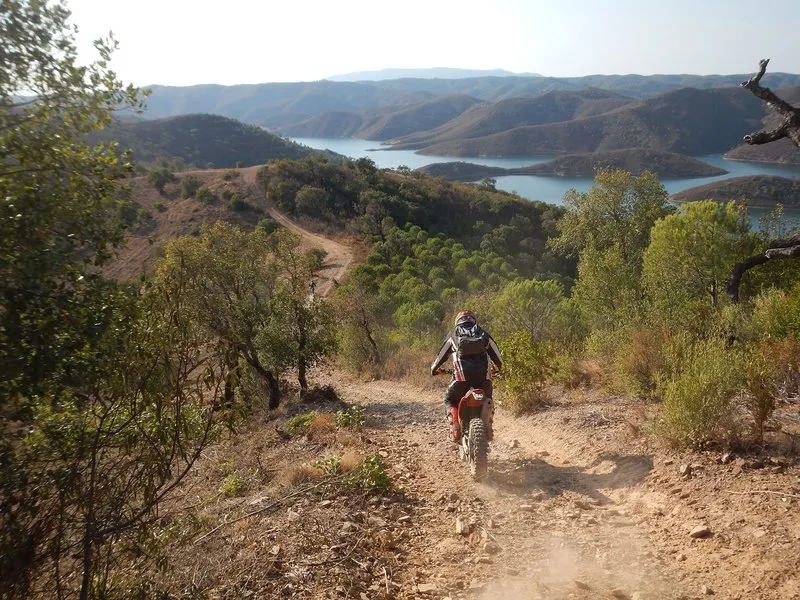
Quiet hills, a dusty line and nobody in your mirrors: the hinterland the beach crowd never sees.
The Guided Way In
You’ll find Kini’s Portugal Magic of Algarve on RIDE KTM, as a Week Tour of eight days and a Short Trip of five. The operator is KINI Adventure Tours from Tyrol, led by Klaus Kinigadner for more than 30 years, working with KTM on an ongoing basis and riding in small groups with experienced guides. You ride KTM EXC four-stroke rentals with fuel included, backed by a mechanic and spare parts, and sleep in a four-star hotel with half board. The week version builds in a rest day and ends with a farewell evening and a certificate.
The route plan doubles as a skill gate. Gravel roads with views over barely populated hills, stony tracks and nameless passes on the first two days, then the difficulty climbs all the way to donkey paths with demanding steep sections. KINI pitches its tours at beginners and seasoned riders alike, so the gentler opening days give you time to find your rhythm before the steep sections.
KTM grades off-road terrain on a scale of levels 1 to 5 (of 5). Level 1 means gravel roads, farm tracks and singletrails without steep climbs, suited to beginners. Level 2, also beginner rated, adds washed-out gravel, ruts, dried riverbeds and simple river crossings. Level 3 brings tight singletrail hairpins, extreme climbs and demanding stream crossings, with off-road practice recommended. Level 4 stacks rock steps, loose rubble, deep sand and slippery ground and asks for regular off-road practice. Level 5 is the hardest terrain in any weather, at speed. Current details sit on the Ride KTM: dates, info and prices page. Flights and the airport transfer aren’t part of the price. On the packing list: passport, riding gear with rain protection and a hydration pack.
Winter Sun and Summer Fire
The climate is Mediterranean with an Atlantic accent: mild, wetter winters and warm to very hot, dry summers. In Faro the daily mean sits around 54°F in January and 75 to 77°F in July and August. Frost is practically unknown, and January days mostly climb past 50°F, sunny spells trading places with wind and rain. The coast gets only about 18 to 20 inches of rain a year, mostly from October to March.
Fall, winter and spring are the seasons to ride. June to September runs too hot in the south, and August is the one to skip. Spring is mild and sunny, though March and early April can still be unsettled. November stays mild but often gray and wet, and Atlantic lows bring wind and rain through the winter half. The Serra de Monchique has its own wetter mountain climate, and in winter its nights are often very cold, with fog and temperatures in the 30s and 40s possible on the summit.
Inland, summer is a furnace. In Beja average highs in July and August top 91°F, and heat waves can push past 104°F. Heat is the main strain of a summer ride. Fire danger runs high from June to September, and tracks can be closed, so your planned line might simply not exist that week. Eucalyptus carries highly flammable oils, and in August 2018 around 67,000 acres burned in the Serra de Monchique. On remote farms and tracks, loose dogs may chase you.
Light riding gear works in summer, protective gear still a must, and rain gear belongs in the winter bag. Faro airport is the main gateway, and for me the most comfortable way in is the RIDE KTM program: the rental KTM EXC and its fuel are included, the flight isn’t, so you fly in and ride. English and Spanish usually get you by. In winter you’ll have your pick of beds, in summer book ahead or move inland.
Medronho After the Last Track
On the coast, fish and seafood rule. Inland it’s hearty meat, and small family-run places are your best bet. Grilled sardines with bread, potatoes and salad are the classic, and Portimão throws them a festival every August. Frango piri-piri, spicy grilled chicken, belongs here too, and Guia near Albufeira counts as its capital. The cataplana takes its name from the lidded copper pot that steams clams, shrimp, fish or pork.
Monchique cooks hearty mountain food, stews and meat off the charcoal grill, and its pork turns into chouriço, morcela, farinheira and air-dried presunto. The wild strawberry tree ends up as medronho, a strong brandy farmers traditionally distill themselves. That’s one for the evening, helmet already on the hook. The sweets lean on almonds, figs and carob, and the Dom Rodrigo from Lagos comes wrapped in colorful foil like a tiny present to yourself. Roadside stands sell hinterland oranges straight from the farmer.
And the prices off the tourist trail? Low, in my book. Add winter sun, cork forest and that raw Atlantic, and you’ve got reasons enough to point the bike south while everyone at home scrapes ice off the windshield.
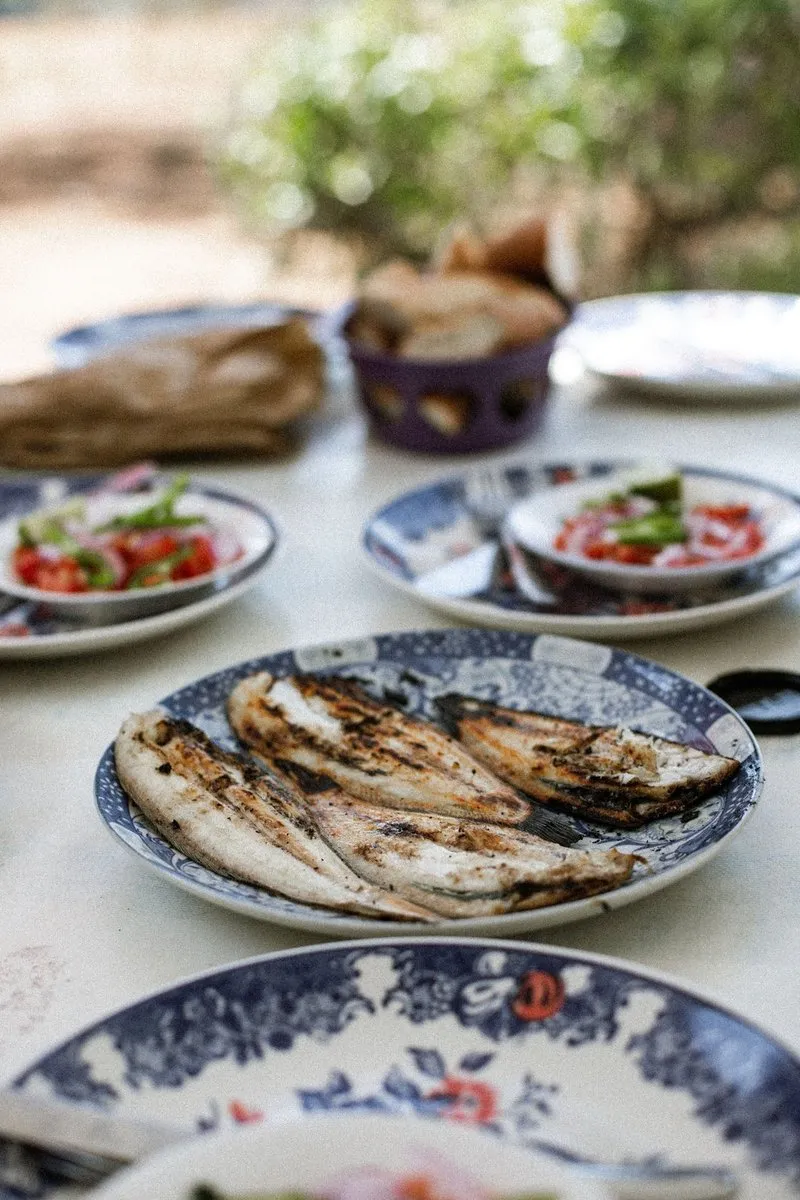
Sardines, bread and salad in the open air: a lunch stop worth planning a route around.