
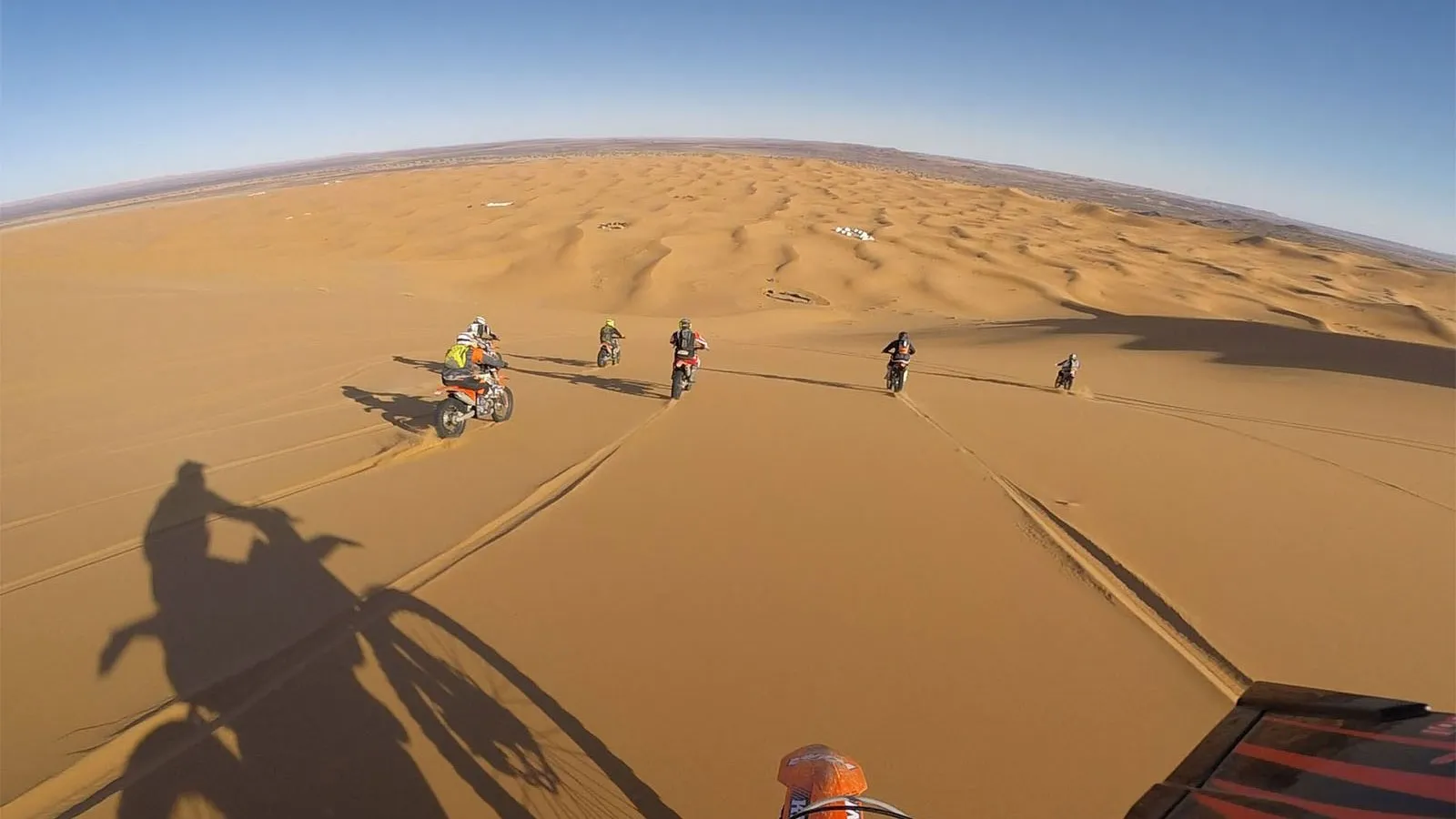
Sand to the horizon and a piste (an unpaved track) that looks exactly like the last ten miles. Not everyone’s going to love Morocco. The distances are huge, the variety comes in small doses, and the desert can get monotonous. For a lot of riders that’s precisely the hook. You, the bike and a long track running out to the horizon. For me it’s the most accessible way for a European to taste the desert and Africa. Is it your kind of empty?
Snow Above Marrakesh
The mountains start almost at the gates of Marrakesh. Toubkal, Morocco’s highest peak at 13,671 feet, stands about 39 miles south, and you can see it from the city. Snow covers the high ground of the High Atlas in winter, usually from November to April, and the Berber villages in its valleys are built from mud.
Cross the range and the palette flips. South of the High Atlas the land turns bare, rock, sand and gravel in ochre and red under snowy summits, and wherever people settled, an oasis of palms, small fields and reeds gives it away. Near Tinghir, the Todra gorge is a limestone canyon whose walls squeeze to roughly 33 feet apart in places on its final 650 yards.
Then the desert takes over. Morocco has two well-known Saharan dune seas, the Erg Chigaga in the Draa region and the Erg Chebbi, which runs between Merzouga and the Algerian border and rises up to about 490 feet above the hammada, the stony desert around it. Tafraoute sits in a valley of pink granite, and the Plage Blanche, about 25 miles of Atlantic beach in the Guelmim region, closes the map.
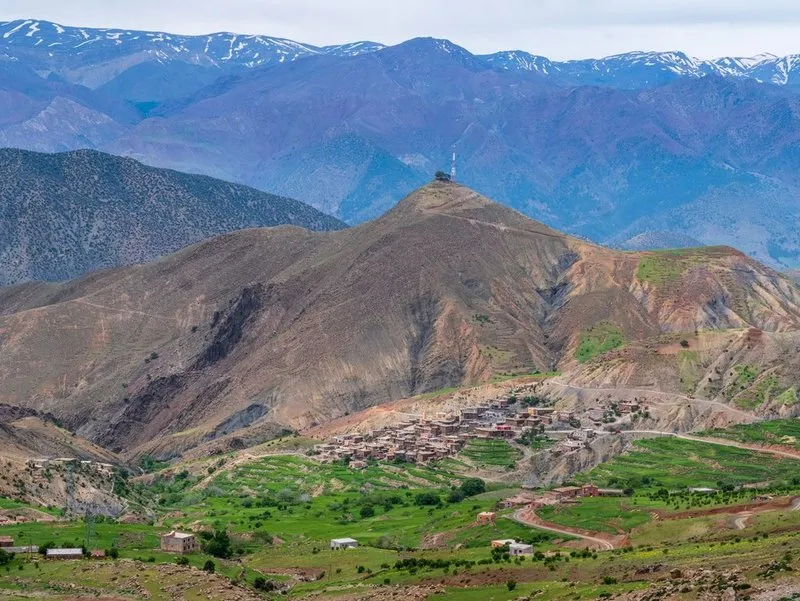
Snow up top, fields down below. Give yourself time to look before you head south.
Rally Country Built From Mud
What makes Morocco unmistakable, its DNA if you like, is that rally racing is part of the furniture. It’s been rally raid country since 1982, when the Paris to Agadir became the Atlas Rally, which ran until the late 1990s. Today the Rallye du Maroc runs every year in the FIA FIM World Rally-Raid Championship, with stages around Erfoud and the Merzouga dunes through dunes, rocky pistes and navigation that’ll make anyone sweat. Plenty of tours roll along the old Dakar tracks, and away from those famous lines you’ll still find rewarding pistes, some of them untouched.
The other half of the DNA is made of earth. The Dadès valley, with hundreds of kasbahs, also goes by the Valley of the Kasbahs, and the ksour, fortified mud villages, count as typical pre-Saharan mud architecture. The fortified Ksar of Aït-Ben-Haddou in the Ounila valley sat on the old caravan route between the Sahara and Marrakesh and made the UNESCO World Heritage list in 1987. Hollywood noticed. Gladiator and The Mummy were shot at the Atlas Film Studios outside Ouarzazate, so if the scenery feels oddly familiar, blame the movies.
What Your Tires Meet
Here’s what the postcards leave out: the dunes are only part of it. Rocky mountain pistes, scree and long stony plains cut by washouts shape the ground too. The open, fast pistes across wide plains hide washouts, loose corners and soft sand. Dry, stony riverbeds are a standard piece of piste, yet after rain they turn into water crossings or mud holes fast.
In the southeast the sand gets nasty. Fesh-fesh lies on the desert pistes there, deep sand as fine as cement dust. Camel grass grows in clumps between the dunes, and guides tell you to steer clear. Many desert pistes near the Atlas look alike, the ground swings from deeper sand to long gravel, and that’s where the monotony bites, because you still have to stay wide awake.
The Dadès gorge road climbs through a tight stack of hairpins, and beyond it the road toward Agoudal becomes about 40 miles of piste: hard rocky ground, loose gravel switchbacks, a few water crossings and packed mud. The Tizi n’Test, around 6,900 feet up between Marrakesh and Taroudant, is narrow, single lane in places and wildly twisty, with gravel and potholes on the road and short walls between you and deep drops.
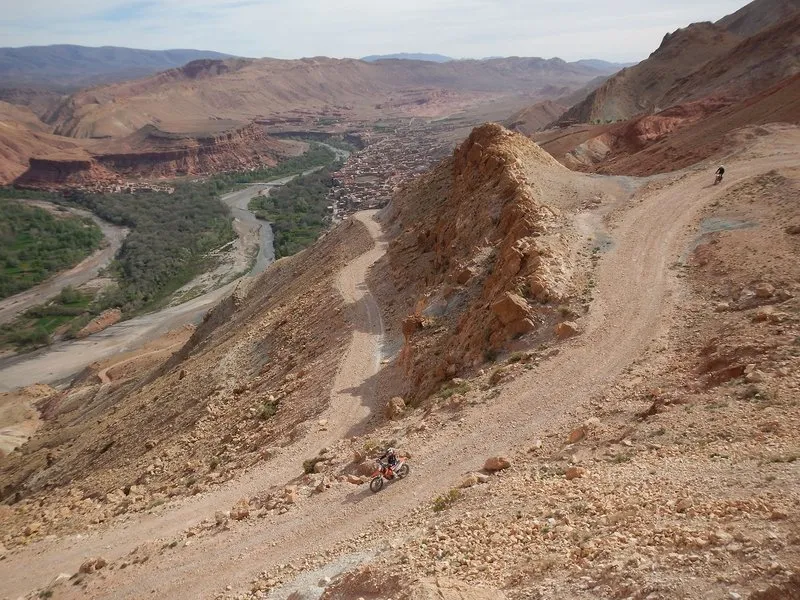
Loose gravel, a long drop and a green valley below: the kind of climb worth taking slowly.
Rally Days From Marrakesh
On RIDE KTM you’ll find two Morocco programs, Kini’s Morocco Atlas Tour and Kini’s Atlas to Atlantic Tour. They’re run by KINI Adventure Tours, which Klaus Kinigadner has led for more than 30 years. Both last eight days from and back to Marrakesh, with six guided day tours in small groups. KINI bills them as rally desert tours on the trail of the Atlas Rally: fast, dusty pistes, dunes, stony mountains, deep gorges. There’s even a special stage called Highest Dune. Whoever climbs the highest dune wins.
The Atlas version spends a day in the Erg Chebbi, the Atlantic version heads out to Tafraoute and the Plage Blanche. Included are KTM EXC four-stroke rentals, fuel, mechanic and spare parts service, and seven nights with half board.
KTM’s off-road scale runs from Level 1 to Level 5. Levels 1 and 2 are rated for beginners: gravel roads and singletrack without steep grades, then washouts, dry riverbeds and simple river crossings. Level 3 brings tight turns and extreme climbs and descents. Level 4 means rock steps, loose scree, deep sand and slippery ground. Level 5 is the hardest terrain in any weather. Ask Klaus Kinigadner which level suits you here; he answers tour questions personally. Details live on Ride KTM: dates, info and prices.
On Your Own Wheels
For me, the most relaxed way to get there is a guided program like this one: the KTM EXC rental and fuel are included, so you fly into Marrakesh Menara, served directly from Europe, and ride. Bringing your own? Daily ferries cross from Algeciras to Tanger Med, the usual port for overlanders.
Going solo asks three things of you: confident control on loose ground, fitness, and attention all day, because the surface swings from perfect asphalt to washed-out riverbeds. On a heavy bike, sandy pistes in the heat wear untrained riders down. The Trans Morocco Trail lets you scale it: about 1,860 miles from Nador on the Mediterranean to Cap Draa on the Atlantic, roughly half unpaved, with the tough stages bypassable on roads. It’s a free download with waypoints for fuel, lodging and water that runs offline in OsmAnd or Gaia GPS. Paving keeps spreading and storms rearrange pistes, as the floods of September 2024 showed. Before you ride into a dune field, pick a landmark.
Riders reckon a fuel range of 185 to 220 miles does the job, and the network counts as dense. In the deep south, though, stations can sit two riding days apart, and remote villages sell gas from bottles at a markup. Carry cash in the countryside.
Heat Frost and Flash Floods
So when do you go? Spring, roughly March to May, and fall, roughly September to November, are the windows, because then it’s neither hot like summer nor cold like winter. The catch is that hot spells in the south can now reach from April to October, right into both windows, and that’s when sandy pistes wear untrained riders on heavy bikes down. In Ouarzazate, just above 3,600 feet, July highs average just under 102°F. Go too late in fall, though, and the light runs short. November leaves you only 10 to 11 hours of daylight, mid-March just under 12. So you’re weighing a little more heat risk against a little less day. Either way, drink regularly, sit out the midday heat and pull a scarf over your face when the wind drives sand.
Cold is the desert’s sparring partner. Winter nights in the desert and the Atlas can freeze, and even spring and fall evenings turn surprisingly chilly. From November to March snow can hit the passes, and after heavy snow the Tizi n’Test can close for hours, rarely for days. In winter, heavy rain can trigger flash floods in the mountains and along rivers, and riding into flooded ground is dangerous.
Poor lighting makes riding after dark in Morocco dangerous, so plan each leg to end before sunset. On back roads and mountain roads you’re sharing the asphalt with potholes, diesel spills, camels, rockfall and patches washed away by the oueds, the riverbeds, which is reason enough to keep something in reserve. In villages, kids and donkeys step into the road without warning, so roll through slowly. Stray dogs can be aggressive and rabies exists; after a bite, get to a doctor right away.
What Ends Up on Your Plate
Mint tea is everyday life and the sign of hospitality, and guests traditionally get at least three glasses. Factor that into the next stretch of piste. Breakfast might be msemen, a many-layered square pancake, sweet with honey or savory, or amlou, a paste of roasted almonds, honey and argan oil. Dinner is usually a tagine, slow-braised under its cone- or dome-shaped clay lid, meat, poultry or fish with vegetables or fruit.
The route doubles as a menu. Taliouine is Morocco’s saffron center, and the harvest there runs from mid-October to mid-November. Tafraoute lives off almond groves, and the Tafilalt oasis around Erfoud is famous for dates. The Tafilalt also gave the world medfouna, the Berber pizza: two layers of dough around meat, vegetables and spices. The name means buried, after the baking in hot desert sand. On Jemaa el-Fna in Marrakesh, the evening food stalls dish up harira, a soup of beans, lentils and noodles. That’s where the long piste to the horizon begins, and with a bowl of that in you, it’s a good place to start.
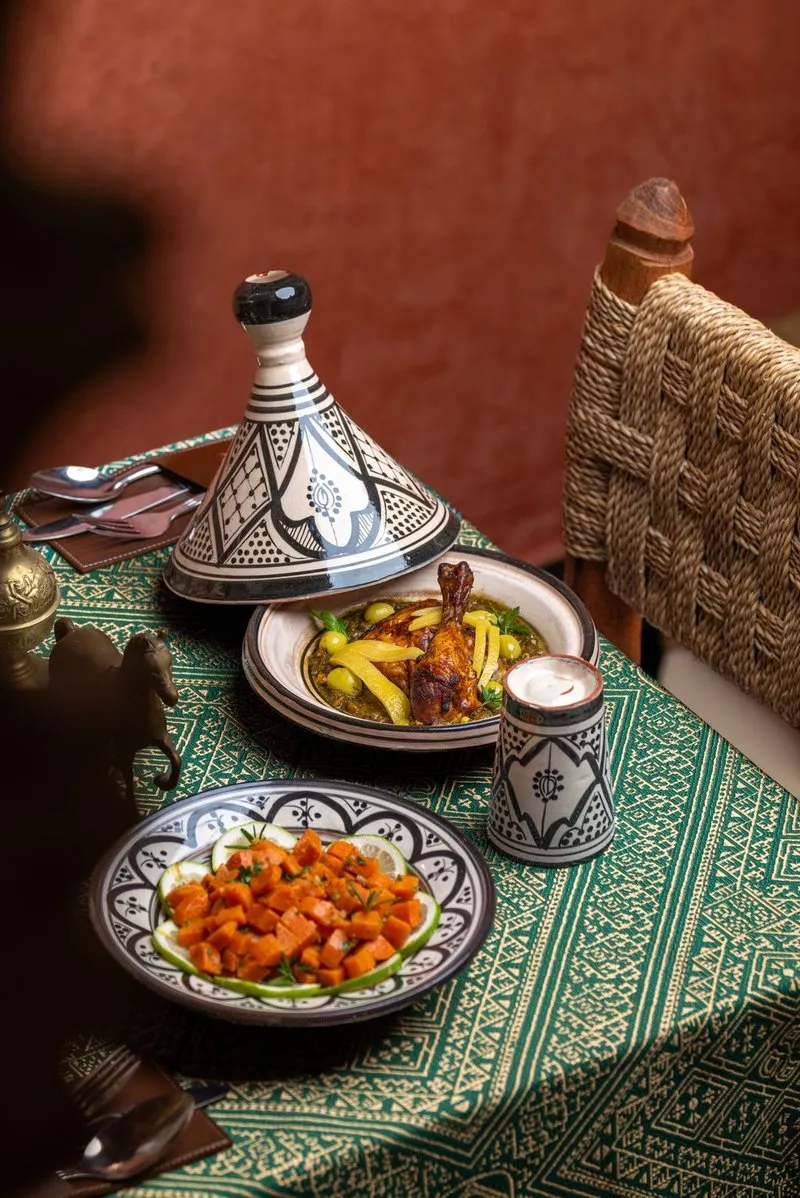
A slow tagine after a long day of piste. I’d plan the last miles around this table.