
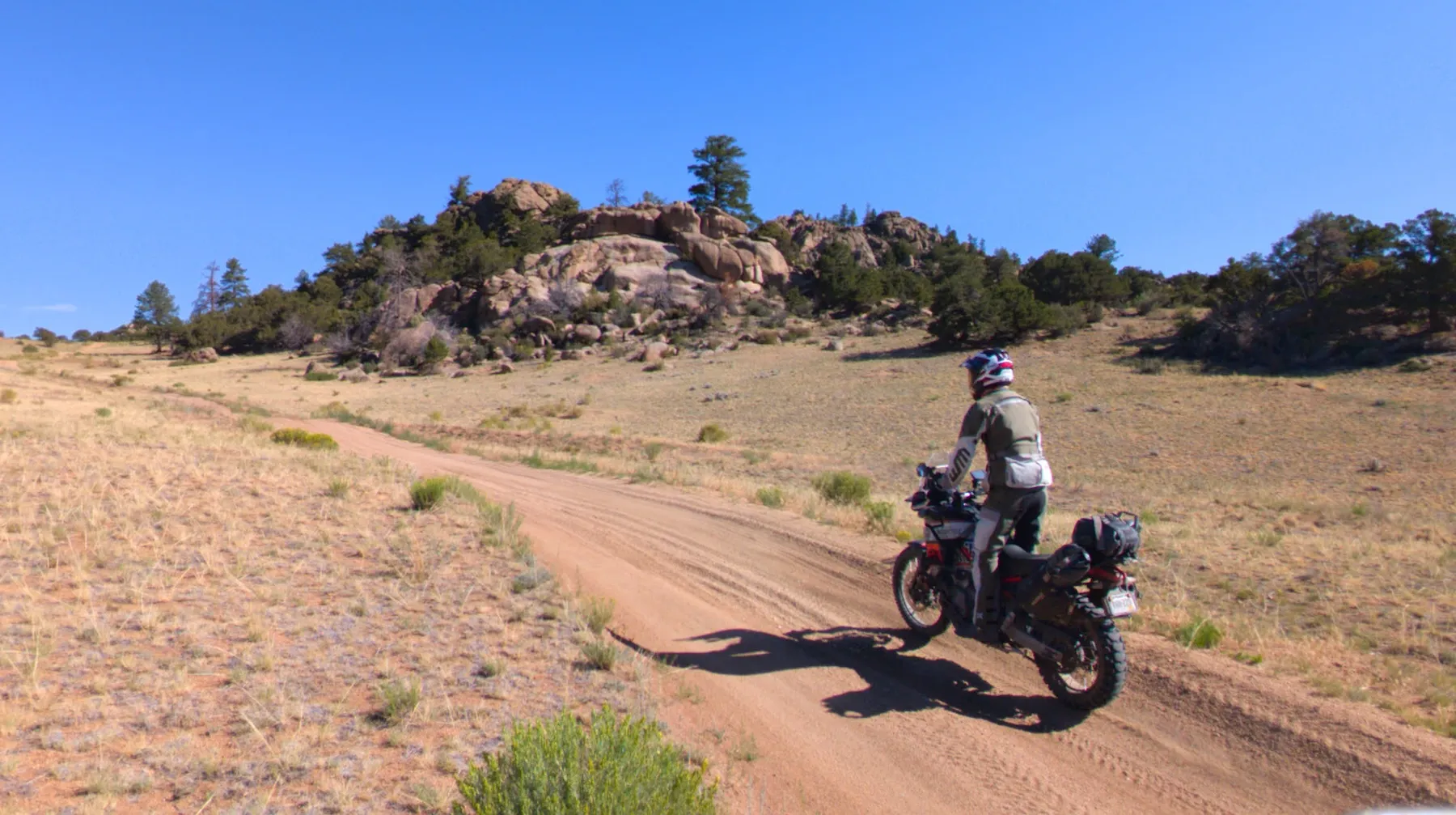
The pavement just stops, and in front of you there’s nothing but loose gray gravel winding up the hill. You’ve got years of riding behind you, you know every apex on your home loop, and you can stop on a dime on asphalt. Then the front wheel rolls onto the stones, the bars start to squirm, and your big adventure bike suddenly feels like somebody else’s motorcycle. Welcome to the club! Every rider who’s ever made this switch knows exactly that feeling. Here’s the good news: a heavy, expensive adventure bike is a riot in the dirt, and the skills that get you there can be learned. You don’t need new tires or a different bike. You need the right order.
Your street miles don’t count out here
Let’s start with the uncomfortable word: humility. Somebody who rides 31,000 miles a year on the street is a good, safe street rider. Off-road, that same rider starts at zero. The reason is right under your tires. On hardpack, a layer of loose stones acts like a ball bearing with corners, and it barely transfers any force. Things you do on asphalt without thinking, like creeping through a tight turn at walking pace, turn into a real problem on loose, coarse ground.
The most common rookie mistake isn’t technical at all: wanting too much, too fast. Nail one drill properly before you cram eight into a short afternoon. And don’t let it get to you when the experienced guys disappear up the trail while your first two-track feels slippery and sketchy as hell. It does for everyone. Your feel for the ground grows with every mile. Promise.
Stand up and take the helm
Why do people who ride dirt seem to stand on the pegs all day? There are four solid reasons.
First, you see more. Standing, you spot rocks, turns and junctions a few tenths of a second, sometimes whole seconds, earlier, and you still see right down to your front wheel. Second, the center of gravity. Seated, your weight goes in through the saddle, above the bike’s combined center of mass, and at low speed that feels tippy. Standing, it goes in through the pegs, below it, and the whole bike settles down. Third, comfort: your legs, knees and ankles work like a factory race suspension and soak up the hits. That helps your passenger over potholes, too. Fourth, control. On the seat you’re often just along for the ride. Up on the pegs, you’re the one steering the ship. Remember that one!
Steer with your ankles, not your arms
Standing alone doesn’t cut it. How you stand is what counts. The trick lives down low: a small angle at the ankles shifts a lot of weight with almost no effort. On the gas, lean forward, or the bike pulls you back. On the brakes, shift your weight back a little so you don’t go over the bars.
Stand right and the bars stay loose in your hands. Your arms carry as little load as possible, no death grip, no tugging the bike off line. Standing, you steer a big part of the time through the pegs, by moving your weight instead of muscling the handlebar. It takes some getting used to. Once it clicks, though, it sticks: plenty of people who take an off-road course sometimes ride a few stretches standing on pavement afterward, just because they’ve discovered how nimble the bike suddenly feels. That’s a sensation, not an assignment. Practice it where it belongs, off the road.
Sit on the easy stuff, stand for the hard stuff
Now for the mistake almost everybody makes. Beginners ride the wide, smooth forest road standing for hours. Eventually their thighs give out, and the moment it gets tricky they drop into the seat in a panic. That’s exactly backward!
Ride the easy sections sitting down and let the suspension do its job. When it gets tricky, get up on the pegs and look over everything like a captain on the bridge. Sitting doesn’t mean being passive, though. Lean your upper body forward a little, push the bike side to side underneath you, use peg pressure to set your line, and let your inner thighs steady the bike. When it gets dicey, squeeze the tank with your knees and the bike gets calmer and more secure. In a left-hand hairpin, press in with your left foot. Honestly, it’s a lot like skiing.
The parking-lot figure eight
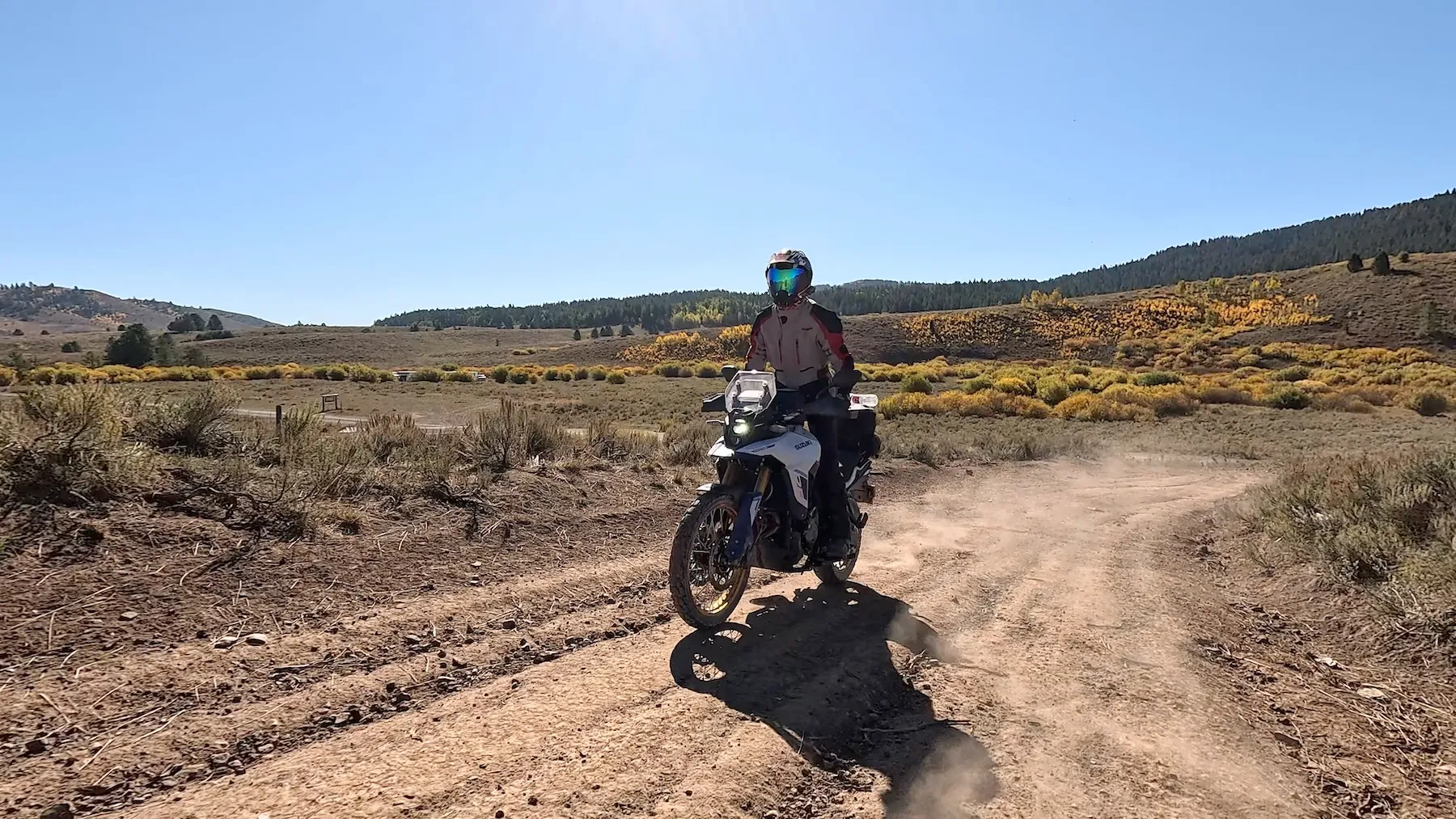
Best news for street riders: the most important drill doesn’t need any gravel. Start with the standing position with the bike on its center stand. You’ll feel right away how much even small shifts in your body change things. Then head to an empty parking lot and ride figure eights standing up. Pavement works just fine for this.
Right foot resting lightly on the rear brake, butt toward the outside of the turn, upper body and eyes into the turn. Accelerating and braking follow pretty much on instinct from there. Sounds too simple? It isn’t. Slow riding is the discipline that trips up even very experienced riders. Get your balance sorted at walking pace and a bike that weighs well over 440 lbs suddenly handles like a toy. Next come gentle climbs and descents. Then the gravel.
One finger, steady throttle
On the street, an emergency stop means four fingers on the lever. In the dirt you want finesse, so keep one or two fingers on the levers at all times. You’ll work them a lot more precisely. One rider with a racing background put it bluntly: he’s always braked with one finger, and he still does off-road.
Here’s a detail most street riders have never heard: stop snapping the throttle open and shut. Crack it a few millimeters, hold it there, and feed the drive with the clutch. Steady gas, clutch does the talking.
And braking itself? That’s mostly a head game. There’s no consistent asphalt, so you’re constantly reading the surface: gravel, grass, a hole, a crest. Your stopping distance on loose ground gets a lot longer than you’re used to. Plan for it, generously!
Dial traction control back one step at a time
Modern adventure bikes are packed with electronics, and early on they’re a huge help. The proven way in goes like this: start with the most sensitive traction control setting. Sooner or later you’ll stall out on a climb because the rear wheel needs more slip than the electronics allow, and the bike just won’t take the throttle. Then drop one level, maybe two. Switching it off completely comes only after plenty of practice rides.
The reason is simple: mess up on the gas, let the rear step out, and you’re on the ground. So ride the off-road mode with the system working first, build your feel, and back the electronics off in small steps. It cuts the other way, too: if you’re running knobbies on wet pavement, set the traction control accordingly. Patience pays twice here.
Know your ABS before you need it
ABS deserves a close look at your menu. A pure street ABS can send you straight into the bushes off-road. Brake for a turn on loose ground, the system senses the tire letting go, releases the brake, and you keep going straight. That’s why switching it has to be quick and easy.
The KTM 890 Adventure Rally (as of 2025) is a good example: in its off-road mode the rear ABS is disabled, so you can drag the rear brake into a turn and swing the back end around. But don’t jump to the conclusion that ABS is bad in the dirt. A well-tuned off-road ABS brakes so well that instructors don’t want to switch it off anymore, and it still lets you slide the rear. The real difference is street ABS versus true off-road ABS. Know your menu before you roll out, and don’t forget to switch when you go from pavement to dirt and back.
Street tires go further than you think
Do you need new rubber before your first gravel ride? Nope! On dry sand and gravel roads, street tires grip almost as well, or as badly, as dedicated off-road tires. You’re short on grip because the stones roll, not because of the tread pattern. Put a little bluntly: on a mellow gravel road you could almost run slicks.
In off-road training, customers often ride on street tires with the pressure dropped a bit, to around 26 psi. That works as long as it’s dry and the gravel is hard, and on big adventure bikes it works surprisingly well. The rule of thumb: if you ride 95 percent street and five percent dirt road, you don’t need knobbies. At 95 percent dirt, you definitely do. So save the money for a training day.
When knobbies earn their keep
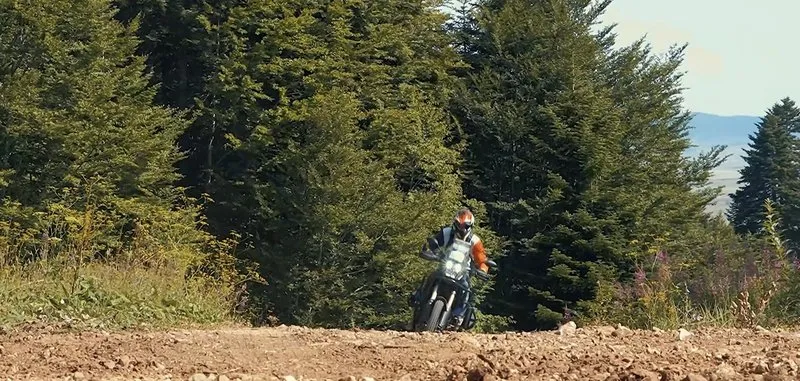
There’s a limit, though, and the weather draws it. Once rain softens the ground and lets knobs dig in, tire construction suddenly matters. You feel it most heading downhill on damp, changing surfaces: on street tires, the front keeps pushing wider and wider in a right-hander. On knobbies, it holds.
If you really want to go adventuring, a 50/50 tire is the minimum. It bites somewhat better in deeper dirt, downhill and on climbs, and these days it works fine on the street too. One catch: on wet pavement it’s worse than a pure street tire. That’s the trade-off. Ride off-road a lot, in any weather, and you’ll happily take it. Stick to dry two-tracks and wide gravel roads, and you can relax on your street tires.
Read the two-track
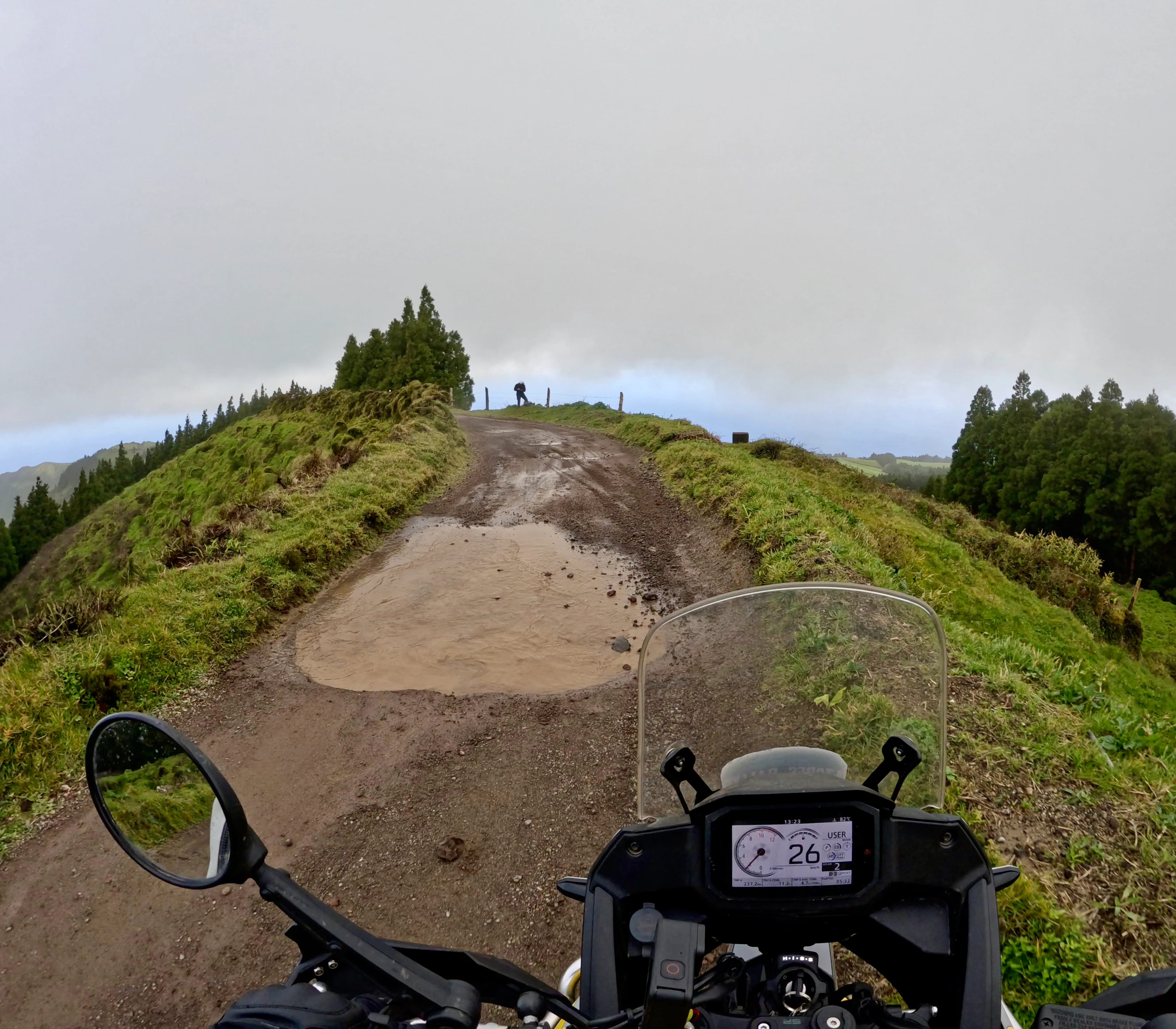
Grass rarely grows on asphalt. On a farm track it’s everywhere. Ruts can steady you as long as you hold your line inside them. Lose your balance, though, and climbing out over the slick edge gets sketchy, so a flat strip beside the rut is often the better choice. The crowned grass hump between the tractor tracks usually has more grip than the sandy ruts when it’s dry, but it hides potholes and turns slick when it’s wet.
Rain changes a lot: coarse gravel gets slipperier, clay turns into an ice rink, wet grass and moss go slick. Only coarse, deep sand can actually get grippier when wet. Then there’s oncoming traffic. Farm tracks are narrow and a tractor can come around the corner at any moment, so ride at a speed where you can stop in half the distance you can see. On a wide, empty road, take the biggest radius you can and save yourself the lean angle. With a bit of practice, you’ll read the trail like a map.
Weight only hurts when you stop
You’ll often hear that weight doesn’t matter once you’re moving. That’s only half true. As long as the bike rolls, it balances itself with its lean angle. The trouble comes at a standstill, in a hairpin, when you’re maneuvering. That’s where heavy adventure bikes tip over to the inside in a hurry, and the taller and heavier the bike, the harder it pulls you down.
A 573 lb bomb leaning just five degrees is almost impossible to catch. At 463 lbs, you might still save it. And if you ever have to turn around on a downhill bank, you’ll find out how much work it is to drag a heavyweight out backward. So what? No reason to panic. A slow tip-over is the smaller problem compared with going down at speed. Better to fall over at walking pace than slide out going too fast. And there’s protection for the consequences.
Crash bars and boots beat gadgets
What does your adventure bike really need for gravel? Less than the accessories catalog wants you to believe. The word from off-road training is clear: proper engine protection and a skid plate are a must. Everything else is nice to have. Add wide, grippy pegs; on some bikes it’s enough to pull the rubber inserts.
For you: off-road boots, armor for knees, hips, back, shoulders and elbows, an off-road helmet with goggles, thin gloves for better feel, a first-aid kit, a few tools, and always a bottle of water and a snack bar. One detail people underrate is the sole of your boot. When you put a foot down on loose ground, it decides whether you stay upright. That stylish designer boot with a leather sole has next to no grip on gravel, sand or damp grass. Skimp on the gadgets, never on the protection.
Start small, and the dirt becomes your playground
So what’s the takeaway? A path in small steps. Standing position on the center stand, figure eights in the parking lot, easy gravel sitting down, tricky bits standing up. One or two fingers on the levers, steady throttle, electronics backed off a notch at a time. On dry gravel your street tires will do, once it’s deep and wet, knobbies earn their place. You can gather experience carefully on your own. If you want to progress faster, train with a professional.
And it’s worth it: riding off-road is the most intense form of motorcycling there is, with fewer people and a lot more nature. Your well-equipped adventure bike isn’t an obstacle, it’s the perfect tool. So go for it, start small and enjoy the quiet away from the pavement. That first dust cloud behind you is addictive!