By NastyNils·
Motorcycle comparison · Supersport vs Naked Bike
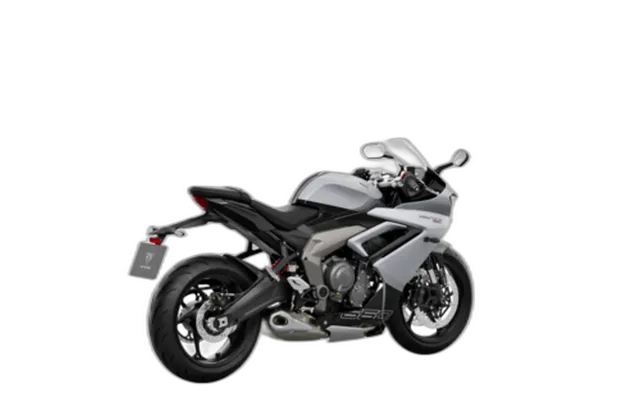
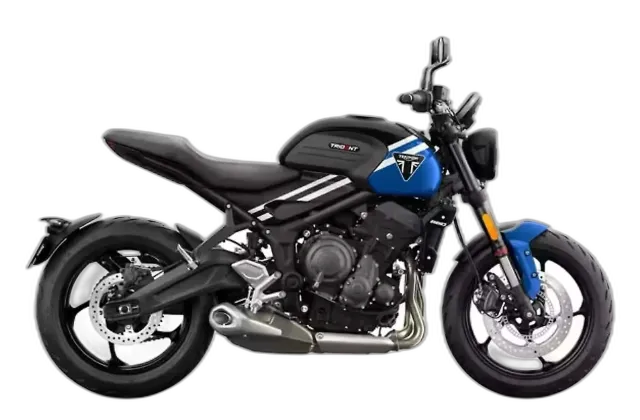
Triumph Daytona 660 (MY2024) vs Trident 660 (MY2021)
Triumph Daytona 660 vs Trident 660: different classes, one choice. Here's how to make it.
Brake hard into a bend on the Triumph Daytona 660 and its soft fork dives until the front doesn't tell you much. The Triumph Trident 660's lever builds its bite gradually while you're squeezing. It's predictable right up to the limit.
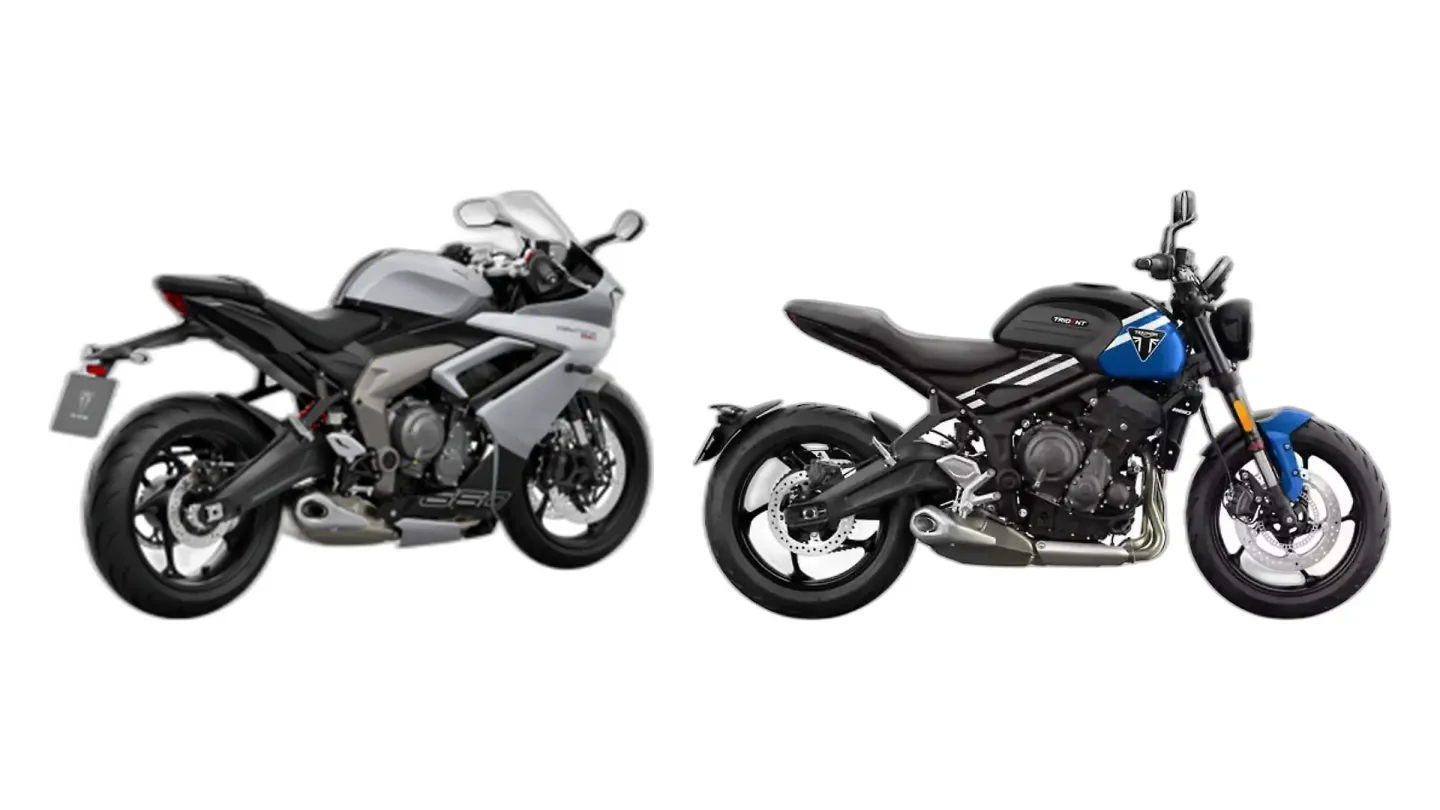
So which one do you buy?
Buy the Trident 660 if…
Daily commuting & city riding
The pick: Trident 660
The Trident 660 earns its keep in weekday traffic better than the other one. The reason: friendlier manners. For a daily commuter, it's the clear choice.
The Daytona 660 has the edge if…
Sporty riding on twisty roads
Nose ahead: Daytona 660
Back-road fun leans slightly toward the Daytona 660. It's a narrow call, so trust your test ride.
The Trident 660 has the edge if…
A confidence-building first motorcycle
Slight edge: Trident 660
For your first season, the Trident 660 makes slightly more sense. Fit and confidence at a standstill still come first.
What makes each one tick
Daytona 660
There's real pull in the Daytona 660's triple from low revs, with the engine spinning freely as the tach climbs. The clip-ons don't pull you far forward, and the seat's got thick, plush padding. A sharp bump at a quick pace finds an underdamped shock that can't keep the chassis settled. The triple howls up to redline.
Trident 660
You'll hear the Trident 660 before anything else, its triple note carrying from the exhaust without turning shouty. The pegs leave tall riders a natural knee angle that doesn't load up over a long day. Quick downshifts into a corner hand the work to the slipper clutch. The rear tire stays in line.
Nils rode the Trident 660 in 2021 (NastyNils Testride).
The Voice of Experience

What actually separates them
- The Trident 660 has the lower wet weight: 417 lb (189 kg) vs 443 lb (201 kg).
- The Daytona 660 makes more peak power: 94 hp (70 kW) vs 80 hp (60 kW).
- The Daytona 660 makes more peak torque: 51 lb-ft (69 Nm) vs 47 lb-ft (64 Nm).
Which one for the way you ride
Comfortable long-distance riding
Not their thing
Long days aren't what these two do best. Plan shorter legs and plenty of stops.
Look at running costs and you'll find two bikes doing the same job equally well. Fit is what breaks the tie.
Who each one is built for
What's good, and what you'll live with
Daytona 660
What owners say
Strengths
- Characterful triple-cylinder engine
- Excellent value for money
Trade-offs
- Soft, underdamped suspension
- Heavier than some competitors
Trident 660
From Nils' own saddle time
Strengths
- Linked Corners Come Naturally
- Torque Everywhere, No Dead Spots
- A Triple Note Worth Hearing
- Friendlier Than It Looks For Tall Riders
- Light Clutch, Precise Controls
Trade-offs
- Unsettled On Broken Pavement
- Preload Is Your Only Adjustment
- Rider Aids Play It Safe
- Seat Softens Under You
What they cost used
These prices compare a 2-year-old Daytona 660 with a 2-year-old Trident 660.
- Daytona 660
- about $7,700
- Trident 660
- about $6,800
At two years old, the Triumph Daytona 660 sits around $7,700 while the Triumph Trident 660 lands near $6,800. That's a $900 gap in the Trident's favor. These are US market estimates, not live listings.
What they share
- Displacement
- 660 cc
- Engine
- Inline-three
- Cooling
- Liquid-cooled
- Fuel capacity
- 3.7 US gal (14 L)
- Gearbox
- 6-speed
- Front tire
- 120/70-17
- Rear tire
- 180/55-17
Where the spec sheets split
| Daytona 660 | Trident 660 | |
|---|---|---|
| Seat height | 31.9 in (810 mm) | 31.7 in (805 mm) |
| Wet weight | 443 lb (201 kg) | 417 lb (189 kg) |
| Daytona 660 | Trident 660 | |
|---|---|---|
| Power | 94 hp (70 kW) | 80 hp (60 kW) |
| Peak power at | 11,250 rpm | 10,250 rpm |
| Torque | 51 lb-ft (69 Nm) | 47 lb-ft (64 Nm) |
| Peak torque at | 8,250 rpm | 6,250 rpm |
| Daytona 660 | Trident 660 | |
|---|---|---|
| Fuel economy | 48 mpg (US) / 4.9 L/100 km | 50 mpg (US) / 4.7 L/100 km |
| Daytona 660 | Trident 660 | |
|---|---|---|
| Wheelbase | 56.1 in (1425 mm) | 55.1 in (1400 mm) |
Head to head, area by area
Both bikes on the same scale, one area at a time.