By NastyNils·
Motorcycle comparison · Supersport
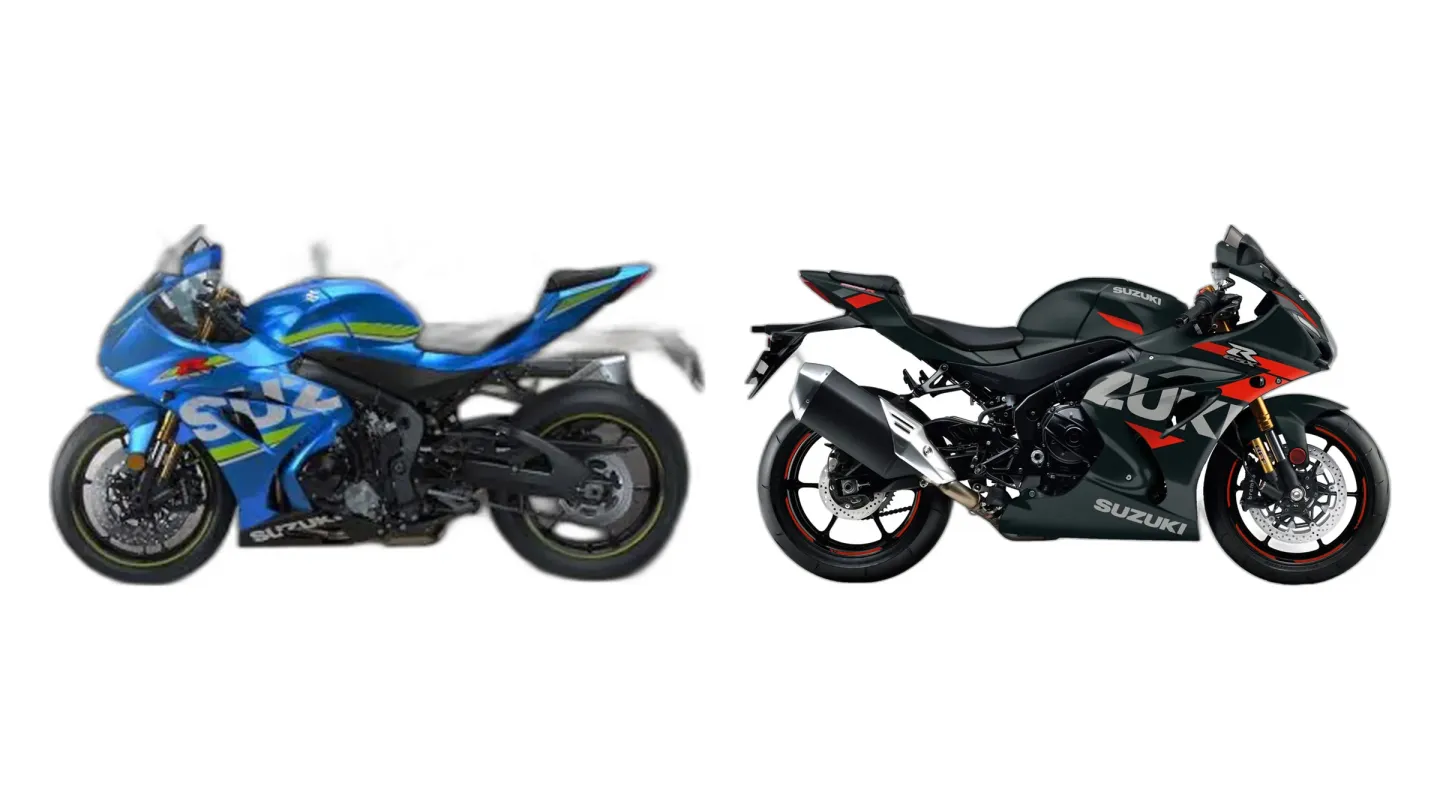
Suzuki GSX-R 1000 (MY2017-R) vs GSX-R 1000 (K9)
2017 Suzuki GSX-R 1000 vs 2009 Suzuki GSX-R 1000: which one to buy for the riding you do.
Lean hard on the bars of the 2017 Suzuki GSX-R 1000 and it takes a firm push to tip in, then holds a line you'd swear is too fast. On the 2009 Suzuki GSX-R 1000, there's a little give in the suspension as you roll in. It slips into the bend without a fight.
So which one do you buy?
The 2017 GSX-R 1000 has the edge if…
Racetrack use
By a nose: 2017 GSX-R 1000
Lap after lap, the 2017 GSX-R 1000 noses ahead. The reason: stronger brakes. Your own riding will make a bigger difference than this gap.
Sporty riding on twisty roads
Slight edge: 2017 GSX-R 1000
The 2017 GSX-R 1000 is a touch more fun when the road starts bending. Most of that is harder acceleration.
What makes each one tick
2017 GSX-R 1000
Out of a corner, the 2017 GSX-R 1000's chassis doesn't squirm, even as the rear wheel takes its full power lap after lap. The lever squeezes Brembo calipers onto floating discs, and there's real bite as they haul the bike down. There's no dip in the four's pull from mid-revs up, even with the throttle opened mid-corner. The rear tire loads up cleanly.
Nils rode the 2017 GSX-R 1000 in Australia in 2017 (NastyNils Testride).
2009 GSX-R 1000
On ordinary pavement, steady torque pulls the 2009 GSX-R 1000 out of each corner while the chassis soaks up broken tarmac. It's quick without asking much of you, and the long way home starts to look like the only way. On a racetrack, compression bumps and mid-corner crests don't go unnoticed: the fork and shock give a visible twitch. Then the fork's settled again.
Nils rode the 2009 GSX-R 1000 in France in 2010, in Portugal in 2012, in Hungary and Slovakia in 2013, and in the Czech Republic in 2014 (NastyNils Testride).
The Voice of Experience
What actually separates them
- The 2009 GSX-R 1000 has the lower seat: 31.9 in (810 mm) vs 32.5 in (825 mm).
- The 2017 GSX-R 1000 makes more peak power: 203 hp (149 kW) vs 185 hp (136 kW).
- The 2009 GSX-R 1000 has the larger fuel tank: 4.6 US gal (17.5 L) vs 4.2 US gal (16 L).
Which one for the way you ride
Comfortable long-distance riding
Neither is a natural fit
Hours in the saddle won't flatter either of these. They're happier on shorter runs.
Look at commuting and running costs and you'll find two bikes doing the same job equally well. Fit is what breaks the tie.
Who each one is built for
What's good, and what you'll live with
2017 GSX-R 1000
Strengths
- Relentless top-end surge
- Corner exit stays planted
- Track-ready Brembo brakes
- Traction control gives real choices
- Torquey, broad-powerband engine
Trade-offs
- Turn-in needs deliberate effort
- Wheelie and TC share one dial
- Two safety recalls to verify
2009 GSX-R 1000
Strengths
- Real pull below the midrange
- Neutral chassis, no heroics
- Three-position pegs come standard
- Composed over serious bumps
- Wide, usable midrange for a litre-class supersport
Trade-offs
- Sluggish in fast chicanes
- Stock fuel map stumbles low
- Tokico front brakes (2009-2011) lack outright bite
- Heat from the underseat/side-exit exhaust on early models
Known problems to check before you buy
2017 GSX-R 1000
- Gearshift double-click between 4th-5th and 5th-6th Shifting between higher gears can feel notchy, with a double-click sensation; adjustment does not always fix it.
2009 GSX-R 1000
- Regulator/rectifier failure The voltage regulator is a known weak point across multiple Suzuki sport-bike platforms of this era; symptoms include battery undercharging, melted connector plugs at the rectifier, and erratic charging voltage. Aftermarket MOSFET-based replacements are a frequent owner upgrade.
- Clutch basket and judder spring wear On hard-ridden or track-used examples the clutch basket can develop notching and the slipper-clutch judder spring can fatigue, leading to clutch shudder and inconsistent engagement.
- Fuel pump failure (early models) Some 2009-2011 examples reported sudden fuel pump failures, often without warning. Suzuki issued a service bulletin in some markets covering the affected units.
- Camchain tensioner rattle A characteristic rattling noise at idle and on light throttle is common as the bike ages; usually traced to wear in the spring-loaded camchain tensioner. Owners report replacement with the updated tensioner part resolves it.
- Low-rpm fueling stumble Numerous owners report a snatchy throttle response and slight bog around 3,000-4,000 rpm under light load — typically resolved with an ECU reflash or aftermarket fuel-mapping device.
What they share
- Wet weight
- 448 lb (203 kg)
- Engine
- Inline-four
- Cooling
- Liquid-cooled
- Gearbox
- 6-speed
- Final drive
- Chain
- Fork
- Upside-down (USD)
- Front tire
- 120/70-17
Where the spec sheets split
| 2017 GSX-R 1000 | 2009 GSX-R 1000 | |
|---|---|---|
| Seat height | 32.5 in (825 mm) | 31.9 in (810 mm) |
| 2017 GSX-R 1000 | 2009 GSX-R 1000 | |
|---|---|---|
| Displacement | 1000 cc | 999 cc |
| Power | 203 hp (149 kW) | 185 hp (136 kW) |
| Peak power at | 13,200 rpm | 12,000 rpm |
| Torque | 87 lb-ft (118 Nm) | 86 lb-ft (117 Nm) |
| Peak torque at | 10,800 rpm | 10,000 rpm |
| 2017 GSX-R 1000 | 2009 GSX-R 1000 | |
|---|---|---|
| Fuel economy | 35 mpg (US) / 6.8 L/100 km | 36 mpg (US) / 6.5 L/100 km |
| Fuel capacity | 4.2 US gal (16 L) | 4.6 US gal (17.5 L) |
| 2017 GSX-R 1000 | 2009 GSX-R 1000 | |
|---|---|---|
| Front brake | 320 mm | 310 mm |
| Rear tire | 190/55-17 | 190/50-17 |
| Wheelbase | 56.1 in (1425 mm) | 55.3 in (1405 mm) |
What comes fitted, what costs extra
| 2017 GSX-R 1000 | 2009 GSX-R 1000 | |
|---|---|---|
| ABS | Standard | Option |
| Cornering ABS | Standard | Not offered |
| Traction Control | Standard | Not offered |
| Wheelie Control | Standard | Not offered |
| Launch Control | Standard | Not offered |
| Quickshifter | Standard | Not offered |
| LED Headlight | Standard | Not offered |
Head to head, area by area
Both bikes on the same scale, one area at a time.