By NastyNils·
Motorcycle comparison · Scooter
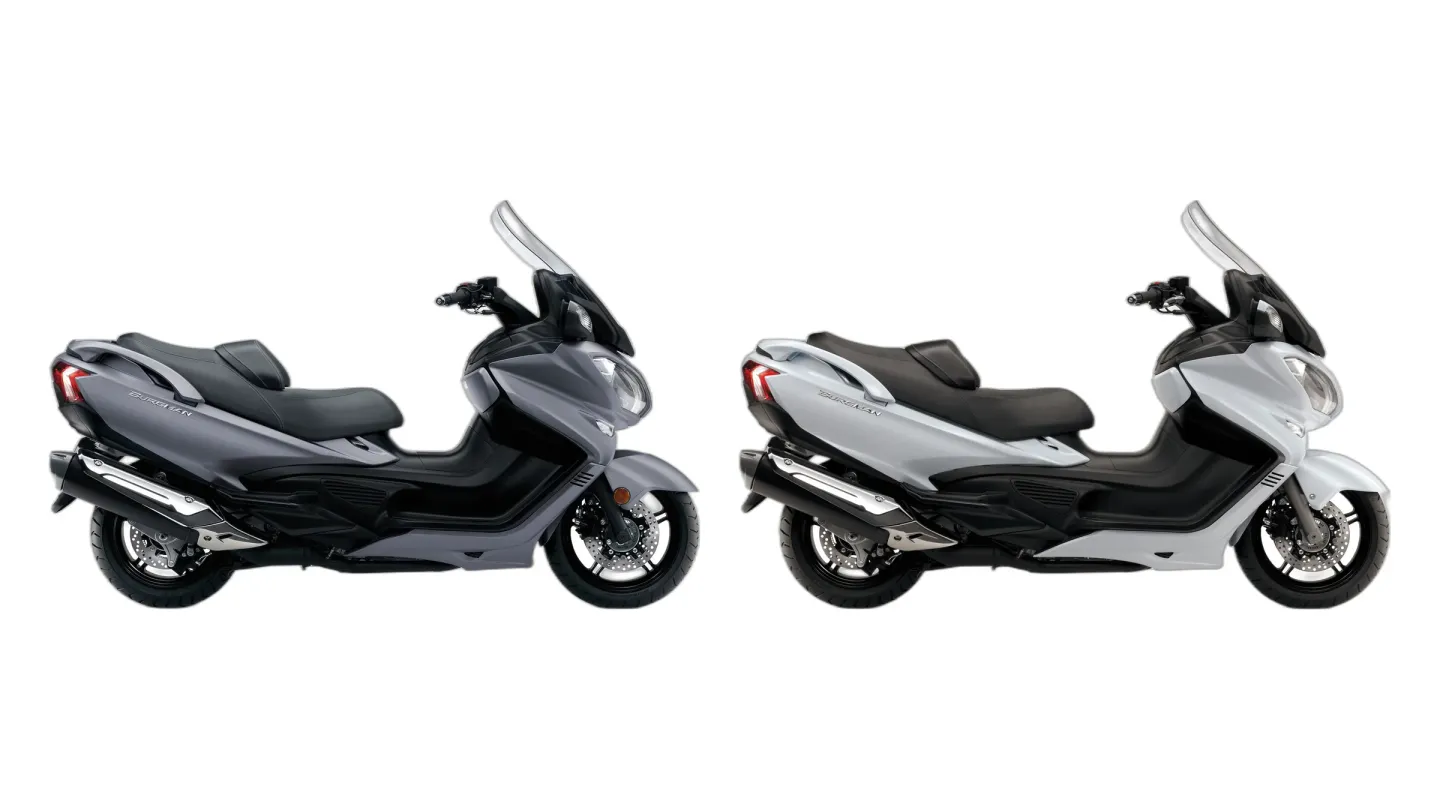
Suzuki Burgman 400Z (MY2014) vs Burgman 650 (MY2013)
Suzuki Burgman 400Z vs Burgman 650: traffic, parking, daily miles. Here's how to choose.
You'll sink into the Suzuki Burgman 400Z's plush seat on a cold, wet morning, and its bodywork won't let the wind and rain reach you. The Suzuki Burgman 650 sends warmth clear into your lower back.
So which one do you buy?
The Burgman 650 has the edge if…
Sporty riding on twisty roads
By a nose: Burgman 650
Once the road starts to bend, the Burgman 650 noses ahead. The difference is a sportier chassis and stronger brakes. Your own skill counts for more than a gap this size.
Comfortable long-distance riding
Slight edge: Burgman 650
For big miles, the Burgman 650 edges it. It's down to a smoother engine and more stability at speed.
What makes each one tick
Burgman 400Z
Around town, the Burgman 400Z carries its mass low and threads through traffic gaps with little effort. The bars stay light. Its single doesn't hesitate when the throttle opens, because the CVT answers at once. At a Los Angeles light, it's gone before most cars.
Burgman 650
There's never any strain in the Burgman 650's parallel twin as it pulls through the CVT. Throttle response is smooth and controllable. With the speed trimmed at the brake lever through ABS, the chassis drops into a bend with an alertness that isn't couch-like at all. A press of the power button pulls the transmission back, and the calm tourer turns urgent. The revs climb on the spot.
Nils rode the Burgman 650 in the Odenwald in 2013, and in the Odenwald in 2026 (NastyNils Testride).
The Voice of Experience

What actually separates them
- The Burgman 400Z has the lower seat: 28.0 in (710 mm) vs 29.5 in (750 mm).
- The Burgman 400Z has the lower wet weight: 474 lb (215 kg) vs 611 lb (277 kg).
- The Burgman 650 makes more peak power: 55 hp (40 kW) vs 34 hp (25 kW).
Which one for the way you ride
A confidence-building first motorcycle
Off its turf: Burgman 650
No first-bike verdict for the Burgman 650. It's a step up for later.
Nothing splits them on commuting and running costs. Ride both back to back and the decision usually makes itself.
Who each one is built for
What's good, and what you'll live with
Burgman 400Z
What owners say
Strengths
- Comfortable ride with excellent weather protection
- Cheap to run and fuel efficient
- Nimble handling and easy maneuverability
- Strong acceleration off the line
Burgman 650
Strengths
- Storage for real life
- Weather simply stays out
- A seat you settle into
- Transmission modes that matter
- Sharper than it looks
Trade-offs
- Bumpy fast corners
- Cockpit feels a tier below
- Fiddly trip computer access
- Nowhere to mount a phone
- Soft, wallowy suspension
What they share
- Cooling
- Liquid-cooled
Where the spec sheets split
| Burgman 400Z | Burgman 650 | |
|---|---|---|
| Seat height | 28.0 in (710 mm) | 29.5 in (750 mm) |
| Wet weight | 474 lb (215 kg) | 611 lb (277 kg) |
| Burgman 400Z | Burgman 650 | |
|---|---|---|
| Displacement | 400 cc | 638 cc |
| Engine | Single-cylinder | Parallel twin |
| Power | 34 hp (25 kW) | 55 hp (40 kW) |
| Torque | 27 lb-ft (36 Nm) | 46 lb-ft (62 Nm) |
| Burgman 400Z | Burgman 650 | |
|---|---|---|
| Fuel capacity | 3.6 US gal (13.5 L) | 4.0 US gal (15 L) |
| Burgman 400Z | Burgman 650 | |
|---|---|---|
| Front tire | 120/80-14 | 120/70-15 |
| Rear tire | 150/70-13 | 160/60-14 |
What comes fitted, what costs extra
| Burgman 400Z | Burgman 650 | |
|---|---|---|
| Heated Grips | Not offered | Option |
| Adjustable Windscreen | Not offered | Standard |
Head to head, area by area
Both bikes on the same scale, one area at a time.