By NastyNils· ·
Motorcycle comparison · Retro Classic
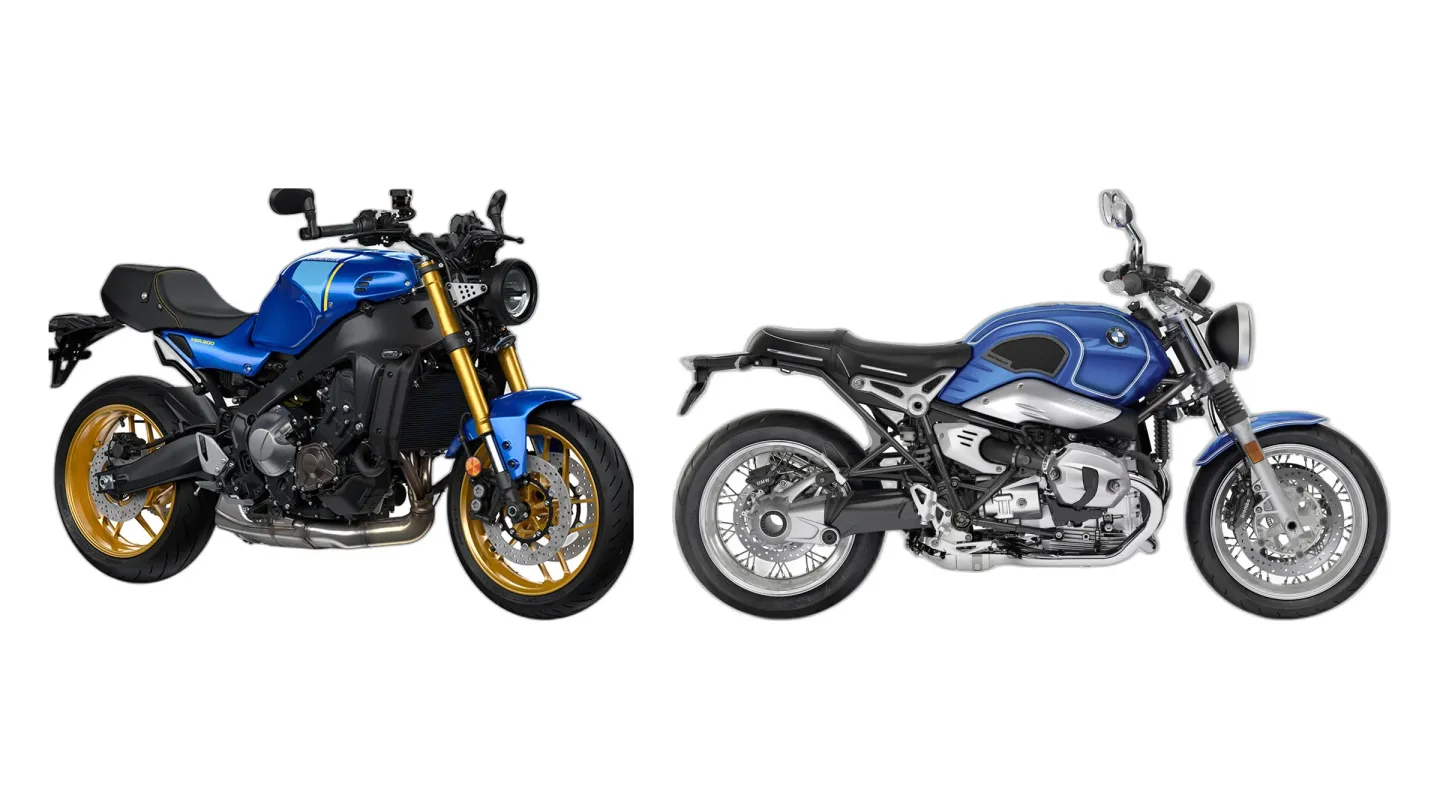
Yamaha XSR900 (RN43) vs BMW R nineT (MY2020)
Yamaha XSR900 vs BMW R nineT: buy with your heart, but read this first.
You'll feel the Yamaha XSR900 pull from low revs, then howl harder the further you wind it out. The BMW R nineT's throttle doesn't chase revs: it shoves you forward on a thick pulse with the first crack of the grip. Its mechanical beat keeps the pace relaxed.
So which one do you buy?
The XSR900 has the edge if…
Sporty riding on twisty roads
A touch ahead: XSR900
Back-road fun leans slightly toward the XSR900. It's a narrow call, so trust your test ride.
The R nineT has the edge if…
Keeping running costs low
By a nose: R nineT
The R nineT comes out a little ahead on upkeep. Only a little.
Character, looks and sound
Small edge: R nineT
On style, the R nineT makes a slightly stronger case. Most of that is more retro style and a purer look. Go see both in person.
Which one's the smarter buy
Even on value
The price gap is too small to decide the value question. Neither bike is the clear better buy for the money.
What makes each one tick
XSR900
Along the Blue Ridge Parkway, the XSR900's neutral steering flicks it through one bend after another, yet it doesn't wander once the speed climbs. With 430 lb (195 kg) to move, it'll change line off a light push on the wide bar. Broken pavement doesn't get soaked up: the fork and shock pass each sharp edge into the seat. Its intake snarl eggs you on.
Nils rode the XSR900 in Styria in 2018 (NastyNils Testride).
R nineT
Mid-corner, the R nineT sits planted on its line, with the wide bar holding the steering steady. Its pegs don't scrape early. Brembo calipers answer the brake lever, and the chassis stays composed into the bend. Its boxer keeps thrumming gruffly below the alloy tank.
The Voice of Experience

What actually separates them
- The R nineT has the lower seat: 31.7 in (805 mm) vs 32.7 in (830 mm).
- The XSR900 has the lower wet weight: 430 lb (195 kg) vs 489 lb (222 kg).
- The R nineT makes more peak torque: 86 lb-ft (117 Nm) vs 65 lb-ft (88 Nm).
Which one for the way you ride
Comfortable long-distance riding
Neither one fits
For all-day comfort, both fall short. Keep the rides short and you'll get on fine with either.
These two run dead level on commuting. Sit on both in the showroom and trust what your body says.
Who each one is built for
What's good, and what you'll live with
XSR900
What owners say
Strengths
- Addictive CP3 engine character
- Neo-retro styling with premium materials
- Excellent value for money
Trade-offs
- Suspension is budget-oriented and can be harsh
- Indicator switch placement is awkward
- Mirrors offer poor rearward visibility
R nineT
What owners say
Strengths
- Charismatic boxer engine
- Timeless custom-friendly styling
Trade-offs
- Suspension can be a mixed bag
- Thin, uncomfortable stock seat
Known problems to check before you buy
XSR900
- Handlebar holder bolt recall Recall 17V221000 On 2016-2017 models, the lower handlebar holders may not have had sufficient thread-locking agent due to improper painting, allowing bolts to loosen and potentially cause loss of control.
- Cam chain tensioner rattle on cold start The automatic cam chain tensioner on the CP3 triple uses a spring and ratchet plunger with no oil-pressure actuation. Its ratchet can fail to hold the plunger in position and back off. The cam chain then runs slack and slaps its guides, which shows up as a ticking or rattling noise from the cam chain area that is loudest on cold starts. At first it may die down once the engine warms up, but it can get worse until it is constant. If ignored, the slack chain speeds up wear on the chain guides and sliders.
R nineT
- Oil consumption The air/oil-cooled boxer engine is known to consume oil by design due to its operating tolerances. Owners typically report consumption that requires attention, though BMW officially considers a certain level as acceptable. While completely normal and not a mechanical defect, it requires action: used buyers must check the sight glass regularly and always carry a top-up bottle on longer tours to prevent running low.
What they cost used
These prices compare a 6-year-old XSR900 with a 6-year-old R nineT.
- XSR900
- about $8,000
- R nineT
- about $7,900
What they share
- Gearbox
- 6-speed
- Fork
- Upside-down (USD)
- Front tire
- 120/70-17
- Rear tire
- 180/55-17
Where the spec sheets split
| XSR900 | R nineT | |
|---|---|---|
| Seat height | 32.7 in (830 mm) | 31.7 in (805 mm) |
| Wet weight | 430 lb (195 kg) | 489 lb (222 kg) |
| XSR900 | R nineT | |
|---|---|---|
| Displacement | 847 cc | 1170 cc |
| Engine | Inline-three | Flat-twin (boxer) |
| Cooling | Liquid-cooled | Air/oil-cooled |
| Power | 115 hp (85 kW) | 110 hp (81 kW) |
| Peak power at | 10,000 rpm | 7,750 rpm |
| Torque | 65 lb-ft (88 Nm) | 86 lb-ft (117 Nm) |
| Peak torque at | 8,500 rpm | 6,000 rpm |
| XSR900 | R nineT | |
|---|---|---|
| Fuel capacity | 3.7 US gal (14 L) | 4.8 US gal (18 L) |
| XSR900 | R nineT | |
|---|---|---|
| Final drive | Chain | Shaft |
| Front brake | 298 mm | 320 mm |
| Wheelbase | 56.7 in (1440 mm) | 58.5 in (1487 mm) |
What comes fitted, what costs extra
| XSR900 | R nineT | |
|---|---|---|
| Ride Modes | Standard | Not offered |
| Slipper Clutch | Standard | Not offered |
Head to head, area by area
Both bikes on the same scale, one area at a time.