By NastyNils·
Motorcycle comparison · Retro Classic
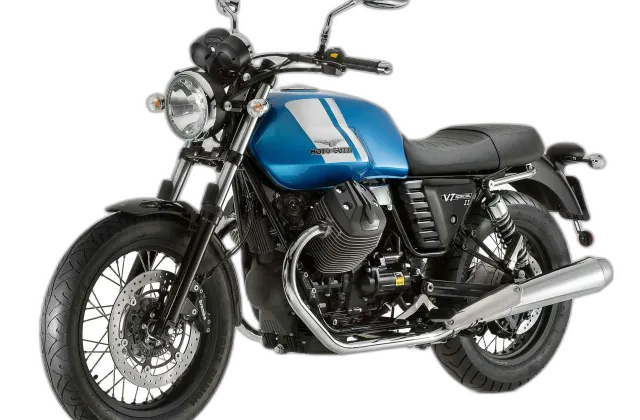
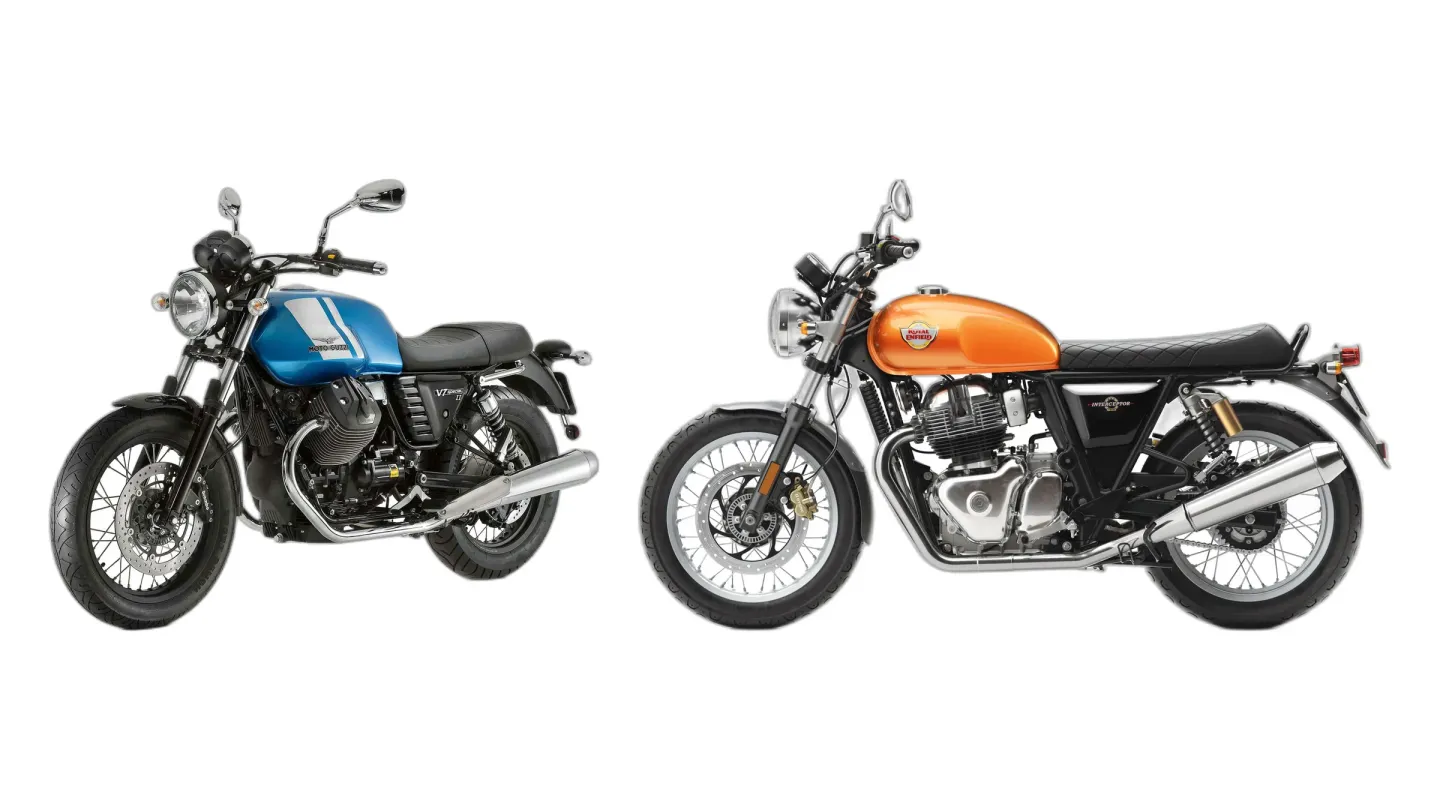
Moto Guzzi V7 II Special (MY2015) vs Royal Enfield Interceptor 650 (MY2018)
Rolling away from a light, the Moto Guzzi V7 II Special's sideways V-twin thumps from low revs, and it's got a soulful Italian pull. The Royal Enfield Interceptor 650's offbeat firing order kicks up a lively beat off the line. Its midrange swells smoothly and doesn't bite back.
So which one do you buy?
The V7 II Special has the edge if…
Sporty riding on twisty roads
A touch ahead: V7 II Special
On a winding road, the V7 II Special comes out a touch ahead. What tips it: stronger brakes. You wouldn't bet much on a gap like that.
Character, looks and sound
Nose ahead: V7 II Special
The V7 II Special carries slightly more attitude. Most of that is a better engine note and more engine character. A close call, and a personal one.
Keeping running costs low
Edges it: V7 II Special
Running costs lean slightly toward the V7 II Special. A well-kept example of either matters more.
Daily commuting & city riding
Narrow edge: V7 II Special
The V7 II Special edges it for the daily grind. Credit simpler maintenance and a smaller footprint. It's a small gap, not a reason on its own.
Which one's the smarter buy
Money won't decide it
The Interceptor 650 costs less, but that gap doesn't make it the better buy. Neither bike is the clear winner on value for the money.
What makes each one tick
V7 II Special
The V7 II Special's wide bar tips the front into a bend with hardly any effort from a seat that sits low. There's peak torque at only 2,800 rpm, and the engine answers a small crack of throttle long before the tach needle climbs. It's breathless at highway pace.
Interceptor 650
On the Interceptor 650, the engine's stout middle and easygoing nature coax you into riding lazily. Its teardrop tank and chrome trim carry a classic roadster look that hasn't aged.
The Voice of Experience

What actually separates them
- The V7 II Special has the lower seat: 31.1 in (790 mm) vs 31.7 in (806 mm).
- The V7 II Special has the lower wet weight: 417 lb (189 kg) vs 470 lb (213 kg).
- The V7 II Special makes more peak torque: 44 lb-ft (60 Nm) vs 39 lb-ft (52 Nm).
Which one for the way you ride
Comfortable long-distance riding
Both fall short
Long days aren't what these two do best. Plan shorter legs and plenty of stops.
Who each one is built for
What's good, and what you'll live with
V7 II Special
What owners say
Strengths
- Charismatic and authentic V-twin engine
- Stunning retro looks with high-quality finish
- Easy handling and approachable for new riders
- Comfortable, natural riding position
Trade-offs
- Basic suspension lacks damping control
- Limited top-end performance
Interceptor 650
What owners say
Strengths
- Torquey and characterful parallel-twin
- Classic, timeless styling
- Outstanding value for money
Known problems to check before you buy
V7 II Special
- Low-speed throttle snatchiness Engine response at very low engine speeds can be abrupt and jerky, making slow riding in traffic frustrating.
Interceptor 650
- Brake caliper corrosion (recall SC-14) Recall 21V045000 Non-anodized calipers can corrode when exposed to road salt, causing brake drag or reduced performance. Royal Enfield recalled 2018-2020 models to replace front and rear calipers with anodized units.
- Rectifier-regulator failure The rectifier-regulator unit malfunctions, causing battery drainage, blown relay fuses, and warning lights on the instrument cluster.
What they cost used
These prices compare a 7-year-old V7 II Special with a 7-year-old Interceptor 650.
- V7 II Special
- about $5,200
- Interceptor 650
- about $3,500
At seven years old, the Moto Guzzi V7 II Special sits around $5,200 while the Royal Enfield Interceptor 650 lands near $3,500. That's a $1,700 gap in the Interceptor 650's favor. These are US market estimates, not live listings.
What they share
- Power
- 48 hp (35 kW)
- Gearbox
- 6-speed
- Front tire
- 100/90-18
Where the spec sheets split
| V7 II Special | Interceptor 650 | |
|---|---|---|
| Seat height | 31.1 in (790 mm) | 31.7 in (806 mm) |
| Wet weight | 417 lb (189 kg) | 470 lb (213 kg) |
| V7 II Special | Interceptor 650 | |
|---|---|---|
| Displacement | 744 cc | 648 cc |
| Engine | 90° V-twin | Parallel twin |
| Cooling | Air-cooled | Air/oil-cooled |
| Peak power at | 6,200 rpm | 7,150 rpm |
| Torque | 44 lb-ft (60 Nm) | 39 lb-ft (52 Nm) |
| Peak torque at | 2,800 rpm | 5,250 rpm |
| Top speed | 100 mph (161 km/h) | 106 mph (170 km/h) |
| V7 II Special | Interceptor 650 | |
|---|---|---|
| Fuel economy | 37 mpg (US) / 6.3 L/100 km | 42 mpg (US) / 5.6 L/100 km |
| Fuel capacity | 5.5 US gal (21 L) | 3.6 US gal (13.7 L) |
| V7 II Special | Interceptor 650 | |
|---|---|---|
| Final drive | Shaft | Chain |
| Rear tire | 130/80-17 | 130/70-18 |
What comes fitted, what costs extra
| V7 II Special | Interceptor 650 | |
|---|---|---|
| Traction Control | Standard | Not offered |
| Manually Adjustable Rear Suspension | Standard | Not offered |
| Slipper Clutch | Not offered | Standard |
Head to head, area by area
Both bikes on the same scale, one area at a time.