By NastyNils·
Motorcycle comparison · Retro Classic
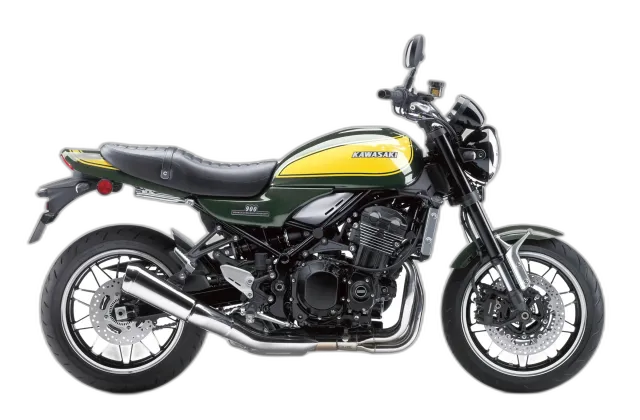
Kawasaki Z 900 RS (MY2018) vs Moto Guzzi V7 Stone (Euro5)
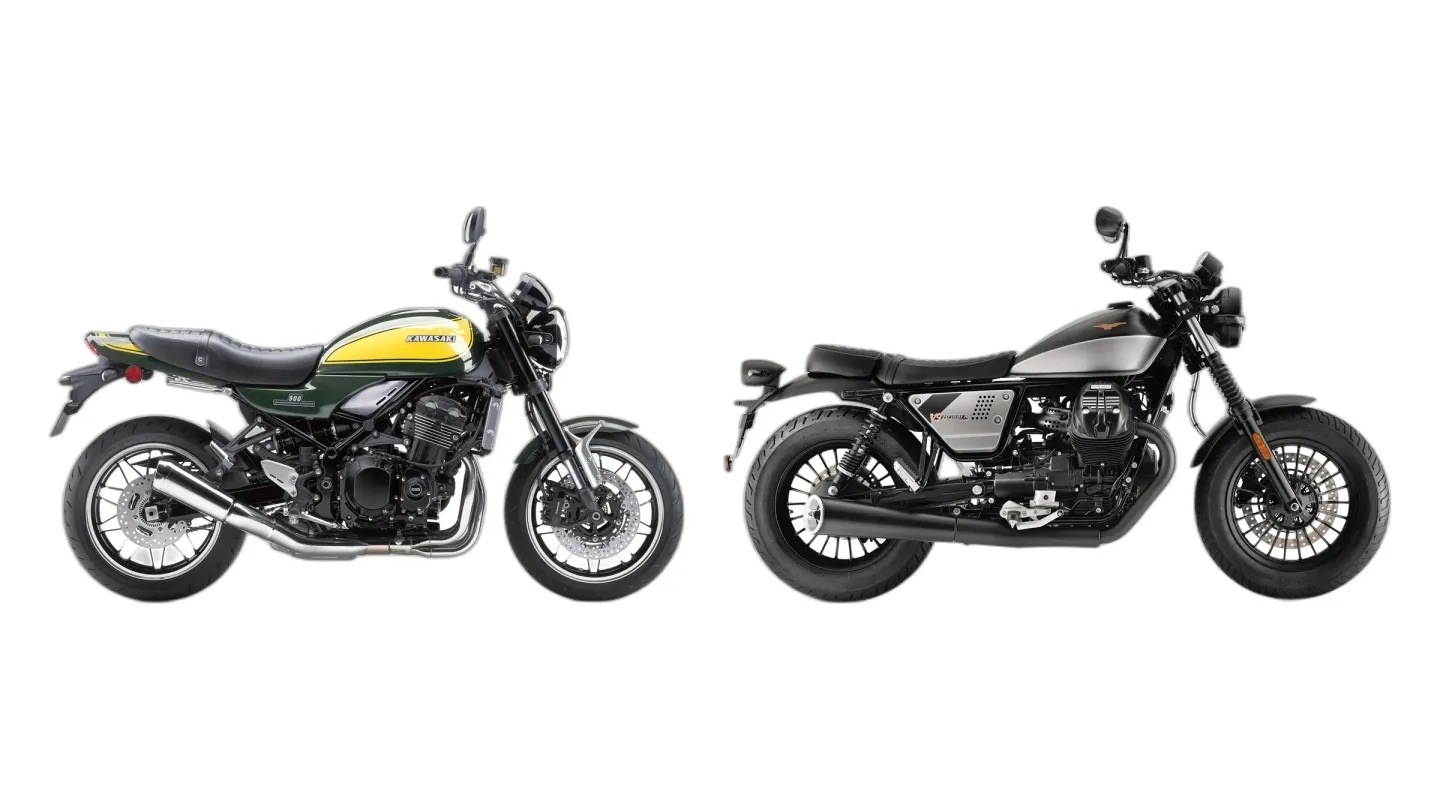
Kawasaki Z 900 RS vs Moto Guzzi V7 Stone: style matters. So does everything underneath.
Push the Kawasaki Z 900 RS through a run of bends and it's right there with far meaner-looking hardware. The Moto Guzzi V7 Stone settles low and holds its line.
So which one do you buy?
The Z 900 RS has the edge if…
Sporty riding on twisty roads
By a nose: Z 900 RS
Once the road starts to bend, the Z 900 RS noses ahead. That comes from harder acceleration and more feel through the bars. Your own skill counts for more than a gap this size.
Character, looks and sound
A touch ahead: Z 900 RS
The Z 900 RS nudges ahead on character. Most of that is a better engine note and more scrambler looks. It's a small gap in a category ruled by taste.
Which one's the smarter buy
No clear advantage
The lower sticker price on the V7 Stone doesn't settle which one is the better buy. Neither is the clear better buy for the money.
What makes each one tick
Z 900 RS
Upright doesn't mean stuck on the Z 900 RS: there's room to shift your weight at corner entry and work the wide bars. The fork keeps talking through the turn and doesn't beat you up on the straights in between. It hustles on a twisty road. Two-up over loose rock at night, the bars still answer.
Nils rode the Z 900 RS in Styria and Switzerland in 2018, and in Austria and Montenegro in 2024 (NastyNils Testride).
V7 Stone
With its mass carried close to the ground and a 30.7 in (780 mm) seat, the V7 Stone doesn't fuss in slow city traffic. On the Blue Ridge Parkway, the frame stays composed through the curves. Bumps don't unsettle the chassis. Down low, the sideways twin pulls and throbs.
The Voice of Experience
What actually separates them
- The V7 Stone has the lower seat: 30.7 in (780 mm) vs 32.9 in (835 mm).
- The Z 900 RS makes more peak power: 111 hp (82 kW) vs 65 hp (48 kW).
- The Z 900 RS makes more peak torque: 73 lb-ft (98 Nm) vs 54 lb-ft (73 Nm).
Which one for the way you ride
A confidence-building first motorcycle
Wrong tool: Z 900 RS
No first-bike verdict for the Z 900 RS. It's a step up for later.
There's no real gap on commuting and running costs. Sit on both and let fit and price decide.
Who each one is built for
What's good, and what you'll live with
Z 900 RS
Strengths
- Torque from the basement
- Built for long days
- Tall-rider friendly ergonomics
- Fully adjustable at both ends
- Faster than it looks
Trade-offs
- Rear shock thumps sharp hits
- Loose through transitions
- No quickshifter offered
- No wind protection
- Stock seat uncomfortable on long rides
V7 Stone
What owners say
Strengths
- Accessible seat height and easy manoeuvrability
- Authentic retro styling with classic charisma
- Improved handling and chassis composure
- Torquey and characterful V-twin engine
Trade-offs
- Electrical gremlins reported by some owners
Known problems to check before you buy
Z 900 RS
- Front tire may develop internal blistering (Sumitomo manufacturing defect) Due to a defective manufacturing process during sidewall rubber installation, the front tire may develop blistering on the inner surface. A tire with internal blistering can fail and increase crash risk. Tire supplier: Sumitomo Rubber Industries, Ltd. Non-compliant with FMVSS 119. Affects only MY2024 Z900RS ABS, Z900RS Café ABS, and Z900RS SE ABS.
- ABS hydraulic unit contaminated with aluminum shavings The ABS hydraulic unit may have been contaminated with aluminum shavings during manufacturing (defective fixture shaving ABS pump housing). This can cause the front or rear wheel to lock up during braking despite ABS. Affects MY2019 Z900RS ABS and Z900RS Café ABS.
- Front brake lacks sharp initial bite, spongy lever feedback Despite radial-mount four-piston Nissin calipers, the front brake lacks direct, firm initial bite. The lever feel is indirect, especially during aggressive downhill braking. Braided steel lines and higher-performance brake pads significantly improve feel. The SE model (from MY2022) with Brembo M4.32 calipers and braided steel lines resolves this issue from the factory.
- ABS activates prematurely, especially on front brake The Nissin ABS unit activates prematurely, especially at the front brake during harder braking. The ABS is not deactivatable on any 2018–2024 model year. This reduces confidence during aggressive braking and trail braking. The ABS kicks in earlier than desired.
- Snatchy, on-off throttle response at low RPM (ECU mapping) The Z900RS exhibits abrupt, jerky throttle behavior at low RPM and low speeds, particularly when rolling on throttle from closed, departing from standstill, and during gentle gas application in corners. The fuel-cut programming (overrun fuel cutoff for emissions compliance) causes abrupt injection on/off behavior. The dual throttle valve system (sub-throttle servo) with cable-operated main throttle exacerbates the issue. The problem is most pronounced on MY2018–2019 models. Common remedies: ECU reflash (e.g., Ivan's Performance), throttle cable adjustment. Later model years show improvement according to multiple sources.
- Engine revs to 2,500–4,000 rpm on cold start On cold start, the engine revs up to 2,500–4,000 rpm to bring the catalytic converter to operating temperature faster (Euro 4/5 emissions compliance). This is particularly intrusive in residential areas. It is not a defect but a deliberate ECU calibration for emissions standards. Some owners report occasional stalling during warm-up phase.
- Clutch judder/shudder when cold during takeoff The clutch exhibits pronounced judder when cold during engagement into first gear. Multiple owners report the problem partially persists after warm-up. Some dealers consider this normal behavior. Possible remedies: soak clutch plates in oil overnight (dealer recommendation), use higher-quality engine oil. The clutch judder when cold is a widely documented complaint.
V7 Stone
- Electrical alternator and ignition coil/plug cap issues Some owners report alternator concerns and failures of spark plug caps or ignition coils, causing intermittent misfires, poor running, or starting difficulties. Often resolved under warranty.
What they cost used
These prices compare a 5-year-old Z 900 RS with a 5-year-old V7 Stone.
- Z 900 RS
- about $8,900
- V7 Stone
- about $6,900
At five years old, the Kawasaki Z 900 RS sits around $8,900 while the Moto Guzzi V7 Stone lands near $6,900. That's a $2,000 gap in the V7 Stone's favor. These are US market estimates, not live listings.
What they share
- Gearbox
- 6-speed
Where the spec sheets split
| Z 900 RS | V7 Stone | |
|---|---|---|
| Seat height | 32.9 in (835 mm) | 30.7 in (780 mm) |
| Wet weight | 474 lb (215 kg) | 481 lb (218 kg) |
| Z 900 RS | V7 Stone | |
|---|---|---|
| Displacement | 948 cc | 853 cc |
| Engine | Inline-four | 90° V-twin |
| Cooling | Liquid-cooled | Air-cooled |
| Power | 111 hp (82 kW) | 65 hp (48 kW) |
| Peak power at | 8,500 rpm | 6,800 rpm |
| Torque | 73 lb-ft (98 Nm) | 54 lb-ft (73 Nm) |
| Peak torque at | 6,500 rpm | 5,000 rpm |
| Z 900 RS | V7 Stone | |
|---|---|---|
| Fuel capacity | 4.5 US gal (17 L) | 5.5 US gal (21 L) |
| Z 900 RS | V7 Stone | |
|---|---|---|
| Final drive | Chain | Shaft |
| Front tire | 120/70-17 | 100/90-18 |
| Rear tire | 180/55-17 | 150/70-17 |
What comes fitted, what costs extra
| Z 900 RS | V7 Stone | |
|---|---|---|
| Manually Adjustable Front Suspension | Standard | Not offered |
| Slipper Clutch | Standard | Not offered |
| Smartphone Connectivity | Not offered | Option |
| USB Charging Port | Option | Not offered |
| Heated Grips | Option | Not offered |
Head to head, area by area
Both bikes on the same scale, one area at a time.