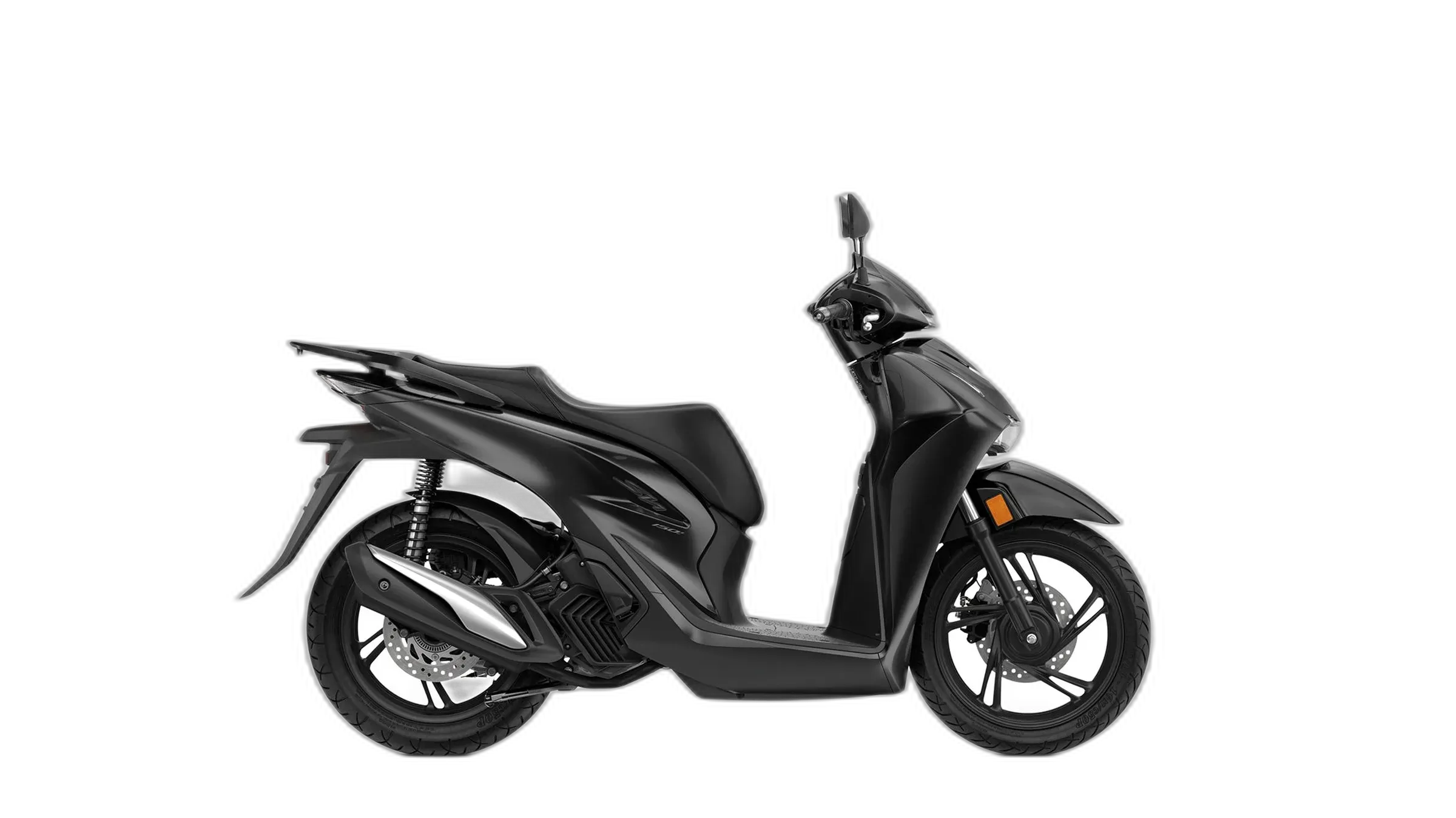



Honda SH150i (Gen1) — Scooter
NastyNils / Honda press archive

2013–2019 · Scooter · Buyer's Guide

SH150i (Gen1)

Big Wheels, Honest Commuter

The Machine's Character

The SH150i is built around 16-inch wheels, and that's what sets it apart from the small-wheel city crowd. Underneath sits a 153cc liquid-cooled, fuel-injected single making 15 hp and 10 lb-ft, enough to reach and hold 68 mph. Those big hoops give it a composure most scooters this size never find, rolling over broken pavement and potholes without the nervous shuffle. It's a commuter first, tuned for stability at speed rather than darty flicks through gaps. That combination lands it in a narrow slice of the class: a scooter you can genuinely take onto a highway for short hops, holding 55-60 mph traffic, even if its 68 mph ceiling leaves nothing for sustained freeway cruising.

Ride it the way real scooter riders ride, throttle into the corner and brake late, and the chassis has reserve to spare. At 303 lb with a 31.5-in seat it stays easy to manage in traffic and cheap to run, sipping fuel at 102 mpg. Reliability and clean build quality are why it ages well. The honest caveat is storage. The under-seat bin swallows a full-face helmet and little else, so anything bigger lives in a top case you unlock with the ignition key. For a rider whose cargo rarely grows past a helmet and a jacket, that's a fair trade.

Hard Numbers

Spec sheets don't ride bikes, but they set the baseline.

Show full specs & equipment Hide specs & equipment
Key specifications
Power 15 hp (11 kW)
Torque 10 lb-ft (14 Nm)
Displacement 153 cc
Engine Single-cylinder
Cooling Liquid-cooled
Final drive Belt
Front brake 240 mm
Front tire 100/80-16
Rear tire 120/80-16
Seat height 31.5 in (799 mm)
Wet weight 303 lb (137 kg)
Fuel capacity 2.0 gal (7.5 L)
Top speed 68 mph (109 km/h)
Fuel economy 102 mpg (US)

The Voice of Experience

Portrait of NastyNils

The test ride

The riding position is upright and roomy, the 31.5-in seat low enough to flat-foot at the lights and the bars falling naturally to hand. Thumb the switchgear and everything clicks with a tight, repeatable snap, no wobble in the throttle grip or levers, the non-slip footmat flush underfoot. The single spins up smooth and quiet, without the buzz that creeps into cheaper scooters at a steady cruise. Sit at a stop and the auto start/stop cuts the engine, then fires it straight back the instant you roll on, no stumble, no waiting. Weight carries low, so all 303 lb feels lighter than the number when you paddle into a parking spot. On rough city streets the big wheels soak up ruts and expansion joints that would jar a small-wheel machine. It feels screwed together to last.

Rated point by point — where it earns its keep

My own 0–100 score for this bike against the class, area by area — the marker on each bar is the class average.

What holds my confidence here is that nothing about the build asks you to keep an eye on it. Every switch answers with the same firm, repeatable action, and there's no slack anywhere in the grips or levers. Running costs stayed genuinely low across my miles, and the automatic engine cut at a red light woke back up without a beat of hesitation whenever I pulled away, every single time.

Here's where a scooter pitched at daily chores trips over itself. The seat well swallows a full-face helmet and quits there, the deep rims stealing the room a loaded backpack or a grocery run would want. Everything else lives out back in the added case, and reaching it is the daily irritation: you tug the ignition key free and walk it to the tail on every stop. On errand-heavy days it wears thin. A remote latch would have ended the whole nuisance.

Ridden the way most people actually ride a scooter, hustled into bends with late brakes and a lazy read of the physics, the chassis just copes and leaves grip in hand. The tall wheels give up the quick, darty steering of a smaller machine, and what they hand back is steadiness. It holds its line at speed and stays calm through longer curves. For everyday miles, that's the bargain I'd take.

What I trust here is how the bike behaves when I brake late and hard while still carried over into a bend. It stays composed at the lever, holds its chosen line, and shows no urge to sit up and drift wide. I leaned on that behavior repeatedly and it never varied, giving back the same predictable stop each pass. For all-day work through packed junctions, that consistency matters to me more than any single headline number.

The reason I stop calling this a pure city bike sits under the floor. There's real motor here, enough to climb onto a highway under its own steam for a short hop and settle into 55-60 mph flow without hunting for a truck to shelter behind, though at its 68 mph ceiling I keep the sustained freeway runs off the menu. That bit of extra capacity is what does it, and it stretches the scooter into a genuine tool for commutes that mix town streets with faster road.

Elevated aerial view of Seattle's downtown skyline looking toward the city core along a dense urban street canyon. A mix of glass-and-steel skyscrapers and mid-rise residential towers fills the frame. A construction crane is active on the left. The street below carries light vehicle traffic flanked by mature street trees.
Josh Hild / Pexels

The Truth on the Street

What follows isn't the record of a single afternoon in the saddle. It's the sum of years spent reading owner mail, trading notes with riders who flag me down to talk, and long conversations with people who put real miles on this scooter. Line it all up and the mood tilts one way on how it rides and the other way on what it costs.

Where The Praise Lands

The large wheels draw the most agreement by far, credited for a planted, unbothered feel across broken city surfaces, and a few riders extend that steadiness to wet roads. Close behind, owners talk up the little liquid-cooled engine for its toughness and thrift, stacking up big miles without drama. Many also point to the upright seating and roomy floorboards for keeping longer commutes easy on the body, and a smaller group values how little upkeep the belt drive and cooling setup ask for.

The Two Sticking Points

Only two gripes recur. Loudest is what it asked for new: riders note it sat well above cheaper rivals and crept toward the money you'd spend on a bigger bike. Far quieter is the rear drum, which a handful say gives up feel and stopping force next to a disc.

Known issues

  • Sudden engine power loss while riding

    enginerare

    Some owners have reported the engine bogging down unexpectedly when applying throttle, requiring a restart or towing.

  • Hill climbing performance on steep grades

    engineoccasional

    On long, steep hills the 153cc engine can feel breathless, dropping speed unless momentum is carried in.

The Expert Benchmark

Where this Honda SH150i pulls ahead of — or falls behind — its rivals on the numbers, and the typical bike in its class on character.

What kind of bike this is — character vs. the class

This bike Class average

Head-to-head: Honda SH150i vs. its rivals

The 'Should I Buy It?' Score

Forget spec-sheet bragging. Here's who the SH150i is actually built for.

Aerial photograph of downtown Austin, Texas, showing modern high-rise buildings against a clear blue sky. Urban infrastructure, highways, and parking structures visible in the foreground.
Thomas Balabaud / Pexels

Best scooter for NYC?

This is your bike. Cheap to run at 102 mpg, easy to park, stable over broken city pavement, and quick enough to hold traffic. Just know the under-seat storage is tight, so budget for the top case.

Made for Austin · Los Angeles · Miami Beach / Miami

Best motorcycle for Bay Area?

It handles your city miles and the calmer ridge roads with composure, but 15 hp and a 68 mph top end mean you're cruising the sweepers, not chasing anyone. Strong for the commute, modest for spirited weekend runs.

Made for Bay Area Ridge Roads · San Francisco / Bay Area · Skyline Boulevard / Alice's Restaurant