


·

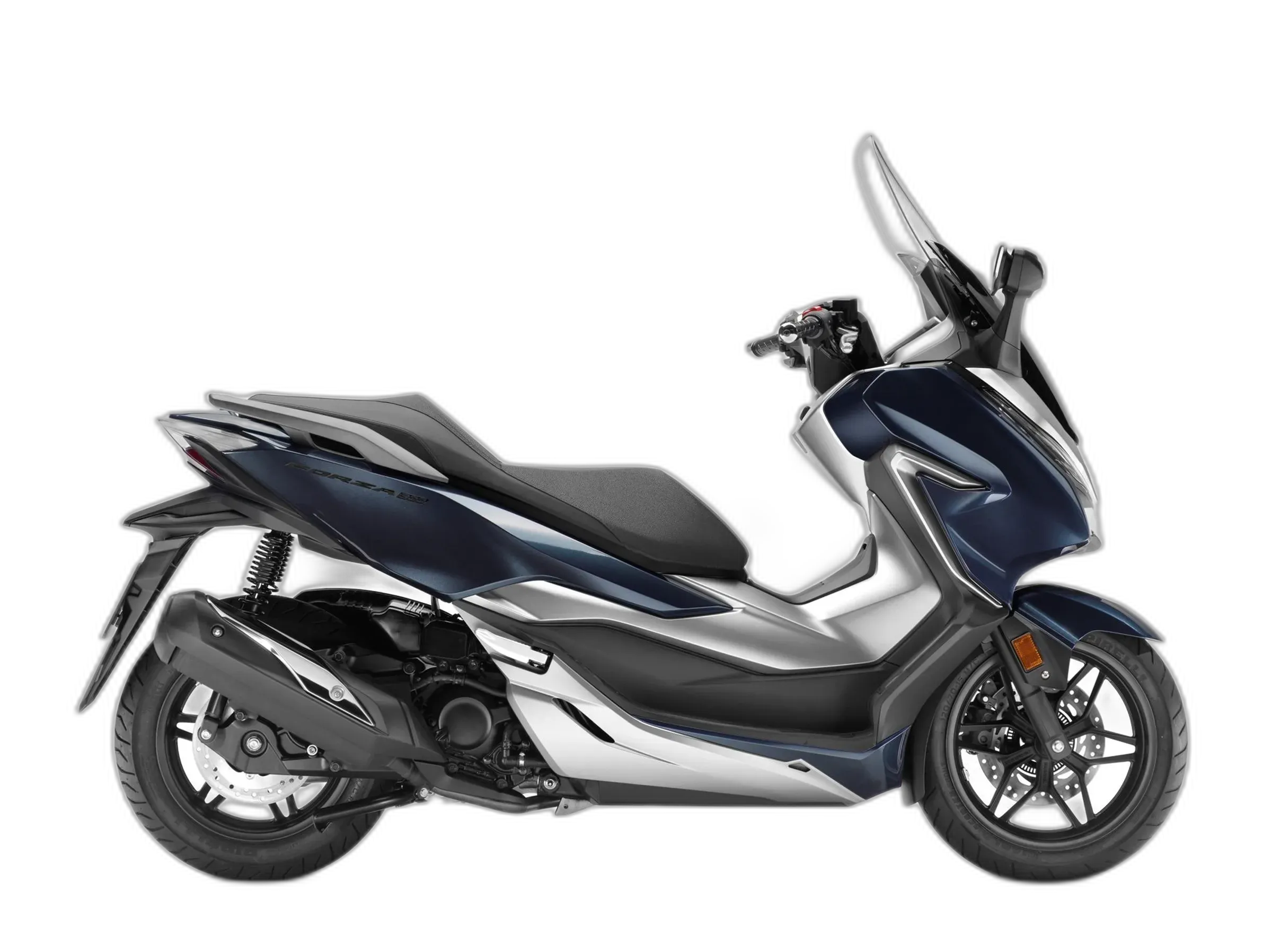
Honda Forza 300 (NSS300 MF13) — Scooter
NastyNils / Honda press archive

2018–2020 · Scooter · Buyer's Guide

Forza 300 (NSS300 MF13)

City Easy, Highway Capable

The Machine's Character

The Forza 300 is Honda's premium maxi-scooter answer for riders who want real utility with none of the fuss. Its 279 cc liquid-cooled single makes 25 hp and 20 lb-ft, enough to keep pace with city traffic and hold a steady clip on faster roads. What sets this one apart is how light and willing it feels for its class, backed by full LED lighting, keyless start, and a genuinely useful under-seat well that hides two full-face helmets. ABS and traction control come standard, which is uncommon reassurance on a scooter.

On the road it does what Hondas do best. It starts every morning, asks little of you, and rewards daily use with low running costs and light, predictable handling. Build quality is solid, so reliability is rarely a worry over the long haul. It suits the city rider first, though it doubles nicely as a relaxed weekend machine. Be honest about the limits. The 25 hp is ample around town but never thrilling, and a few niggles around the battery, smart key, and low-speed take-off can surface. Manage those and it stays quietly satisfying.

Hard Numbers

Spec sheets don't ride bikes, but they set the baseline.

Show full specs & equipment Hide specs & equipment
Key specifications
Power 25 hp (18 kW) @ 7,000 rpm
Torque 20 lb-ft (27 Nm) @ 5,750 rpm
Displacement 279 cc
Engine Single-cylinder
Cooling Liquid-cooled
Front tire 120/70-15
Rear tire 140/70-14
Seat height 30.7 in (780 mm)
Wet weight 401 lb (182 kg)
Fuel capacity 3.0 gal (11.5 L)
Top speed 80 mph (129 km/h)

Equipment check

Comfort

  • Heated Grips Optional
  • Adjustable Windscreen Standard

Connectivity

  • Keyless System Standard

Lighting

  • LED Headlight Standard

Safety

  • ABS Standard
  • Traction Control Standard

The Voice of Experience

Portrait of NastyNils

The test ride

Swing a leg over and the 30.7-inch seat puts you upright and commanding, boots flat on the floorboards, wide bars falling right into your hands. Roll on and there's just a soft whir from the drive and a faint buzz through the seat, never harsh. At walking pace it hides its 401 pounds well, balancing easily as you filter and paddle through jams. The screen pushes the worst of the wind up over your chest, and the riding position stays comfortable through a full morning of stops and starts. Twist the throttle and it simply goes, no clutch and no shifting, your left hand free to signal. It feels less like a machine you operate and more like one you just live with.

Elevated aerial view of Seattle's downtown skyline looking toward the city core along a dense urban street canyon. A mix of glass-and-steel skyscrapers and mid-rise residential towers fills the frame. A construction crane is active on the left. The street below carries light vehicle traffic flanked by mature street trees.
Josh Hild / Pexels

The Truth on the Street

The notes below aren't mine to grade. Over many seasons I've gathered what Forza 300 riders pass along, through long online exchanges, talk in the paddock, and messages that reach me once someone has lived with one. Stack it up and a steady theme surfaces: owners pick this scooter for plain, practical reasons and stay on it because it asks so little of them.

Light, smooth, and simple to live with

Riders consistently describe it as light and easy to place at low speed, quick through gaps. The engine earns the same steady praise: the fuel-injected single pulls smoothly, stays free of vibration, and holds a highway clip past 80 mph. Many single out the upright seating and raised bar for keeping them fresh in town and on longer rides. Owners also flag the underseat well that takes two full-face helmets, economy that stretches a tank beyond 200 miles, and traction control that steadies them on wet roads.

The handful of recurring gripes

The gripes are few. The one raised most is the seat, which some find goes hard over a long day, so they fit an aftermarket cushion. A handful add that the battery starts more reliably on a trickle charger when the scooter sits unused for a spell.

Known issues

  • Battery drain when unused

    electrics rare

    Several reports indicate that the battery may lose charge if the scooter isn't ridden regularly, requiring a battery tender to guarantee starting.

  • Jerky take‑off from a stop

    drivetrain occasional

    Some owners experience a jerking symptom when accelerating from a standstill, often starting around 3,000 km. The dealer typically addresses it by removing or adjusting the clutch assembly.

  • Smart key system malfunction

    electrics rare

    If the battery in the smart key is low or the system is not properly set, the scooter may fail to start. Correct key setting resolves the issue.

The Expert Benchmark

Where this Honda Forza 300 pulls ahead of — or falls behind — its rivals on the numbers, and the typical bike in its class on character.

What kind of bike this is — character vs. the class

This bike Class average

Head-to-head: Honda Forza 300 vs. its rivals

The 'Should I Buy It?' Score

Forget spec-sheet bragging. Here's who the Forza 300 is actually built for.

Aerial photograph of downtown Austin, Texas, showing modern high-rise buildings against a clear blue sky. Urban infrastructure, highways, and parking structures visible in the foreground.
Thomas Balabaud / Pexels

Best scooter for NYC?

This is the bike you want. It parks anywhere, sips fuel, and hides two helmets under the seat, built for stop-and-go NYC or Miami Beach days where nothing beats twist-and-go simplicity.

Made for Austin · Los Angeles · Miami Beach / Miami

Best motorcycle for Bay Area?

For city days and relaxed ridge-road weekends it fits well. Just know the 25 hp single is happiest cruising the scenery, not chasing pace up Skyline, and it stays as photogenic as it is practical.

Made for Bay Area Ridge Roads · San Francisco / Bay Area · Skyline Boulevard / Alice's Restaurant