


·

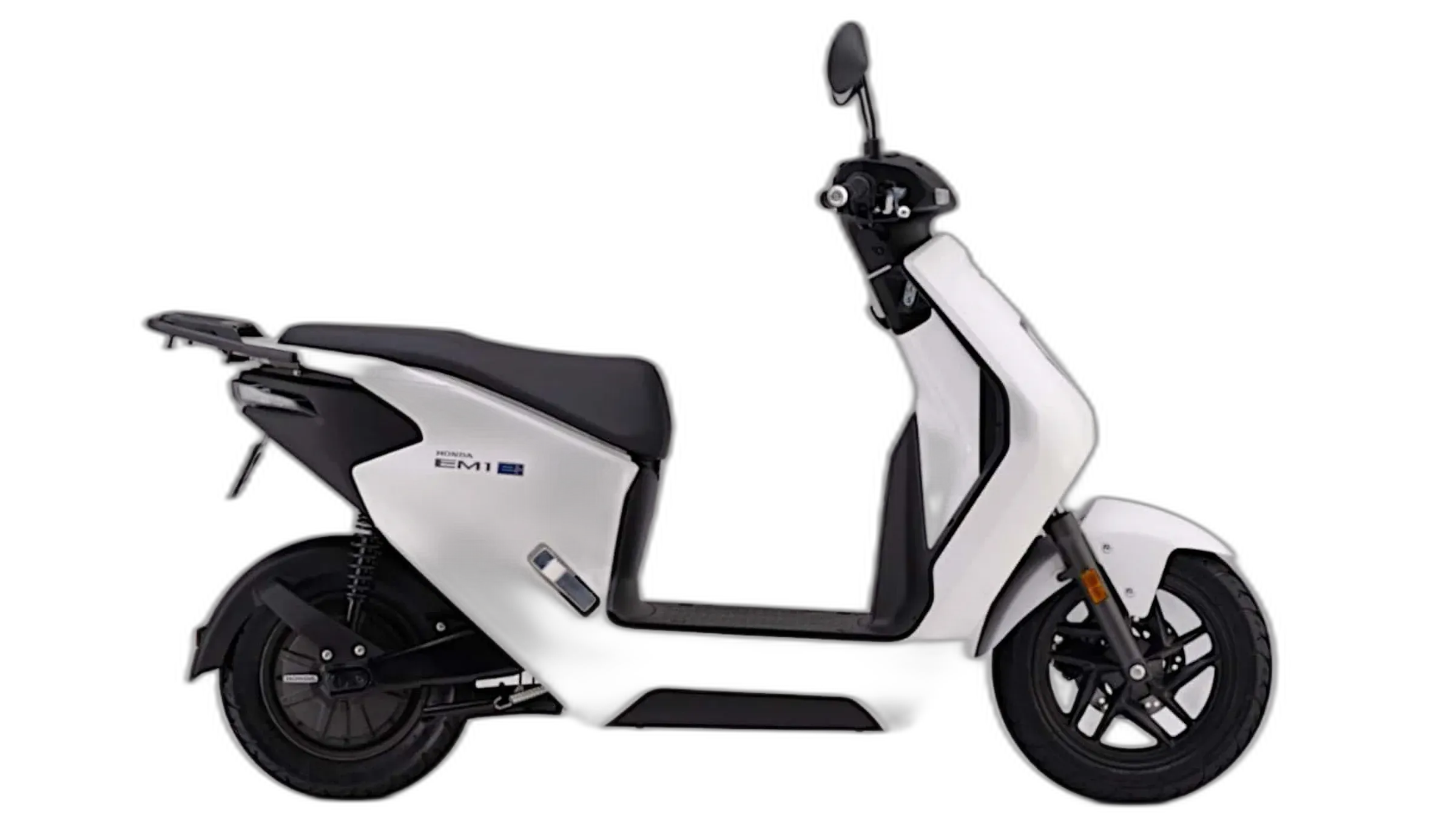
Honda EM1 e (MY2023) — Scooter
NastyNils / Honda press archive

2023–2026 · Scooter · Buyer's Guide

EM1 e (MY2023)

City Quiet Done Right

The Machine's Character

Honda's first electric two-wheeler reads less like a statement and more like a tool built to make city life smaller. The heart is a swappable Mobile Power Pack that slides out the back and charges off any wall socket, so you skip dedicated infrastructure entirely. Twist-and-go operation, a flat floorboard, and a 29.1 in (740 mm) seat mean anyone can ride it on day one. Output sits at 2 hp with a 28 mph (45 km/h) top speed, and Ride Modes let you trade pace for range. What sets it apart in its class is build quality that feels like a real motorcycle maker signed it off.

On the road it flatters you. The 209 lb (95 kg) weight and light steering make dense traffic feel trivial, and the chassis stays composed where budget scooters get nervous. Over time the honest caveats show up. Range shrinks as the battery ages, and it drops further in winter cold or heavy rain. The pack eats nearly all under-seat space, so plan on a top case from the start. And with no onboard charging port, you pull the battery and carry it in every night. For an apartment dweller running short urban miles, that math works. For anyone else it adds friction.

Hard Numbers

Spec sheets don't ride bikes, but they set the baseline.

Show full specs & equipment Hide specs & equipment
Key specifications
Power 2 hp (2 kW)
Torque 66 lb-ft (90 Nm)
Engine Electric
Cooling Air-cooled
Gearbox 1-speed
Fork Telescopic
Front brake 190 mm
Front tire 90/90-12
Rear tire 100/90-10
Seat height 29.1 in (740 mm)
Wet weight 209 lb (95 kg)
Top speed 28 mph (45 km/h)

The Voice of Experience

Portrait of NastyNils

The test ride

Thread it through a busy block and the first thing that lands is the quiet. No exhaust bark, no vibration buzzing up through the floorboard, just clean forward motion that changes how the whole ride feels on your body. The ergonomics disappear in the good way: even at well over six feet I sat relaxed, knees clear of the bars through tight turns. The switchgear falls right where your thumb expects it. Roll the throttle and there's no jerk or surge to manage, so slow filtering stays smooth and unfussy. My test route threw a real climb at it, up to a ski jump facility, and it hauled a full-grown adult up the grade without laboring. The battery pack pulls from the rear cleanly, the latch hardware tight and precise every single time.

Rated point by point — where it earns its keep

My own 0–100 score for this bike against the class, area by area — the marker on each bar is the class average.

Trust over the long run comes down to how it's assembled, and it banks some early. The switches, levers, and body panels carry a density you just don't meet this far down the market, the feel of a company that makes full-size machines holding a small one to the same bar. I worked that battery latch over and over through the test, and it never went loose or vague, holding the same crisp action from the first pull to the last. That kind of consistency is what earns confidence in the years after a test ends.

The chassis quietly refuses to act like cheap plastic. Grooves and ridges cut into the pavement, the kind that flick a rental's front wheel off its line, slide by underneath without unsettling you, and long quick bends hold their arc instead of turning light and skittish. The gulf between this and something built to a rock-bottom price isn't a thing you have to hunt for; it announces itself the first time you lean into a corner. Even well-seasoned riders dropped onto it and felt at home right away, with no settling-in period at all.

Comfort here is about a layout that stays out of your way rather than any cushioning. I stand comfortably past six feet and still settled in relaxed and upright, the bars swinging to full lock in a tight turn without ever clipping my knees, the sort of clash that trips up plenty of compact scooters. The interface stays just as plain: two brake levers, a mode toggle, a USB point, and a hook for a shopping bag. Nothing to puzzle over before you pull away.

The removable pack decides how you live with this scooter, and it opens well. It slides free of the tail in seconds, and the connector hardware feels sturdier than this class usually bothers with: solid, with no play or slop the moment you handle it. Point the front at a genuine climb and it hauls a full-grown adult up the grade without straining. The costs land quickly, though. Raise the saddle and the pack has claimed the room beneath it, leaving barely enough for a folded rain shell, so a rear box belongs in your first budget rather than an afterthought. You also can't run a cord to it. Every top-up means carrying the battery indoors, which is fine over an apartment stairwell and a real nuisance for anyone with a garage already wired for the job. And on a long coast nothing feeds back into the cells, a modest loss on a machine this light but a loss I'd rather not hand away.

Stopping is another spot where it punches past its size. Pull the rear lever on its own and a measured share of the force is routed to the front tire as well, without you asking for it, a trick usually kept for far heavier machines. What won me over more was the feel of it. The action builds gently and reads clearly through the lever, so you can shave speed with real delicacy in slow traffic, and there's honest clamping power held back for the moment a stop turns serious.

What stays with me is how clean the power comes on. Crack it open and there's no snatch and no sudden step, just an even answer that holds whether I'm trickling between cars or clearing an open gap. The pace behind it is honest and modest, building steadily and never once feeling urgent. ECO stretches range but drains enough shove to leave a grown rider dawdling, so I left it alone. Honda built a propulsion tool here, not a thrill machine.

This scooter knows precisely what it's for, and that's dense city work. Thread it through the streets and the first thing to reset is the sound, or the near-total absence of it. With nothing humming under you and no exhaust chasing you through traffic, the ride goes unusually calm, and you're left with a clean forward push and whatever the street itself adds. It reads like a throwaway line on paper and turns out to be anything but the moment you're actually out among the cars, running the short errands it was drawn for.

Elevated aerial view of Seattle's downtown skyline looking toward the city core along a dense urban street canyon. A mix of glass-and-steel skyscrapers and mid-rise residential towers fills the frame. A construction crane is active on the left. The street below carries light vehicle traffic flanked by mature street trees.
Josh Hild / Pexels

The Truth on the Street

This isn't my own test log. It's what I've gathered over years of listening to riders: the letters that reach my inbox, the questions readers put to me directly, and the talk that circulates wherever owners compare notes. For the EM1 e:, that chatter settles into a clear shape.

What owners keep praising

Most of the goodwill collects around the battery. Riders report the pack lifts out easily and tops up from an ordinary household outlet, so no fixed charging point is needed to own one. The weight draws nearly as much comment: at 209 lb (95 kg), owners find it easy to thread through congestion and simple to park. Beginners add their own vote, pointing to the low 29.1 in (740 mm) seat and clutch-free, twist-and-go operation for why it never felt daunting on day one.

Where the complaints gather

The gripes run just as consistent, and range leads. Against about 25 miles (41 km) on the spec sheet, owners see closer to 22 (35 km) once city stop-and-go sets in, and cold weather trims it further, holding the scooter to short errands. Suspension is the next recurring note: fine on smooth pavement, the fork and twin shocks give up over potholes and speed bumps and pass the hit straight to the rider. A few also find the steering nervous at walking pace until they adapt to it.

Known issues

  • Battery degradation reduces range significantly

    electricscommon

    Battery capacity diminishes over heavy charge cycles, reducing the already limited range. Some owners report 15-25% range drop in winter or heavy rain, making the scooter less dependable for longer commutes.

  • 12V auxiliary battery weakness

    electricsoccasional

    The 12V auxiliary battery can weaken after 2-3 years of daily use, leading to electrical quirks or failure to start.

  • Suspension harshness on uneven roads

    suspensionoccasional

    When encountering large potholes or speed bumps, the basic suspension bottoms out easily, causing a jarring ride and discomfort for the rider. This is inherent to the low‑cost, non‑adjustable suspension design and not a defect.

  • Front-end suspension knocking on potholed roads

    suspensionoccasional

    Some owners report a knocking sound from the front suspension when hitting sharp bumps, likely due to loose bushings or insufficient damping.

  • Charging port corrosion or damage

    electricsoccasional

    Moisture ingress can cause corrosion or bent pins in the charging port, leading to intermittent connection or charging failure.

  • Brake pad wear often neglected by owners

    brakesoccasional

    Brake pads can wear quickly, especially at the rear drum, and owners may overlook replacement until braking performance degrades.

  • Display/console firmware glitches

    electricsoccasional

    Early software can cause temporary display flickering or incorrect readouts; typically resolved by an OTA update.

The Expert Benchmark

Where this Honda EM1 e pulls ahead of — or falls behind — its rivals on the numbers, and the typical bike in its class on character.

What kind of bike this is — character vs. the class

This bike Class average

Head-to-head: Honda EM1 e vs. its rivals

The 'Should I Buy It?' Score

Forget spec-sheet bragging. Here's who the EM1 e is actually built for.

Aerial photograph of downtown Austin, Texas, showing modern high-rise buildings against a clear blue sky. Urban infrastructure, highways, and parking structures visible in the foreground.
Thomas Balabaud / Pexels

Best scooter for NYC?

This is exactly your machine. Short hops, tight parking, and pennies-per-mile running costs are its whole reason to exist, and it shrinks NYC or Miami Beach traffic down to nothing.

Made for Austin · Los Angeles · Miami Beach / Miami

Best motorcycle for Bay Area?

The silent electric character and clean design photograph well and suit your city commute. But at a 28 mph cap it can't touch Skyline's ridge roads, so treat it as a pure urban tool, not a weekend bike.

Made for Bay Area Ridge Roads · San Francisco / Bay Area · Skyline Boulevard / Alice's Restaurant