
Some people talk about electric bikes like the last four-cylinder is about to be put down. Those people should spend ten minutes at Honda’s stand at EICMA 2026 in Milan. Sure, there are electric scooters and electric motorcycles on display. But right next to them, Honda rolls out two brand-new gas engine families in a single year: a 500 cc inline-four and the V3R, a gas engine fed by an electric compressor. Whatever the doomsayers claim, combustion is alive and kicking in Milan.
I’ll admit it, I got lost at first. The stand is packed so tight with new hardware that I can’t think of a manufacturer showing more at this show. So I pulled out my cheat sheet, elbowed my way through the crowd and climbed onto whatever bike came free.
A supersport that’s barely there
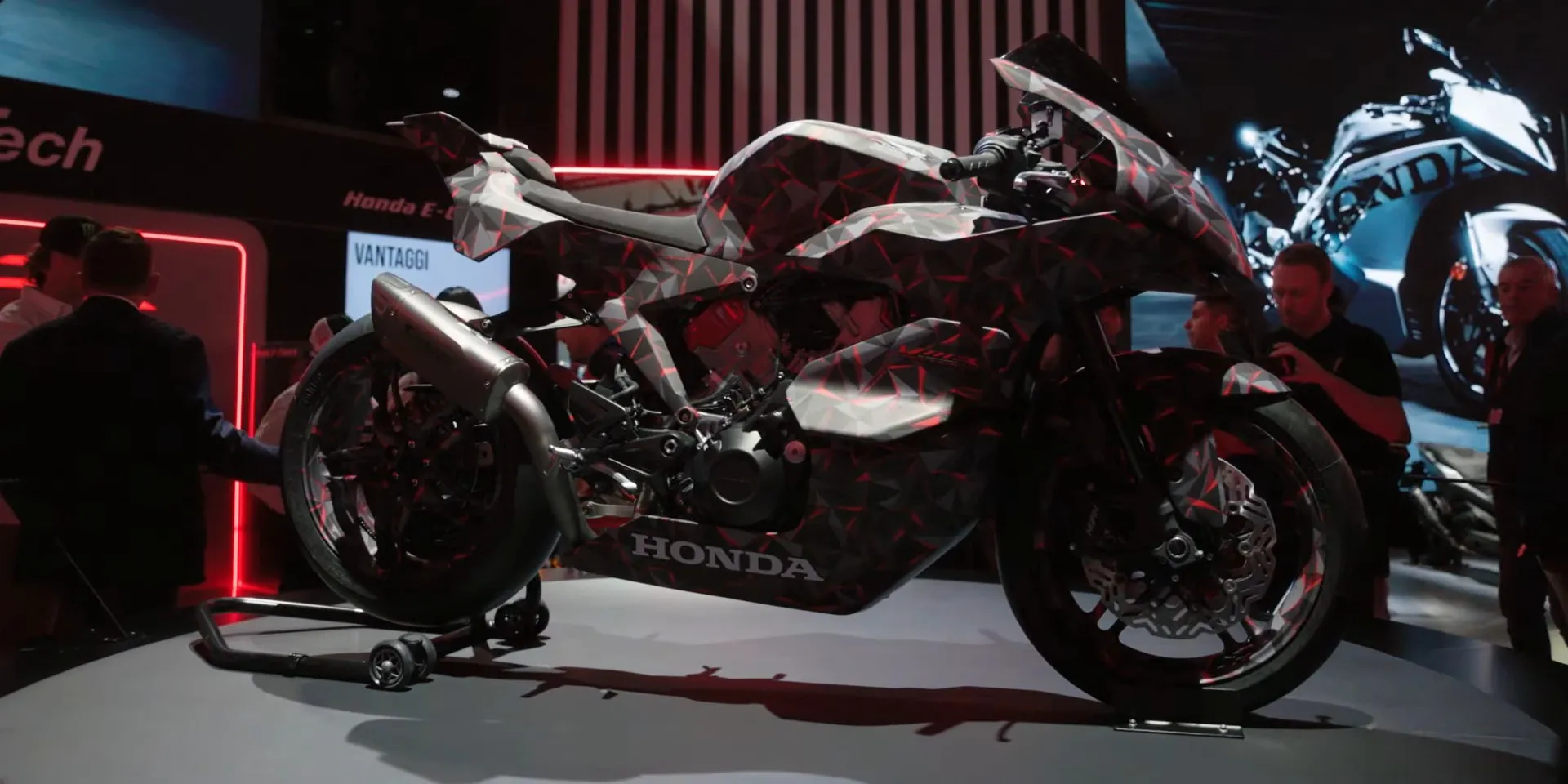
The tank says V3R, and underneath sits the most interesting engine idea in Milan. Honda takes a liquid-cooled 75-degree V3 with 900 cc and force-feeds it with an electronically controlled compressor. Honda says it’s the world’s first for motorcycles. The development target is the output of a 1,200 cc engine. On the stand it sits in a radical supersport prototype covered in aero bits, and the seat unit is basically a rumor. There’s remarkably little bike wrapped around that compact V3, and plenty of room for the rider to tuck in. Walking around it, I’d bet it’s ridiculously light. It’s still a prototype, and my personal guess is that a production version is more like a late 2028 story. The direction is already clear, though, and it’s a good one.
Why an e-compressor beats a turbo
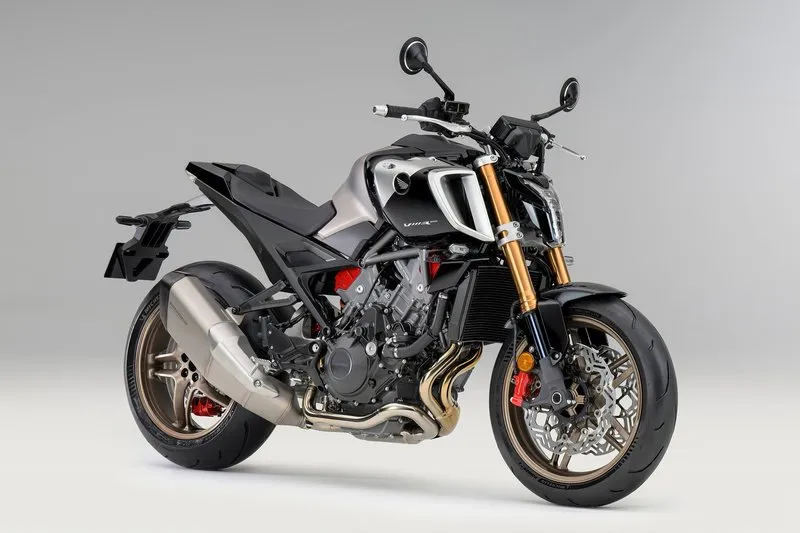
At the far end of the stand the V3R shows up again, this time as a naked bike that already looks close to production. Honda says the prototype is being refined for production but doesn’t give a date. Why does this concept get me so fired up? A turbo comes with all that moody, laggy behavior. The electric compressor makes it disappear: it shoves exactly as much air into the combustion chamber as the engine wants right now, no matter the rpm. That’s why Honda promises torque from way down low. For engineers it’s a playground. Fuel, air, throttle opening, all of it becomes something you can dial in. Run it clean and mild, and when you twist the grip, pour a whole lot of fire onto the pavement. That’s what makes it so interesting.
Three new Africa Twins, all called 1150
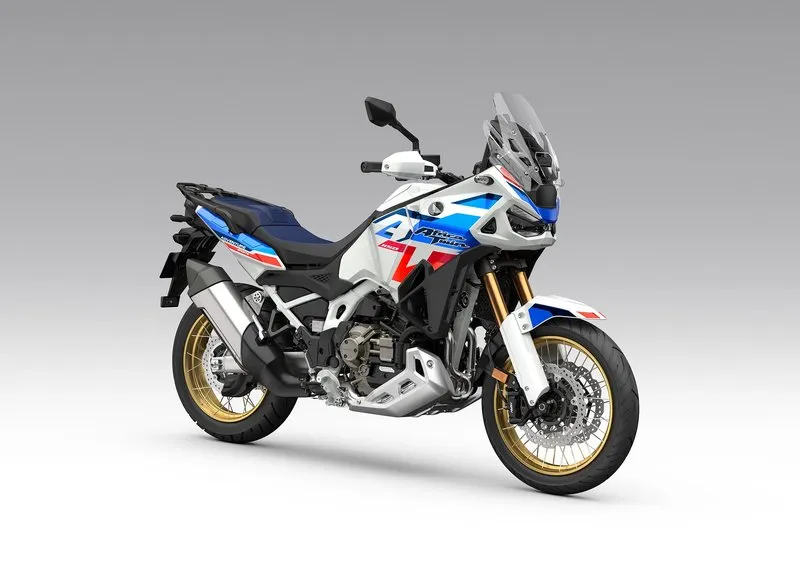
The Africa Twin is now a family. There are three models, and all three are new for 2027. The regular Africa Twin is the standard bike, the Adventure Sports is the touring version with more equipment and a bigger tank, and the Enduro Sports is the hardcore dirt machine. The name tells you what changed: CRF1150L. The parallel twin grows to 1,131 cc and now makes 117 hp and 88 lb-ft, up from 101 hp. The Africa Twins were so mobbed that I had to wait until somebody hesitated for half a second. Then I was on. Two screens in one, phone navigation, the familiar big control cluster on the left for the rider aids and the windshield. DCT is still part of the deal, and the new top-spec Adventure Sports with Honda’s SENSING RIDE radar system comes with DCT only.
The Enduro Sports is the cool one
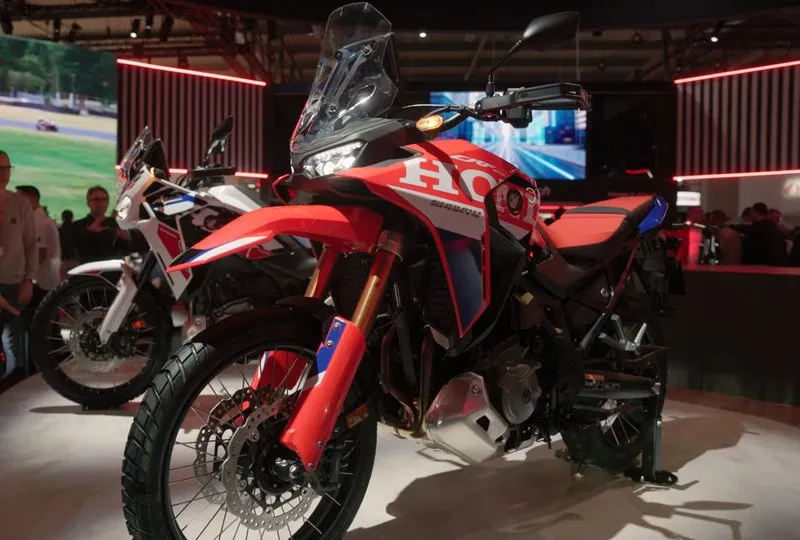
I wasn’t going to say it, but I’m saying it: the Enduro Sports is the cooler Africa Twin. Honda says it’s 20 lbs lighter than the standard bike, at 503 lbs fully fueled with the manual gearbox, and it rolls on a 21” front wheel that takes whatever dirt tires you want. Add a fully adjustable Showa fork with 9.4” of travel. Standing on the pegs, I could already picture the trips. My colleague Gregor, our adventure-bike guy, called it his show highlight on the spot. The old Africa Twin’s footpegs sat so far forward that he ended up hanging off the bars on steep climbs. Off-road coach Bernd Hiemer stood up on the new one right there at the stand and told me the pegs are now much closer to where they belong on an adventure bike. None of us has ridden it yet.
Three Fireblades, three ways to do suspension
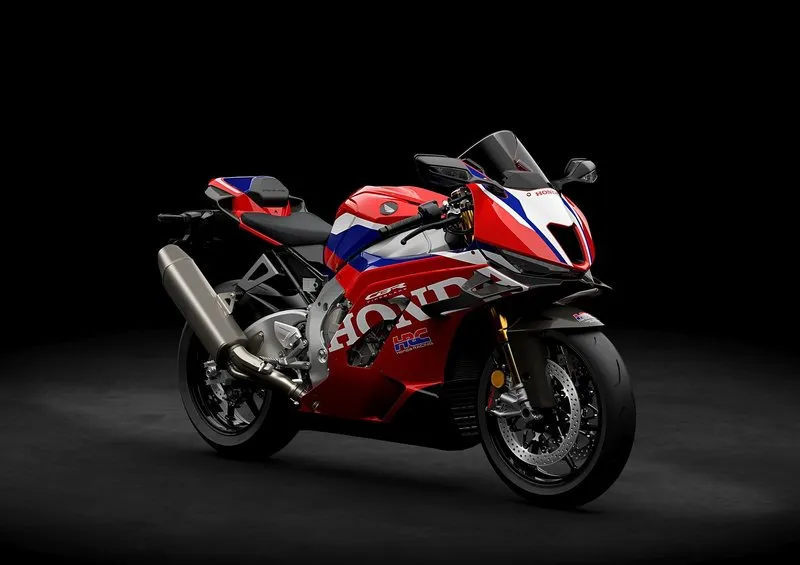
Same puzzle at the Fireblade: three versions again. The base CBR1000RR-R Fireblade runs mechanical Showa suspension, the SP gets electronic Öhlins. And then there’s the sharpest one, the HRC Works Edition. You spot it by the HRC paint and by the fact that it goes back to mechanical Öhlins. That’s the bike for racers who don’t trust electronic suspension. It also gets carbon winglets from the Superbike world that push weight onto the front, mid-corner and on the straights. Honda rates all three at 215 hp. I couldn’t find the base Fireblade on the stand, by the way, and I did look. In an EICMA crowd you take what you can get, and the two sharper versions are the interesting ones anyway.
The little four-cylinder is back
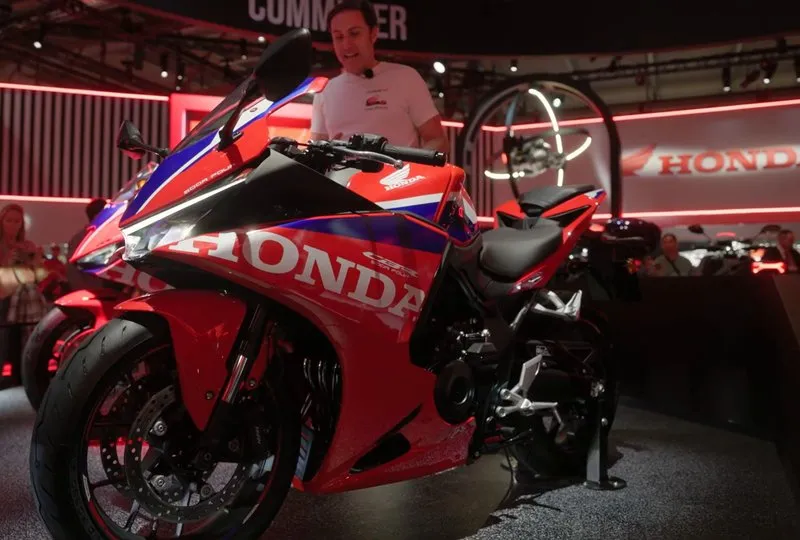
The bike that surprised me most is the CBR500R FOUR. Honda already sells a 600, a 650 and a 1000, and it just slides another inline-four in below them. I didn’t see that coming. The engine is a 502 cc four that revs to 12,500 rpm, and Honda Germany quotes 71 hp and 417 lbs ready to ride. The clutch is handled by Honda’s E-Clutch as standard. For Europe there’s a restricted A2 version for newer riders who still want four cylinders. There’s no price for Germany, Austria or Switzerland yet, but Honda UK lists it from £6,999. Bluntly put: four-cylinder howl and real revs in a proper CBR, for everybody who had to settle for a twin until now.
The “dead” 600 keeps selling
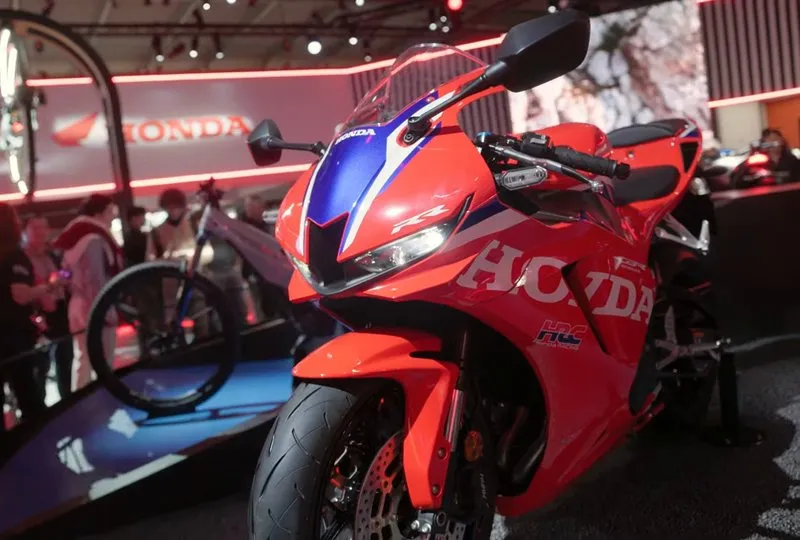
Middleweight supersports were supposed to be dead. Nobody needs them, nobody buys them, or so the story went. Honda says it has sold more than 9,600 CBR600RRs in Europe since bringing the bike back in 2024. For 2027 it gets a small update: radial-mount calipers borrowed from the Fireblade, a nose with small integrated spoilers under the headlights and a revised 5-inch TFT. Output stays at 119 hp. I love that Honda’s comeback for the 600 is working. It’s the best possible answer to everybody who already wrote the class off. If you want to learn on a racetrack what a screaming inline-four feels like, you’ve got a real choice again.
A Rebel with E-Clutch and a scooter for the apocalypse
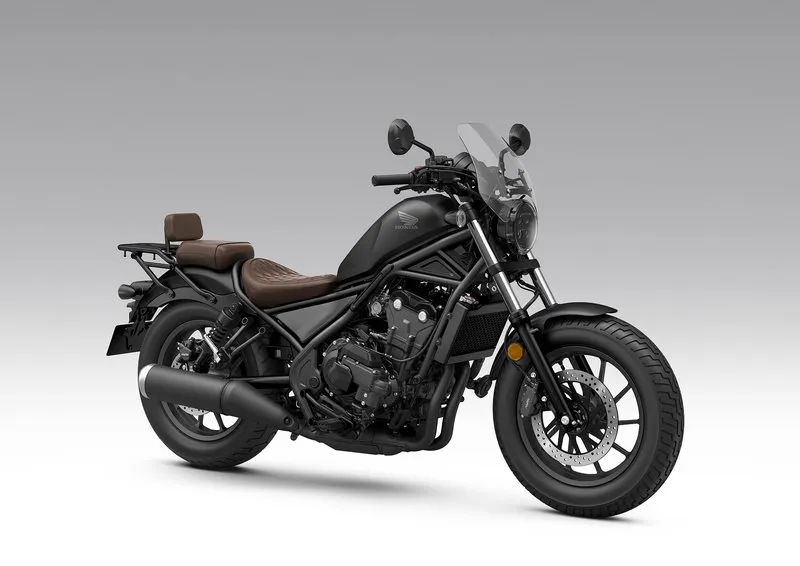
Almost in passing I found the CMX500 Rebel, now with E-Clutch. It’s the most approachable bike on the stand: a 27.2” seat, and everybody fits. It’s a little compact for me, sure, but it’s a feel-good seat. The E-Clutch isn’t an automatic. A small actuator works the clutch, you still shift yourself, you just don’t need the lever anymore. In stop-and-go city traffic that’s gold. Spinning above the stand is the ADV125, the rugged, chunky end-of-the-world scooter, now as a 125. A bit more suspension travel, knobbier tires for bad pavement or the odd gravel detour, and still room under the seat for a full-face helmet. Honda even brought an e-mountain bike, the RN0, reportedly with a Shimano motor good for 74 lb-ft.
What Honda is really showing here
Even hardcore Honda fans probably can’t list every engine concept this brand is building right now. I can’t either. All of that costs a pile of money, and that’s exactly what gets me. Honda pays for this variety, keeps electric and gas alive side by side and brings an engine idea with the V3R that’s never existed before. You feel that passion on the stand, even while you’re fighting through the crowd. 2027 is going to put more trips on my calendar than I planned, and the Enduro Sports is to blame. And if you’ve been waiting for a small, rev-happy four-cylinder, the CBR500R FOUR is exactly that. Motorcycling’s future looks a lot more varied than the doomsayers think.
When these Hondas hit the US
None of this hardware has a US price yet. Honda Europe says dates and pricing get set market by market, and American Honda hasn’t announced any of the EICMA bikes so far. For a sense of scale, here’s where the current US lineup sits on Honda’s own site, before destination: the 2026 Africa Twin starts at $15,199 ($15,999 with DCT), the Adventure Sports ES at $17,799, the CBR600RR at $11,499 and the Rebel 500 at $6,799. American Honda already lists a 2027 Fireblade SP at $28,999, but that’s the carryover spec, not the updated bike from Milan, and there’s no word on the HRC Works Edition. The CBR500R FOUR and the Enduro Sports are brand-new, so there’s no US reference at all. And the ADV125 isn’t sold in the States; you get the ADV160, which starts at $4,499.
Quick specs:
- V3R 900 E-Compressor: 75-degree V3, 900 cc, electronically controlled compressor, output target of a 1,200 cc engine, no production date
- CRF1150L Africa Twin: 1,131 cc, 117 hp at 7,500 rpm, 88 lb-ft at 5,750 rpm, 522 lbs fully fueled (DCT 545 lbs), seat 33.5”/34.3”
- Africa Twin Adventure Sports: 117 hp, 88 lb-ft, 540 lbs fully fueled (SENSING RIDE with DCT 564 lbs), 6.4 gal tank, seat 32.7”/33.5”
- Africa Twin Enduro Sports: 117 hp, 88 lb-ft, 503 lbs fully fueled (DCT 527 lbs), 9.4”/9.1” travel, 21/18-inch wheels, seat 34.3”/35.0”
- CBR1000RR-R Fireblade, SP, HRC Works Edition: 215 hp at 14,000 rpm, 84 lb-ft, 439 / 443 / 441 lbs fully fueled
- CBR500R FOUR: 502 cc, 71 hp at 11,000 rpm, 35 lb-ft, 417 lbs ready to ride, seat 30.7”, UK from £6,999
- CBR600RR: 119 hp at 14,250 rpm, 46 lb-ft, 428 lbs ready to ride, seat 32.3”
- CMX500 Rebel: 46 hp at 8,500 rpm, 32 lb-ft, 421 lbs ready to ride, seat 27.2”, E-Clutch
- ADV125: 12 hp, 8.6 lb-ft, 293 lbs fully fueled, seat 30.7”
- US pricing: not announced for any of the EICMA models above (as of Nov 5, 2026)