
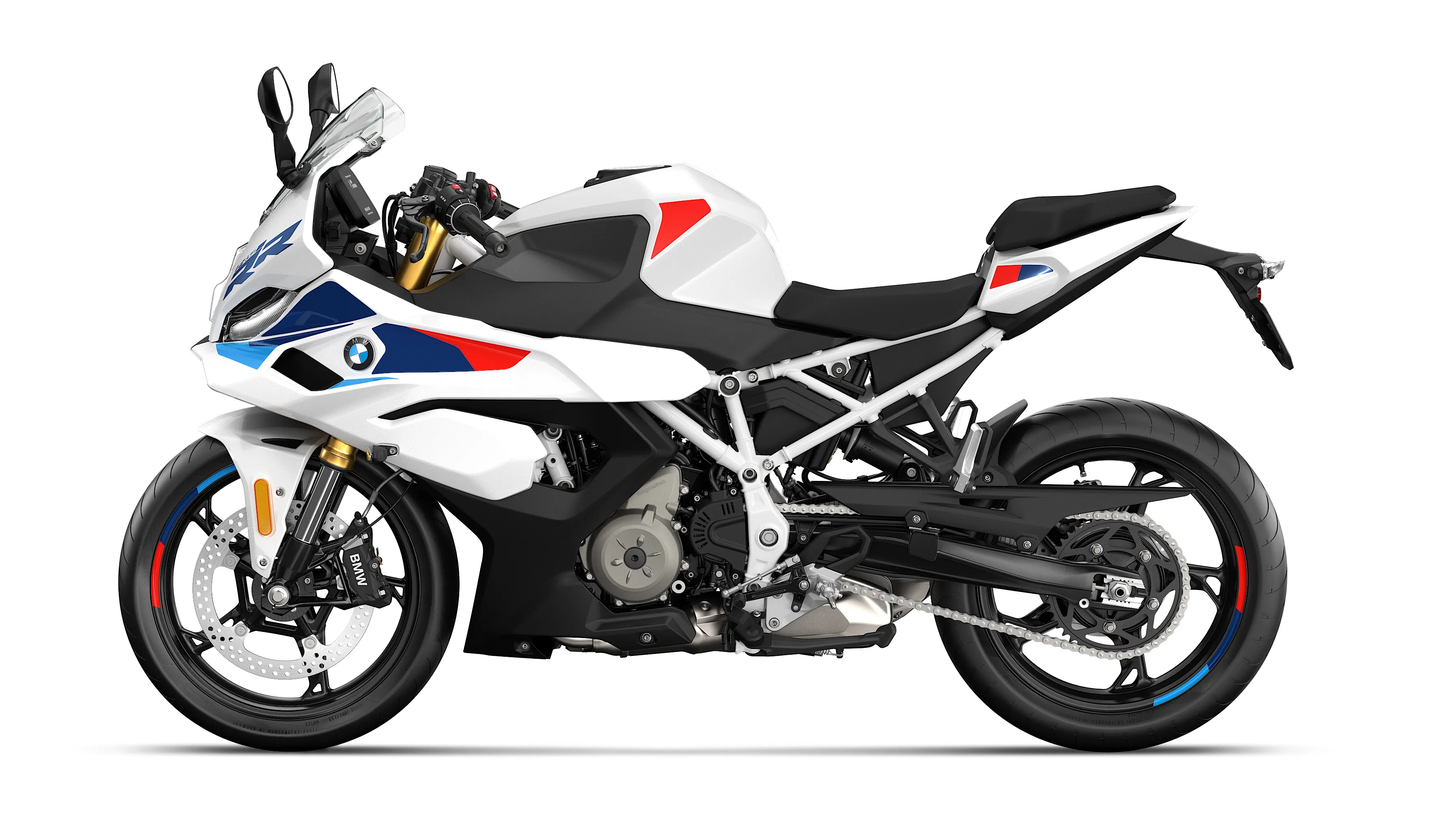
A Shrunken RR Look on a 420cc Twin
Nose down, tail up, winglets on the fairing and gills on the right side only: BMW put the styling cues of its current S 1000 RR on a 420cc twin. The F 450 RR was announced on October 15, 2026. BMW calls it a standalone supersport within the F 450 family, and it borrows the engine and the basic chassis layout BMW first built for the F 450 GS adventure bike. Every figure for the RR below is BMW’s claim, taken from the German-language press kit.
The target is Europe’s A2 license class, which caps output at 47 hp. That’s exactly what BMW quotes for the RR, so according to BMW there’s no restrictor kit involved.
The Twin With the Odd Crank
It’s a liquid-cooled parallel twin, mounted across the frame, with 420cc from a 72 mm bore and a 51.6 mm stroke. The crankpins are offset by 135 degrees, which gives an uneven firing interval, and a gear-driven balance shaft sits ahead of the crank. Up top there are two overhead cams working four valves per cylinder through finger followers. Compression is 13:1, fuel goes in through port injection with 38 mm throttle bodies, and the throttle is ride-by-wire.
BMW claims 47 hp at 8,750 rpm and 31.7 lb-ft at 6,750 rpm, and says 80 percent of peak torque is already there at 3,000 rpm. The engine meets Euro 5+. The stainless muffler sits under the engine with two catalytic converters, and the clutch and gearbox covers are magnesium.
BMW quotes 62 mpg on the WMTC cycle and a 3.7-gallon tank, which by its math is good for more than 217 miles. The service interval is about 6,200 miles. Top speed is 110 mph, and 0 to 62 mph takes 5.6 seconds.
A Clutch You Can Ignore
The gearbox is a six-speed driving an X-ring chain on the left side. The clutch is a mechanically operated wet multi-plate unit, unless you order the Easy Ride Clutch. That’s a centrifugal unit that engages by engine speed. BMW says it stays closed on the overrun, so engine braking works until you’re almost stopped, and only opens at idle so the bike won’t stall. The lever stays on the bar for when you want it.
Combine it with Shift Assistant Pro, BMW’s up and down quickshifter, and you don’t touch the clutch at all in normal riding. The ERC adds 2 lbs, according to BMW. You can also flip the shift pattern to race shift without much work.
Steel Frame, KYB Suspension, Brembo Up Front
The frame is a welded steel trellis with forged sections, and the engine is a stressed member. Wheelbase is 55.3” (1,405 mm), rake is 23.4 degrees and trail is 4.3” (110 mm). Up front there’s a 43 mm KYB upside-down fork with gold-anodized tubes and 5.5” (140 mm) of travel, held by a forged aluminum triple clamp. Rebound and compression on the fork are adjustable only with the sport suspension. Out back a hollow-cast aluminum swingarm works a directly mounted KYB shock with adjustable preload and rebound, also with 5.5” of travel.
The cast aluminum wheels carry tubeless 110/70-17 and 150/60-17 tires. The front brake is a single floating 310 mm disc with a Brembo four-piston monobloc caliper. The rear is a 240 mm disc with a ByBre single-piston floating caliper.
BMW gives the ready-to-ride weight as 390 lbs. The clip-ons mount directly to the top clamp, the two-piece seat sits at 31.1” (790 mm), and accessory seats take that to 31.9” or 30.5”. Shift lever, brake pedal and side stand are forged aluminum, and the passenger peg brackets bolt to the subframe.
What’s Wired In as Standard
Every version gets three ride modes: Rain, Road and Race. BMW says Race dials back the traction control, the wheelie detection and the engine drag torque control. Lean-sensitive ABS Pro, traction control, engine drag torque control and Dynamic Brake Control are standard. DBC keeps the throttle valves shut if you twist the grip while you’re braking hard. There’s also a dynamic brake light that warns traffic behind you in two stages.
Riding Modes Pro adds a fourth mode, Race Pro, where you set throttle response, traction control and ABS yourself. On the M Sport versions it also brings three sport screens for traction control, braking force and lean angle, plus a lap timer.
The dash is a 6.5” TFT. Phone calls and music work over Bluetooth without an app, and BMW’s free Connected App adds arrow navigation on the screen. Map navigation needs the accessory navigation prep plus either BMW’s ConnectedRide Navigator or its smartphone cradle. Lighting is LED all around, there’s a USB-C socket in the cockpit, and heated grips are standard.
Four Versions, One Engine
The base bike comes in Cosmic Black. The Sport, in Racing Red, adds Shift Assistant Pro and the sport suspension. The M Sport is white with M Motorsport colors, a white frame and M Motorsport rim stripes, and adds Riding Modes Pro on top. The M Sport with Innovation Package is the only version that gets the Easy Ride Clutch from the factory.
Everything else can be added later, according to BMW: the ERC as a genuine accessory on the other three versions, Shift Assistant Pro on the base bike, and Riding Modes Pro wherever it isn’t fitted. The accessory list also has soft cases of 4.4 gallons each, a strapless tank bag, a Sport windshield, M hand lever protectors, an engine guard and paddock stands.
No Price and No Word on the US
The press kit gives no price for any of the four versions and no date for dealers. It also doesn’t say whether the RR will be sold in the US. For a US buyer, that’s the first open question.
The F 450 RR Next to Four Other Bikes
No ranking here, just the technical gaps. The RR figures are BMW’s claims; the others come from the NastyNils database.
The Aprilia RS 457 is the closest match on paper. Its 457cc liquid-cooled twin makes the same 47 hp, with the peak at 9,400 rpm, 650 rpm higher than the BMW. Torque is 32.1 lb-ft at 6,700 rpm, 0.4 lb-ft more. It weighs 386 lbs, 4 lbs less, its seat sits 0.3” higher at 31.4”, and its wheelbase is 2.2” shorter. The tire sizes are identical.
Kawasaki’s Ninja 500 runs a 451cc twin with 51 hp at 10,000 rpm, about 4 hp more and 1,250 rpm higher. Torque matches at 31.7 lb-ft, but it peaks at 7,500 rpm, 750 rpm later. At 379 lbs it’s 11 lbs lighter, the seat is 30.9” and the tires are the same sizes.
The Yamaha YZF-R3 is the small one: 321cc, 41.4 hp and 21.8 lb-ft, so 5.5 hp and 9.9 lb-ft less than the BMW. It weighs 373 lbs, 18 lbs less, its seat is 0.4” lower at 30.7”, and it runs a narrower 140/70-17 rear tire.
Then there’s BMW’s own F 450 GS, where this engine started. Same 420cc twin, same rpm for both peaks. It weighs 392 lbs, 2 lbs more than the RR, its seat is 2.2” higher at 33.3”, and its fork has 7.1” (180 mm) of travel against the RR’s 5.5”.
One caveat on weight: BMW quotes the RR as ready to ride, while our database carries the other four as wet weights. They’re close, but they aren’t guaranteed to be measured the same way.