By NastyNils·
Motorcycle comparison · Retro Classic
Triumph Bonneville T120 (MY2016) vs Bonneville T100 (986MF2)
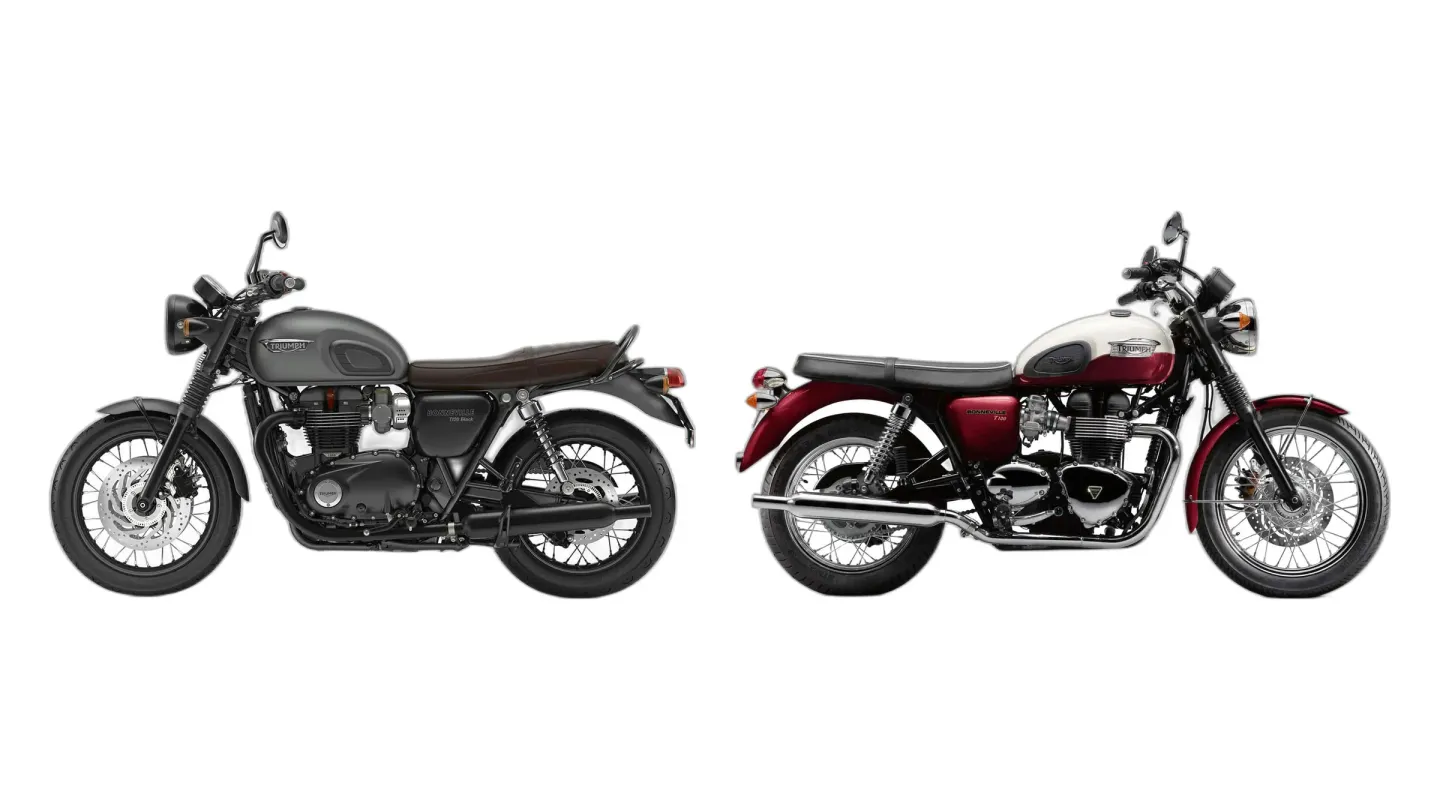
Triumph Bonneville T120 vs Bonneville T100: which one to buy once you're past the looks.
Roll on the Triumph Bonneville T120's throttle and it's already tugging hard right above idle. The Triumph Bonneville T100's throttle opens onto a thumping exhaust beat that's backed by a smooth swell of pull. It doesn't need revs to pass.
So which one do you buy?
The Bonneville T120 has the edge if…
Sporty riding on twisty roads
Small edge: Bonneville T120
The Bonneville T120 is a touch more fun when the road starts bending. It's down to harder acceleration.
Character, looks and sound
Nose ahead: Bonneville T120
On style, the Bonneville T120 makes a slightly stronger case. The difference is a better engine note. Go see both in person.
Keeping running costs low
Inches ahead: Bonneville T120
On upkeep, the Bonneville T120 asks a bit less of your wallet. The difference won't change your life.
What makes each one tick
Bonneville T120
Most of the Bonneville T120's character lives in its crankshaft, whose uneven firing pulse feels closer to a V-twin than to an old British twin. Its low center of gravity hides the bike's heft at speed, and the bar turns in neutrally. The soft fork and twin shocks soak up a pothole in town. At speed on rougher pavement, they're underdamped. There's grunt for every traffic gap.
Bonneville T100
A leisurely tempo comes naturally to the Bonneville T100, whose air-cooled twin doesn't hurry you anywhere. You sit upright, at ease. Corner entry asks little of the bar: the bike tips in lightly and holds a neutral line.
Nils rode the Bonneville T100 in 2014 (NastyNils Testride).
The Voice of Experience

What actually separates them
- The Bonneville T100 has the lower seat: 30.5 in (775 mm) vs 31.1 in (790 mm).
- The Bonneville T100 has the lower wet weight: 505 lb (229 kg) vs 520 lb (236 kg).
- The Bonneville T120 makes more peak power: 78 hp (58 kW) vs 63 hp (47 kW).
Which one for the way you ride
Comfortable long-distance riding
Neither is a natural fit
Big miles aren't where either one shines. You'll be watching for the next rest stop.
Count commuting as a draw. The deal on the table and the condition of the bike matter more here.
Who each one is built for
What's good, and what you'll live with
Bonneville T120
What owners say
Strengths
- Strong torque-led 1200 HT engine character
- Easy, accessible handling despite mass
- Authentic retro styling and finish
- Modern essentials present and unobtrusive
Trade-offs
- Front brake lacks initial bite
- Mass for some riders
- Soft, basic suspension
- Pre-LED-era halogen replacement aside, basic headlight beam pattern
- Snatchy / abrupt throttle in Road mode at low rpm
Bonneville T100
What owners say
Strengths
- Charismatic, torquey engine
- Timeless classic styling
- Easy to maintain
Known problems to check before you buy
Bonneville T120
- Fuel pump sub-harness moulding defect can allow fuel to seep along wire insulation, risk of electrical short and fire Recall 19V133000 A moulding defect in the fuel pump sub-harness allows fuel to migrate along the wire insulation and reach the main harness connector, where it can cause an electrical short and ignite.
- Clutch cable can chafe through main harness cover and damage internal wiring Recall 19V133000 The clutch cable contacts the main harness cover at the headstock and abrades wires inside, leading to symptoms including loss of headlights, indicators not flashing, or unexpected stall. The fault is the root cause of many community indicator-failure reports.
- Gear-change selector mechanism failure The gear-change selector mechanism can fail through a broken internal return spring or through a bent claw on the detent wheel (often after a left-side drop), causing the bike to lock in a gear or refusing to downshift. Triumph released an updated shifter-mechanism kit (P/N T1191968) in October 2019, retrofittable to the start of production.
- Abrupt throttle response in Road mode at low rpm in 1st and 2nd gear The ride-by-wire ECU map in Road mode is described by owners as having coarse throttle resolution — small wrist inputs produce comparatively large throttle-body movements at low engine speed, resulting in an on/off character in tight low-speed riding. Rain mode smooths the response but reduces overall throttle authority. Common community workarounds: Booster Plug device, ECU re-flash with adjusted throttle map.
- Fuel gauge under- or over-reads; reserve light triggers inconsistently Owners report that the dash fuel gauge does not track tank level accurately and the reserve warning may activate with substantial fuel still in the tank. Triumph has reportedly issued a dealer memo and replaced the fuel-level sender under warranty in confirmed cases.
- Surface corrosion on grab-rail bolts, spoke nipples, brake disc carriers and TPS cover Within months of use, owners commonly report rust forming on exposed steel hardware: grab-rail bolts, spoke nipples, brake-disc carriers, throttle-position-sensor cover. Reported even in non-coastal, non-winter climates. Cosmetic, not structural; progressive if unaddressed.
Bonneville T100
- Electrical gremlins (coils, sensors, connectors) Older bikes can suffer from failing coil packs, corroded connectors and broken sensors (MAP, TPS) leading to rough running; often traced to poor grounds and vibration.
- Cam cover gasket leaks A common weeping leak develops from the cam cover gasket; usually an easy fix with a replacement rubber gasket.
What they share
- Engine
- Parallel twin
- Final drive
- Chain
- Front brake
- 310 mm
Where the spec sheets split
| Bonneville T120 | Bonneville T100 | |
|---|---|---|
| Seat height | 31.1 in (790 mm) | 30.5 in (775 mm) |
| Wet weight | 520 lb (236 kg) | 505 lb (229 kg) |
| Bonneville T120 | Bonneville T100 | |
|---|---|---|
| Displacement | 1200 cc | 865 cc |
| Cooling | Liquid-cooled | Air/oil-cooled |
| Power | 78 hp (58 kW) | 63 hp (47 kW) |
| Peak power at | 6,550 rpm | 7,250 rpm |
| Torque | 77 lb-ft (105 Nm) | 50 lb-ft (68 Nm) |
| Peak torque at | 3,100 rpm | 6,000 rpm |
| Top speed | 130 mph (209 km/h) | 106 mph (170 km/h) |
| Bonneville T120 | Bonneville T100 | |
|---|---|---|
| Fuel capacity | 3.8 US gal (14.5 L) | 4.2 US gal (16 L) |
| Bonneville T120 | Bonneville T100 | |
|---|---|---|
| Gearbox | 6-speed | 5-speed |
| Front tire | 100/90-18 | 100/90-19 |
| Rear tire | 150/70-17 | 130/80-17 |
| Wheelbase | 57.1 in (1450 mm) | 59.1 in (1500 mm) |
What comes fitted, what costs extra
| Bonneville T120 | Bonneville T100 | |
|---|---|---|
| ABS | Standard | Not offered |
| Traction Control | Standard | Not offered |
| Ride Modes | Standard | Not offered |
| Cruise Control | Option | Not offered |
| Slipper Clutch | Standard | Not offered |
| USB Charging Port | Standard | Not offered |
| Heated Grips | Standard | Option |
Head to head, area by area
Both bikes on the same scale, one area at a time.