By NastyNils·
Motorcycle comparison · Retro Classic
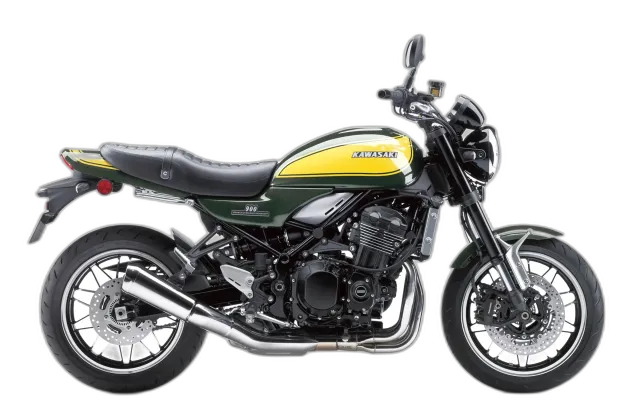
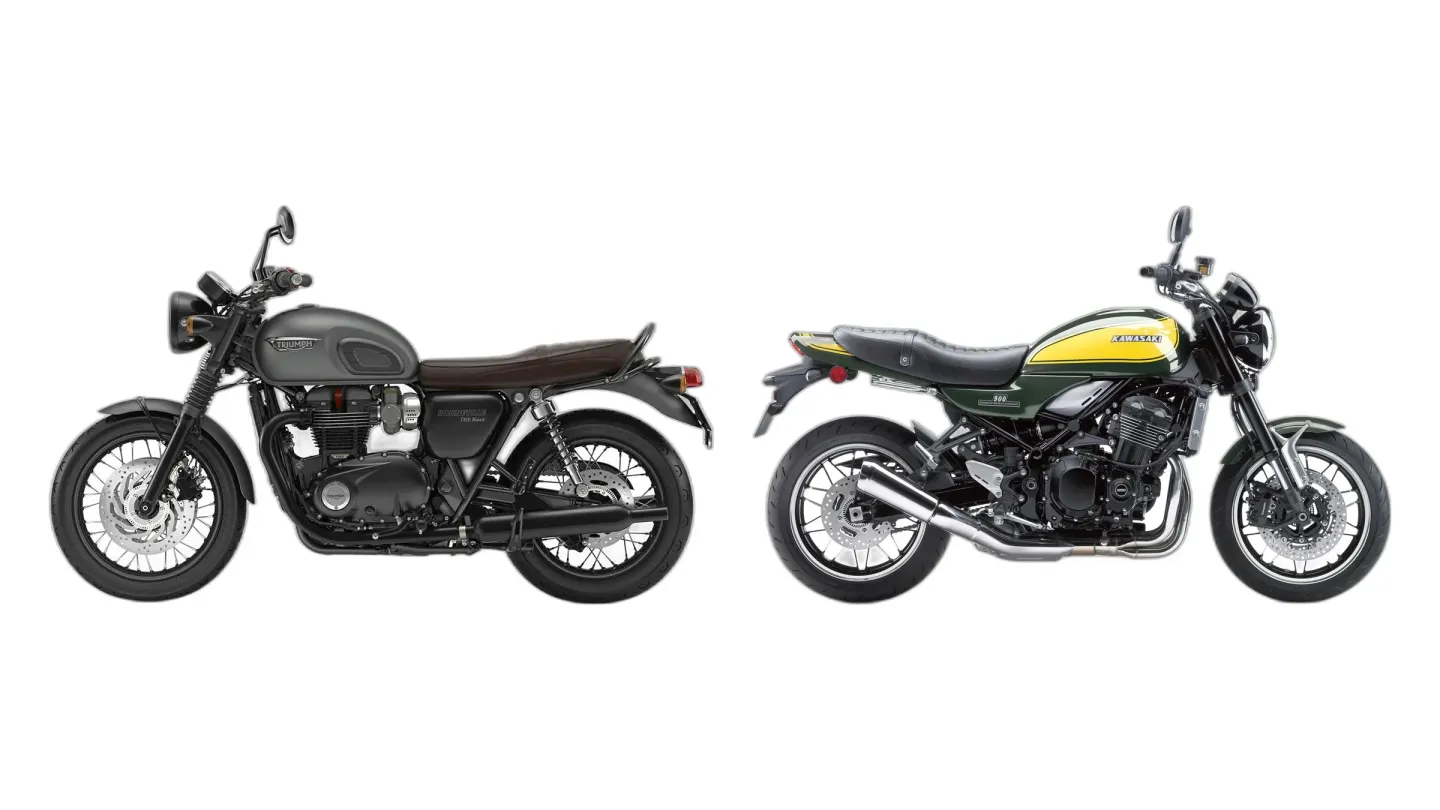
Triumph Bonneville T120 (MY2016) vs Kawasaki Z 900 RS (MY2018)
Triumph Bonneville T120 vs Kawasaki Z 900 RS: buy with your heart, but read this first.
Tip into a long bend and the Triumph Bonneville T120 drops in on neutral steering, and it's sitting low and plush through the arc. The Kawasaki Z 900 RS keeps pace there with meaner-looking hardware.
So which one do you buy?
The Z 900 RS has the edge if…
Sporty riding on twisty roads
By a nose: Z 900 RS
Back-road fun leans slightly toward the Z 900 RS. The reason: more feel through the bars. It's a narrow call, so trust your test ride.
Which one's the smarter buy
Money won't decide it
Neither bike is the clear better buy at these used prices. The lower sticker price doesn't make the Triumph the smarter spend.
What makes each one tick
Bonneville T120
There's a thick shove from the Bonneville T120's twin almost as soon as the clutch is out, with full torque on tap by 3,100 rpm. There's little point chasing revs, since the engine works hardest low down and loses interest up top. The low center of gravity hides its mass at corner entry, and the front tucks in without a fight once it's rolling. The twin thumps like a V-twin.
Z 900 RS
A broad bar holds the Z 900 RS rider tall, yet there's room to slide across the seat and lean weight into a corner. Its inline-four is happy short-shifted, yet it doesn't punish a run to the top of the tach. Sharp bumps make the shock kick. Two-up over loose rock, it still steers true.
Nils rode the Z 900 RS in Styria and Switzerland in 2018, and in Austria and Montenegro in 2024 (NastyNils Testride).
The Voice of Experience
What actually separates them
- The Bonneville T120 has the lower seat: 31.1 in (790 mm) vs 32.9 in (835 mm).
- The Z 900 RS has the lower wet weight: 474 lb (215 kg) vs 520 lb (236 kg).
- The Z 900 RS makes more peak power: 111 hp (82 kW) vs 78 hp (58 kW).
Which one for the way you ride
Comfortable long-distance riding
Wrong job for both
Hours in the saddle won't flatter either of these. They're happier on shorter runs.
These two run dead level on character, commuting, and running costs. Sit on both in the showroom and trust what your body says.
Who each one is built for
What's good, and what you'll live with
Bonneville T120
What owners say
Strengths
- Strong torque-led 1200 HT engine character
- Easy, accessible handling despite mass
- Authentic retro styling and finish
- Modern essentials present and unobtrusive
Trade-offs
- Front brake lacks initial bite
- Mass for some riders
- Soft, basic suspension
- Pre-LED-era halogen replacement aside, basic headlight beam pattern
- Snatchy / abrupt throttle in Road mode at low rpm
Z 900 RS
Strengths
- Torque from the basement
- Built for long days
- Tall-rider friendly ergonomics
- Fully adjustable at both ends
- Faster than it looks
Trade-offs
- Rear shock thumps sharp hits
- Loose through transitions
- No quickshifter offered
- No wind protection
- Stock seat uncomfortable on long rides
Known problems to check before you buy
Bonneville T120
- Fuel pump sub-harness moulding defect can allow fuel to seep along wire insulation, risk of electrical short and fire Recall 19V133000 A moulding defect in the fuel pump sub-harness allows fuel to migrate along the wire insulation and reach the main harness connector, where it can cause an electrical short and ignite.
- Clutch cable can chafe through main harness cover and damage internal wiring Recall 19V133000 The clutch cable contacts the main harness cover at the headstock and abrades wires inside, leading to symptoms including loss of headlights, indicators not flashing, or unexpected stall. The fault is the root cause of many community indicator-failure reports.
- Gear-change selector mechanism failure The gear-change selector mechanism can fail through a broken internal return spring or through a bent claw on the detent wheel (often after a left-side drop), causing the bike to lock in a gear or refusing to downshift. Triumph released an updated shifter-mechanism kit (P/N T1191968) in October 2019, retrofittable to the start of production.
- Abrupt throttle response in Road mode at low rpm in 1st and 2nd gear The ride-by-wire ECU map in Road mode is described by owners as having coarse throttle resolution — small wrist inputs produce comparatively large throttle-body movements at low engine speed, resulting in an on/off character in tight low-speed riding. Rain mode smooths the response but reduces overall throttle authority. Common community workarounds: Booster Plug device, ECU re-flash with adjusted throttle map.
- Fuel gauge under- or over-reads; reserve light triggers inconsistently Owners report that the dash fuel gauge does not track tank level accurately and the reserve warning may activate with substantial fuel still in the tank. Triumph has reportedly issued a dealer memo and replaced the fuel-level sender under warranty in confirmed cases.
- Surface corrosion on grab-rail bolts, spoke nipples, brake disc carriers and TPS cover Within months of use, owners commonly report rust forming on exposed steel hardware: grab-rail bolts, spoke nipples, brake-disc carriers, throttle-position-sensor cover. Reported even in non-coastal, non-winter climates. Cosmetic, not structural; progressive if unaddressed.
Z 900 RS
- Front tire may develop internal blistering (Sumitomo manufacturing defect) Due to a defective manufacturing process during sidewall rubber installation, the front tire may develop blistering on the inner surface. A tire with internal blistering can fail and increase crash risk. Tire supplier: Sumitomo Rubber Industries, Ltd. Non-compliant with FMVSS 119. Affects only MY2024 Z900RS ABS, Z900RS Café ABS, and Z900RS SE ABS.
- ABS hydraulic unit contaminated with aluminum shavings The ABS hydraulic unit may have been contaminated with aluminum shavings during manufacturing (defective fixture shaving ABS pump housing). This can cause the front or rear wheel to lock up during braking despite ABS. Affects MY2019 Z900RS ABS and Z900RS Café ABS.
- Front brake lacks sharp initial bite, spongy lever feedback Despite radial-mount four-piston Nissin calipers, the front brake lacks direct, firm initial bite. The lever feel is indirect, especially during aggressive downhill braking. Braided steel lines and higher-performance brake pads significantly improve feel. The SE model (from MY2022) with Brembo M4.32 calipers and braided steel lines resolves this issue from the factory.
- ABS activates prematurely, especially on front brake The Nissin ABS unit activates prematurely, especially at the front brake during harder braking. The ABS is not deactivatable on any 2018–2024 model year. This reduces confidence during aggressive braking and trail braking. The ABS kicks in earlier than desired.
- Snatchy, on-off throttle response at low RPM (ECU mapping) The Z900RS exhibits abrupt, jerky throttle behavior at low RPM and low speeds, particularly when rolling on throttle from closed, departing from standstill, and during gentle gas application in corners. The fuel-cut programming (overrun fuel cutoff for emissions compliance) causes abrupt injection on/off behavior. The dual throttle valve system (sub-throttle servo) with cable-operated main throttle exacerbates the issue. The problem is most pronounced on MY2018–2019 models. Common remedies: ECU reflash (e.g., Ivan's Performance), throttle cable adjustment. Later model years show improvement according to multiple sources.
- Engine revs to 2,500–4,000 rpm on cold start On cold start, the engine revs up to 2,500–4,000 rpm to bring the catalytic converter to operating temperature faster (Euro 4/5 emissions compliance). This is particularly intrusive in residential areas. It is not a defect but a deliberate ECU calibration for emissions standards. Some owners report occasional stalling during warm-up phase.
- Clutch judder/shudder when cold during takeoff The clutch exhibits pronounced judder when cold during engagement into first gear. Multiple owners report the problem partially persists after warm-up. Some dealers consider this normal behavior. Possible remedies: soak clutch plates in oil overnight (dealer recommendation), use higher-quality engine oil. The clutch judder when cold is a widely documented complaint.
What they cost used
These prices compare an 8-year-old Bonneville T120 with an 8-year-old Z 900 RS.
- Bonneville T120
- about $6,300
- Z 900 RS
- about $7,900
At eight years old, the Triumph Bonneville T120 sits around $6,300 while the Kawasaki Z 900 RS runs about $7,900. That's a $1,600 gap in the T120's favor. These are US market estimates, not live listings.
What they share
- Cooling
- Liquid-cooled
- Gearbox
- 6-speed
- Final drive
- Chain
Where the spec sheets split
| Bonneville T120 | Z 900 RS | |
|---|---|---|
| Seat height | 31.1 in (790 mm) | 32.9 in (835 mm) |
| Wet weight | 520 lb (236 kg) | 474 lb (215 kg) |
| Bonneville T120 | Z 900 RS | |
|---|---|---|
| Displacement | 1200 cc | 948 cc |
| Engine | Parallel twin | Inline-four |
| Power | 78 hp (58 kW) | 111 hp (82 kW) |
| Peak power at | 6,550 rpm | 8,500 rpm |
| Torque | 77 lb-ft (105 Nm) | 73 lb-ft (98 Nm) |
| Peak torque at | 3,100 rpm | 6,500 rpm |
| Top speed | 130 mph (209 km/h) | 139 mph (224 km/h) |
| Bonneville T120 | Z 900 RS | |
|---|---|---|
| Fuel capacity | 3.8 US gal (14.5 L) | 4.5 US gal (17 L) |
| Bonneville T120 | Z 900 RS | |
|---|---|---|
| Front tire | 100/90-18 | 120/70-17 |
| Rear tire | 150/70-17 | 180/55-17 |
| Wheelbase | 57.1 in (1450 mm) | 57.9 in (1470 mm) |
What comes fitted, what costs extra
| Bonneville T120 | Z 900 RS | |
|---|---|---|
| Ride Modes | Standard | Not offered |
| Manually Adjustable Front Suspension | Not offered | Standard |
| Cruise Control | Option | Not offered |
| USB Charging Port | Standard | Option |
| Heated Grips | Standard | Option |
| LED Headlight | Not offered | Standard |
Head to head, area by area
Both bikes on the same scale, one area at a time.