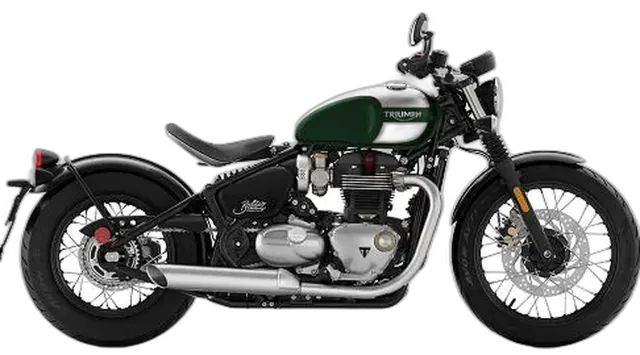
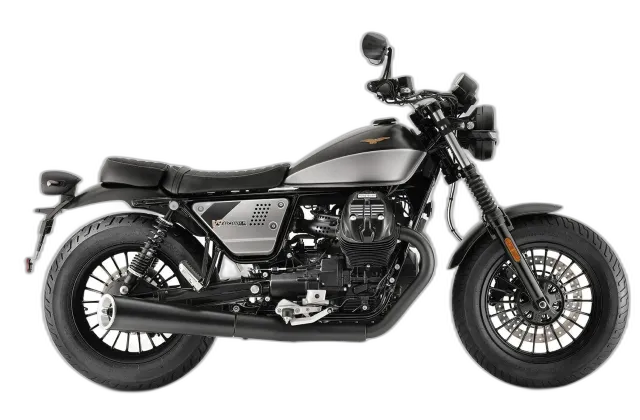
By NastyNils·
Motorcycle comparison · Retro Classic
Triumph Bonneville Bobber (DV01A) vs Moto Guzzi V9 Bobber (MY2021-SE)
You'll feel these two split at corner entry: the Triumph Bonneville Bobber carries its weight low and tips in neutral. The Moto Guzzi V9 Bobber's bars turn in off a light nudge. Mid-corner, the Guzzi's locked onto the arc you chose.
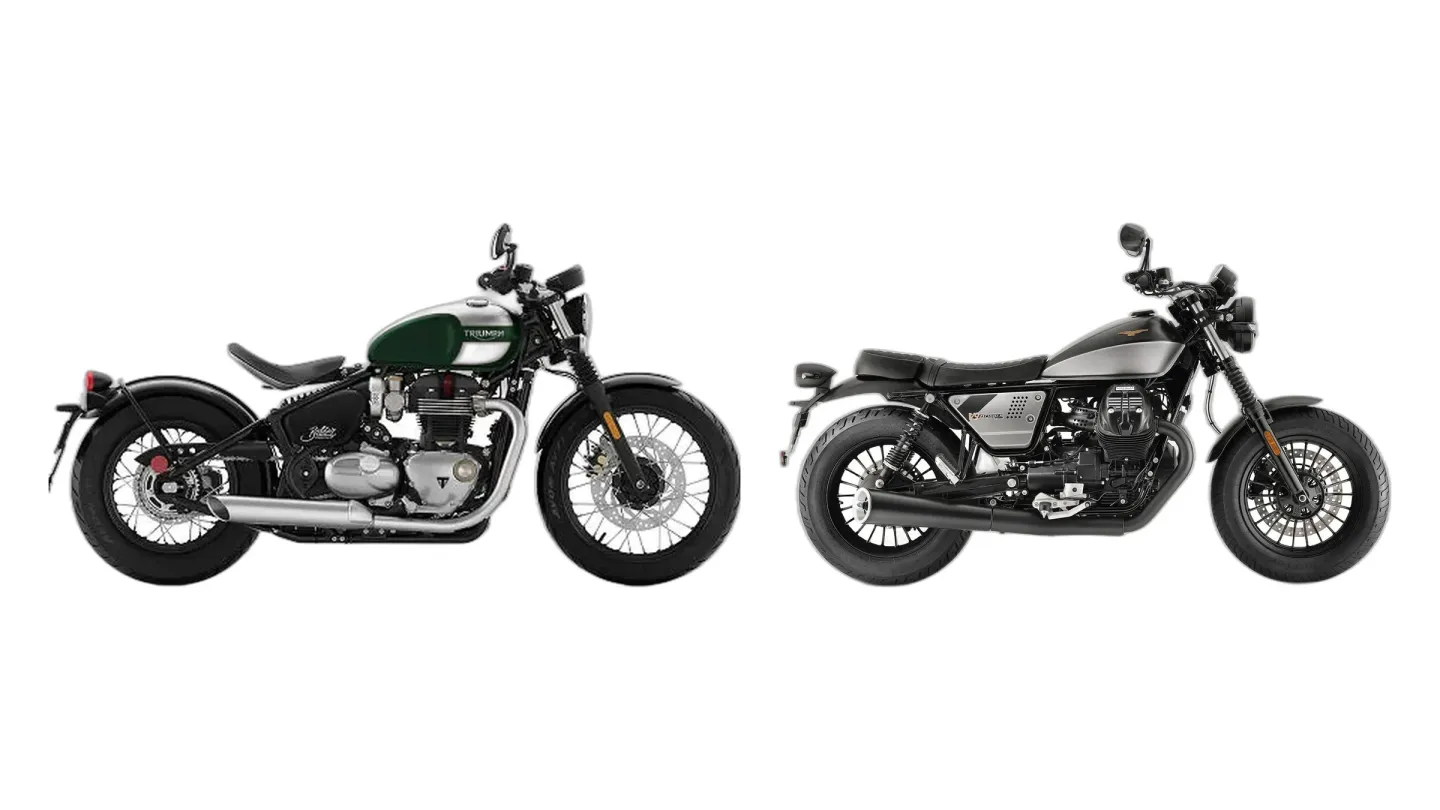
So which one do you buy?
The Bonneville Bobber has the edge if…
Character, looks and sound
By a nose: Bonneville Bobber
On style, the Bonneville Bobber makes a slightly stronger case. Thank a better engine note for that. Go see both in person.
The V9 Bobber has the edge if…
Daily commuting & city riding
Slight edge: V9 Bobber
The V9 Bobber edges it for the daily grind. That comes from simpler maintenance. It's a small gap, not a reason on its own.
Keeping running costs low
Nose ahead: V9 Bobber
The V9 Bobber comes out a little ahead on upkeep. Only a little.
What makes each one tick
Bonneville Bobber
Down at the bottom of the tach, the Bonneville Bobber's parallel twin already pulls hard, and it doesn't wait for the needle to climb. The floating aluminum seat slides fore and aft to set the reach, while its 27.2 in (690 mm) height tucks the rider down low. Fast bends don't unsettle the chassis. The exhaust answers every roll-on with a rich bark.
V9 Bobber
Sitting crosswise in the frame, the V9 Bobber's V-twin pulls from idle and fizzes as the revs build, with an off-beat thump from the exhaust. The pegs sit mid-mounted below a scooped bench, and there's nothing stretched about the upright posture they set. On the Blue Ridge Parkway, 463 lb (210 kg) of bike doesn't take much effort to carve from one sweeper into the next. The twin's alive on every commute.
The Voice of Experience
What actually separates them
- The Bonneville Bobber has the lower seat: 27.2 in (690 mm) vs 30.9 in (785 mm).
- The V9 Bobber has the lower wet weight: 463 lb (210 kg) vs 522 lb (237 kg).
- The Bonneville Bobber makes more peak power: 76 hp (57 kW) vs 65 hp (48 kW).
Which one for the way you ride
Comfortable long-distance riding
Neither is a natural fit
For all-day comfort, both fall short. Keep the rides short and you'll get on fine with either.
Don't look for a gap on twisty roads: there isn't one. Go by how each one fits you.
Who each one is built for
What's good, and what you'll live with
Bonneville Bobber
What owners say
Strengths
- Confident handling and low center of gravity
- Stunning, authentic factory bobber styling
- Torque-rich, characterful engine
- Low seat height inspires confidence
Trade-offs
- Intermittent electrical problems and quality control lapses
V9 Bobber
What owners say
Strengths
- Surprisingly nimble handling
- Torquey, character‑laden V‑twin
Known problems to check before you buy
Bonneville Bobber
- Electrical system failures and wiring loom tightness Multiple owners report intermittent electrical problems including dashboard blackouts, warning lights illuminating, and engine cut-outs, often traced to loose or overstretched wiring harnesses near the headstock.
V9 Bobber
No confirmed faults on file yet. That's not the same as fault-free.
What they share
- Gearbox
- 6-speed
- Rear tire
- 150/80-16
Where the spec sheets split
| Bonneville Bobber | V9 Bobber | |
|---|---|---|
| Seat height | 27.2 in (690 mm) | 30.9 in (785 mm) |
| Wet weight | 522 lb (237 kg) | 463 lb (210 kg) |
| Bonneville Bobber | V9 Bobber | |
|---|---|---|
| Displacement | 1200 cc | 853 cc |
| Engine | Parallel twin | 90° V-twin |
| Cooling | Liquid-cooled | Air/oil-cooled |
| Power | 76 hp (57 kW) | 65 hp (48 kW) |
| Peak power at | 6,100 rpm | 6,800 rpm |
| Torque | 78 lb-ft (106 Nm) | 54 lb-ft (73 Nm) |
| Peak torque at | 4,000 rpm | 5,000 rpm |
| Top speed | 112 mph (180 km/h) | 106 mph (170 km/h) |
| Bonneville Bobber | V9 Bobber | |
|---|---|---|
| Fuel economy | 57 mpg (US) / 4.1 L/100 km | 48 mpg (US) / 4.9 L/100 km |
| Fuel capacity | 2.4 US gal (9.1 L) | 4.0 US gal (15 L) |
| Bonneville Bobber | V9 Bobber | |
|---|---|---|
| Final drive | Chain | Shaft |
| Front tire | 100/90-19 | 130/90-16 |
Head to head, area by area
Both bikes on the same scale, one area at a time.