By NastyNils·
Motorcycle comparison · Naked Bike
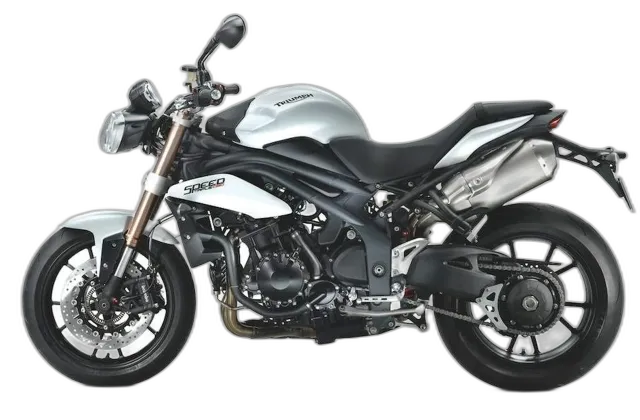
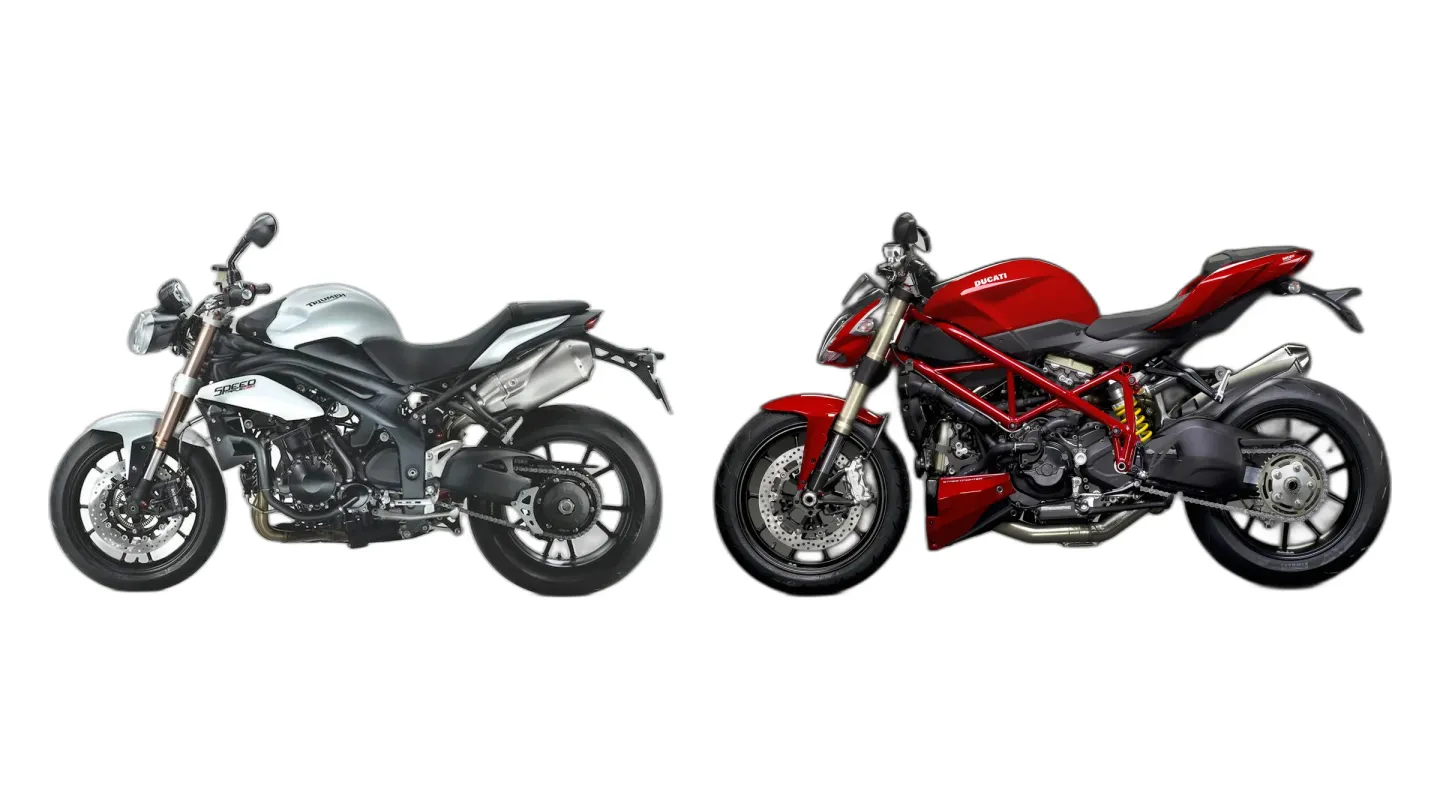
Triumph Speed Triple 1050 (MY2011) vs Ducati Streetfighter 848 (MY2011)
Tip the Triumph Speed Triple 1050 into a bend and it rolls onto its side neutrally: it doesn't flop in or stand up. On the Ducati Streetfighter 848, the wide bars let you put the front exactly where you're aiming it. Its fork and shock keep talking under you.
So which one do you buy?
The Streetfighter 848 has the edge if…
Sporty riding on twisty roads
Narrow edge: Streetfighter 848
On a winding road, the Streetfighter 848 comes out a touch ahead. It's down to more feel through the bars and better suspension. You wouldn't bet much on a gap like that.
Which one's the smarter buy
Value's a wash
At these used prices, neither bike is the clear better buy for the money. The Streetfighter 848 sits slightly lower on the sticker, but that doesn't make it the value pick.
What makes each one tick
Speed Triple 1050
Thrust from the Speed Triple 1050's long-stroke triple builds in one steady swell, and there's a sound from its intake and exhaust that no twin or four makes. The brake lever doesn't go vague under a hard squeeze. The bike stops with sportbike bite. The twin-spar frame tells you what the tires feel.
Nils rode the Speed Triple 1050 in 2013 (NastyNils Testride).
Streetfighter 848
Most of the Streetfighter 848's shove sits in the midrange, where its L-twin pulls hard on a steady roll-on. It doesn't need frantic revs to hustle. Corner entry on the Angeles Crest Highway brings out the sportbike geometry in its chassis. It turns in on cue and stays settled as the speed climbs. The sit-in seat holds you upright all day.
Nils rode the Streetfighter 848 in 2012 (NastyNils Testride).
The Voice of Experience

What actually separates them
- The Speed Triple 1050 has the lower seat: 32.5 in (825 mm) vs 33.1 in (840 mm).
- The Streetfighter 848 has the lower wet weight: 439 lb (199 kg) vs 467 lb (212 kg).
- The Speed Triple 1050 makes more peak torque: 83 lb-ft (112 Nm) vs 69 lb-ft (94 Nm).
Which one for the way you ride
Comfortable long-distance riding
Wrong job for both
Big miles aren't where either one shines. You'll be watching for the next rest stop.
A confidence-building first motorcycle
Neither is a natural fit
If this is your first motorcycle, keep looking. Neither one makes learning easy.
Nothing splits them on commuting and running costs. Ride both back to back and the decision usually makes itself.
Who each one is built for
What's good, and what you'll live with
Speed Triple 1050
Strengths
- Good chassis feedback
- Handy and neutral falling into a lean
- Sport-level brakes you can trust
- Distinctive triple character
- 2016 update closed the electronics gap
Trade-offs
- Charging system reliability concerns
- Limited wind protection
Streetfighter 848
What owners say
Strengths
- Agile, confidence‑inspiring handling
- High‑quality, fully adjustable suspension
- Strong mid‑range with accessible power
- Upright and comfortable riding position
Known problems to check before you buy
Speed Triple 1050
- Generator link lead wire chafe — engine stall risk On ABS-equipped bikes, the generator link lead in the charging circuit can rub against the ABS modulator mounting bracket. Over time, vibration wears through the wire insulation. This can cause an electrical short and an unexpected engine stall.
- Neutral indicator switch incorrect washer thickness Recall 13V211000 A washer of incorrect thickness between the neutral indicator switch and the gear selector drum can cause the neutral indicator to falsely show the bike is in neutral when it is not. Releasing the clutch in this condition can cause unexpected lurching and crash risk. **Official safety recall.**
- 2011-only front brake rotor warping 2011 examples specifically reported warped front rotors (Sunstar disc supplier issue cited as a wider-industry pattern in 2011). Some replacement floating discs from grey-market sources reportedly assembled incorrectly. Triumph subsequently moved to Brembo monobloc on R variants from 2012 and revised the brake package for 2016.
- ABS warning light triggered by sensor air-gap or connector corrosion ABS warning light triggered by sensor air-gap out of specification, connector corrosion, or failed sensor. Speedometer can freeze when the rear ABS sensor fails because the speed signal on these bikes is derived from the rear-wheel ABS sensor.
- Rear wheel hub bearing premature wear The single-sided swingarm rear hub uses needle bearings that can fail before sealed bearings would in a conventional dual-sided design. Wide range of reported failure mileages (15,000–56,000 miles); inadequate factory grease and bearing quality cited by long-term owners.
- Charging system: regulator/rectifier failure leading to stator failure The factory shunt-type regulator/rectifier runs very hot because it dumps surplus charging current as heat. Over time it can fail, leaving the battery undercharged or overcharged. The heat also cooks the connector between the stator and the regulator. When the regulator fails, it can overload the stator windings and burn them out. A common pattern is a repeat stator failure soon after the regulator is replaced. This happens when the real causes are left alone: corroded or overheated connectors and the heat-prone shunt design. Typical signs are a flat battery, dimming lights, a battery warning, or the bike dying while riding.
- Starter sprag clutch failure The starter sprag clutch (one-way clutch between starter motor and crank) can fail, particularly when battery voltage is marginal at start. Symptoms: clicking sound on start, starter spins without engaging, can strip starter motor shaft teeth and contaminate the starter cover with metal shavings. Early 1050 examples reportedly used a smaller sprag than later units; later runs are less affected but pattern persists.
- Cam chain tensioner premature wear The hydraulic automatic cam chain tensioner can wear prematurely. Aggressive engine braking accelerates damage. Symptoms: "cam chain slap," rattling under load at higher revs, ticking noise. Severe cases produce aluminum filings in cases. Aftermarket manual tensioners (often GSX-R-derived) are common owner remedies.
- Clunky gearbox, particularly neutral → 1st and 1st → 2nd Universally reported gearbox feel: "notoriously clunky" shifts, particularly on cold engines and low-speed shifts. Some 2012–2013 examples additionally suffered the neutral-indicator washer fault and the transmission detent-arm spring fault (both officially recalled). False neutrals also reported on 2016+ bikes when aftermarket quickshifter rods foul the shift arm, and when the front sprocket nut works loose.
- Throttle hesitation at low RPM and small throttle openings Touchy or jumpy throttle below approximately 4,000 rpm, particularly when rolling on in turns or in slow traffic. Root cause linked to ECU map switching from throttle-position-sensor (TPS) to manifold-air-pressure (MAP) at low RPM, occasionally to oxygen-sensor drift. Pre-2016 cable-throttle behaviour; 2016+ ride-by-wire is generally smoother but some reports of aggressive throttle response in 1st and 2nd gears persist.
- Premature front fork seal leaks Fork seal leaks reported at low mileages (approx. 6,000 miles (10,000 km)) and after winter storage. Some recurrences shortly after dealer reseals, with anecdotal reports of reused parts not being properly cleaned.
- Thin tank paint, mirror-stem rust, frame paint vulnerability Tank paint reported as relatively thin compared to Japanese rivals. Mirror stems develop surface rust after several years. Frame and swingarm paint vulnerable to chipping. Fork-leg corrosion and underbelly engine paint peeling reported on long-ownership and salt-belt bikes.
- Valve cover gasket weeping (left side of head) Light oil film on the left side of the cylinder head, particularly around the four "half-moon" rubber plugs at the cam ends that require RTV sealant on reassembly. Loose valve-cover bolts can contribute. Cosmetic rather than performance impact.
Streetfighter 848
- Voltage regulator/rectifier failure The voltage regulator/rectifier can fail, causing erratic electrical behavior, starting problems, and dash voltage spikes. Replacement with an updated unit resolves the issue.
What they cost used
These prices compare an 11-year-old Speed Triple 1050 with an 11-year-old Streetfighter 848.
- Speed Triple 1050
- about $8,000
- Streetfighter 848
- about $7,500
What they share
- Cooling
- Liquid-cooled
- Gearbox
- 6-speed
- Final drive
- Chain
- Fork
- Upside-down (USD)
- Front tire
- 120/70-17
Where the spec sheets split
| Speed Triple 1050 | Streetfighter 848 | |
|---|---|---|
| Seat height | 32.5 in (825 mm) | 33.1 in (840 mm) |
| Wet weight | 467 lb (212 kg) | 439 lb (199 kg) |
| Speed Triple 1050 | Streetfighter 848 | |
|---|---|---|
| Displacement | 1050 cc | 848 cc |
| Engine | Inline-three | L-twin |
| Power | 136 hp (102 kW) | 132 hp (97 kW) |
| Torque | 83 lb-ft (112 Nm) | 69 lb-ft (94 Nm) |
| Speed Triple 1050 | Streetfighter 848 | |
|---|---|---|
| Fuel capacity | 4.6 US gal (17.5 L) | 4.4 US gal (16.5 L) |
| Speed Triple 1050 | Streetfighter 848 | |
|---|---|---|
| Rear tire | 190/55-17 | 180/60-17 |
What comes fitted, what costs extra
| Speed Triple 1050 | Streetfighter 848 | |
|---|---|---|
| ABS | Option | Not offered |
| Traction Control | Standard (from 2016) | Standard |
| Ride Modes | Standard (from 2016) | Not offered |
Head to head, area by area
Both bikes on the same scale, one area at a time.