By NastyNils·
Motorcycle comparison · Naked Bike
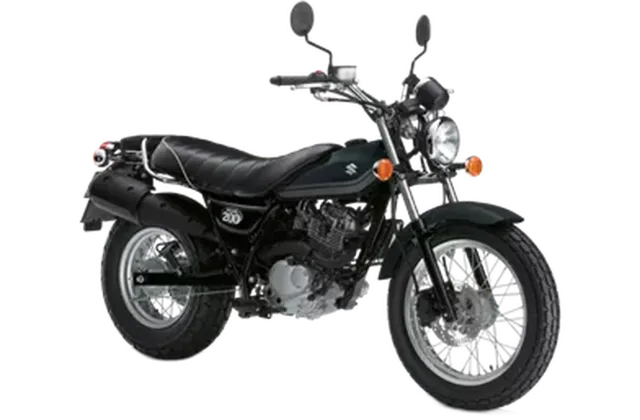
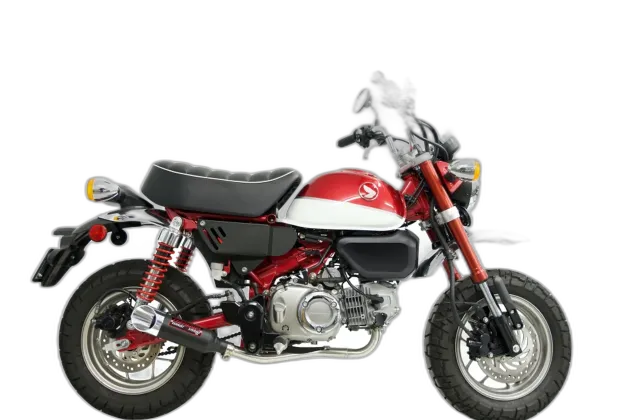
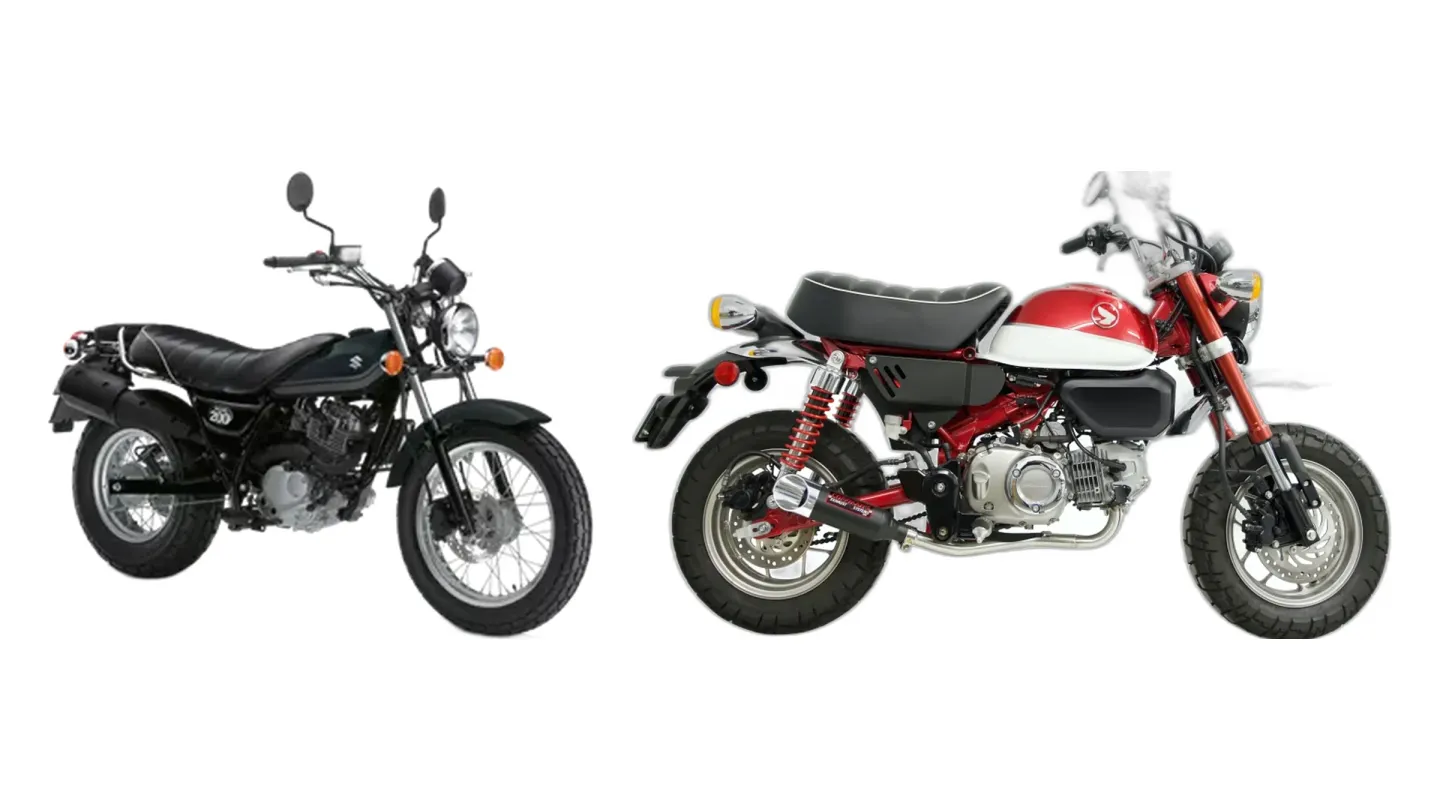
Suzuki RV 200 VanVan (MY2016) vs Honda Monkey 125 (MY2018)
Suzuki RV 200 VanVan vs Honda Monkey 125: no fairing, no excuses. Here's how to pick.
Roll on the throttle of the Suzuki RV 200 VanVan and it's already tugging you forward from low revs. The Honda Monkey 125 wants that grip pinned wide open.
So which one do you buy?
The Monkey 125 has the edge if…
Daily commuting & city riding
Nose ahead: Monkey 125
Your daily ride leans slightly toward the Monkey 125. Fit and price can easily outweigh that.
A confidence-building first motorcycle
Small edge: Monkey 125
The Monkey 125 nudges ahead as a first bike. Don't let a gap this narrow outweigh how it fits you.
Which one's the smarter buy
Money won't decide it
The lower sticker price doesn't settle which one is the better buy. Neither is the clear better buy for the money.
What makes each one tick
RV 200 VanVan
On fat balloon tires and soft suspension, the VanVan's torquey single thumps along a back road at its own easy pace. The long, thick bench and plush twin shocks soak up broken pavement, and rough patches don't break the calm. The cockpit's bare, with barely a gauge to read, yet that plain dash only adds to the VanVan's charm. Even errands become small adventures.
Monkey 125
With its high exhaust and round headlight, the Monkey's air-cooled single makes even a short hop feel like an occasion. Corner entry doesn't take more than a nudge on the bar, since 236 lb (107 kg) of bike tips in like a bicycle. It slips through San Francisco's tightest gaps. Bystanders can't stop admiring the chrome.
The Voice of Experience

What actually separates them
- The Monkey 125 has the lower wet weight: 236 lb (107 kg) vs 282 lb (128 kg).
- The RV 200 VanVan makes more peak power: 14 hp (10 kW) vs 9 hp (6.8 kW).
- The RV 200 VanVan makes more peak torque: 11 lb-ft (15 Nm) vs 8 lb-ft (11 Nm).
Which one for the way you ride
There's no real gap on twisty roads. Sit on both and let fit and price decide.
Who each one is built for
What's good, and what you'll live with
RV 200 VanVan
What owners say
Strengths
- Fun-loving, characterful ride
- Surprisingly comfortable suspension and seat
Trade-offs
- Limited top speed and highway capability
- Lacks modern features like ABS
Monkey 125
What owners say
Strengths
- Smile-inducing fun factor
- Ultra-lightweight and flickable
- Excellent beginner bike
- Proven Honda reliability
Trade-offs
- Basic suspension and brakes
- High purchase and insurance cost
- Very limited performance
What they cost used
These prices compare a 7-year-old RV 200 VanVan with a 7-year-old Monkey 125.
- RV 200 VanVan
- about $4,000
- Monkey 125
- about $2,900
At seven years old, the Suzuki RV 200 VanVan sits around $4,000 while the Honda Monkey 125 lands near $2,900. That's a $1,100 gap in the Monkey's favor. These are US market estimates, not live listings.
What they share
- Engine
- Single-cylinder
- Cooling
- Air-cooled
- Top speed
- 65 mph (105 km/h)
- Final drive
- Chain
Where the spec sheets split
| RV 200 VanVan | Monkey 125 | |
|---|---|---|
| Seat height | 30.3 in (770 mm) | 30.6 in (776 mm) |
| Wet weight | 282 lb (128 kg) | 236 lb (107 kg) |
| RV 200 VanVan | Monkey 125 | |
|---|---|---|
| Displacement | 199 cc | 125 cc |
| Power | 14 hp (10 kW) | 9 hp (6.8 kW) |
| Peak power at | 8,000 rpm | 7,000 rpm |
| Torque | 11 lb-ft (15 Nm) | 8 lb-ft (11 Nm) |
| Peak torque at | 6,000 rpm | 5,250 rpm |
| RV 200 VanVan | Monkey 125 | |
|---|---|---|
| Fuel economy | 71 mpg (US) / 3.3 L/100 km | 98 mpg (US) / 2.4 L/100 km |
| Fuel capacity | 1.7 US gal (6.4 L) | 1.5 US gal (5.5 L) |
| RV 200 VanVan | Monkey 125 | |
|---|---|---|
| Gearbox | 5-speed | 4-speed |
| Fork | Telescopic | Upside-down (USD) |
| Front tire | 130/80-18 | 120/80-12 |
| Rear tire | 180/80-14 | 130/80-12 |
What comes fitted, what costs extra
| RV 200 VanVan | Monkey 125 | |
|---|---|---|
| ABS | Not offered | Standard |
| LED Headlight | Not offered | Standard |
Head to head, area by area
Both bikes on the same scale, one area at a time.