
By NastyNils·
Motorcycle comparison · Adventure
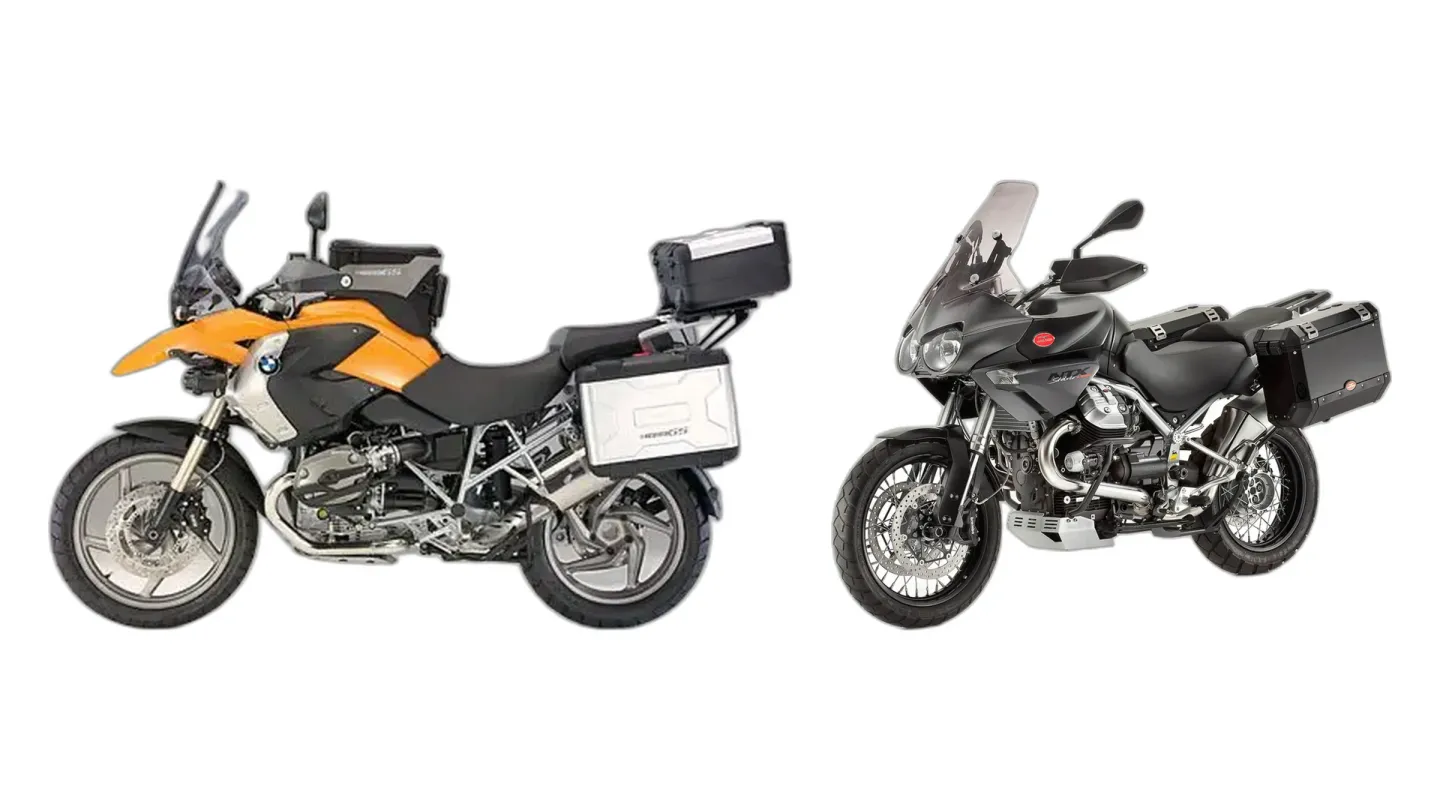
BMW R 1200 GS (MY2008) vs Moto Guzzi Stelvio 1200 NTX (MY2009)
BMW R 1200 GS vs Moto Guzzi Stelvio 1200 NTX: long days, loaded bags, one choice to make.
Flip the BMW R 1200 GS into a hairpin and it's settled on its line at once. The Moto Guzzi Stelvio 1200 NTX's bars ask for barely a push. Then it holds that arc all the way out.
So which one do you buy?
The R 1200 GS has the edge if…
Keeping running costs low
Inches ahead: R 1200 GS
For the money you spend after the purchase, the R 1200 GS nudges ahead. The gap is too small to plan a budget around.
Comfortable long-distance riding
Narrow edge: R 1200 GS
Over a full day's ride, the R 1200 GS noses ahead on comfort. The reason: a better reliability record. A long test ride could easily flip that.
Daily commuting & city riding
Edges it: R 1200 GS
The R 1200 GS edges it for the daily grind. It's a small gap, not a reason on its own.
What makes each one tick
R 1200 GS
Steep serpentines wake the R 1200 GS up, and its Telelever front end tips it from one lean into the next. You can keep squeezing the brake lever while it's already changing lean angle mid-corner. The bike doesn't protest. Out of each chicane the boxer pulls hard.
Nils rode the R 1200 GS in Italy in 2008 (NastyNils Testride).
Stelvio 1200 NTX
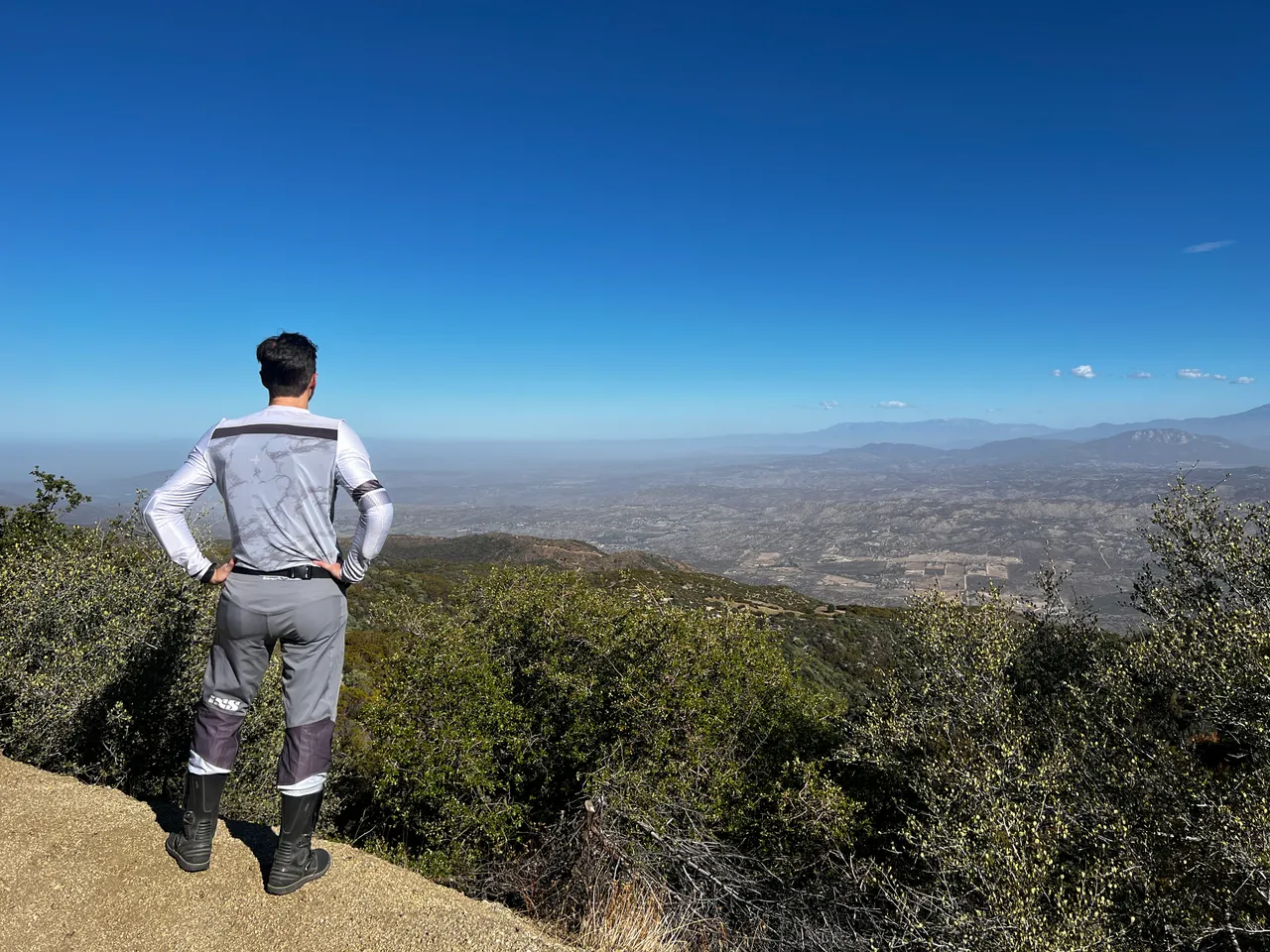
The Stelvio's 90-degree V-twin keeps up a steady thrum, and there's torque barely above idle. The throttle answers with torque spread wide, as content at a town crawl as across a mountain pass. On the Blue Ridge Parkway, its front end steers light and doesn't wander through the curves. The wide seat carries long days.
The Voice of Experience
What actually separates them
- The Stelvio 1200 NTX has the lower seat: 32.3 in (820 mm) vs 33.5 in (850 mm).
- The R 1200 GS has the lower wet weight: 505 lb (229 kg) vs 553 lb (251 kg).
- The R 1200 GS has the larger fuel tank: 5.3 US gal (20 L) vs 4.8 US gal (18 L).
Which one for the way you ride
Real off-road capability
Not their thing
Off-road ability isn't a strength of either bike. Stick to graded dirt roads.
Nothing splits them on twisty roads. Ride both back to back and the decision usually makes itself.
Who each one is built for
What's good, and what you'll live with
R 1200 GS
Strengths
- Hairpins Are Its Home Turf
- Brakes and Redirects in One Move
- Makes the Most of a Good Tire
- ASC Rarely Needs to Step In
- Exceptional long-distance comfort
Trade-offs
- Bulky in Narrow City Streets
- Fuel Strip Sensor Fails
- ABS Modulator Can Drop Out
- Electronics prone to intermittent glitches
- High dealership maintenance costs
Stelvio 1200 NTX
What owners say
Strengths
- Characterful 90-degree V-twin
- Charismatic Italian style
- Surprisingly agile handling
- Powerful Brembo brakes
Known problems to check before you buy
R 1200 GS
- ABS modulator/pump failure The ABS hydraulic pressure modulator can fail on this non-servo Integral ABS II — the ABS warning lamp stays lit and the system drops out, while the hydraulic brakes themselves keep working normally. Out of warranty the unit is one of the priciest parts on the bike, so a clean ABS self-test at the start of a test ride is worth insisting on.
- Fuel pump control unit sealing issue (recall) Recall 09V319000 NHTSA campaign 09V-319 covers 2006-2008 R1200 GS machines built between August 2006 and January 2008: the fuel pump control unit housing may not seal properly, so water can get in and the humid atmosphere corrodes the pump until it fails. The engine then stops running without warning. Dealers replaced the fuel pump control unit free of charge.
- Gearbox intermediate shaft defect (recall) Recall 08V290000 NHTSA campaign 08V-290 is tiny and specific: 46 model year 2008 machines across the R1200 R, R1200 GS and R1200 GS Adventure. A material defect in the transmission intermediate shaft could let the shaft break and seize the gearbox. BMW replaced the transmission on the affected bikes.
- Electrical interference can switch off the ABS (recall) Recall 09V129000 NHTSA campaign 09V-129 is specific to model year 2008 R1200 GS machines: high generator speeds combined with a large electrical demand can create spurious signals that corrupt the pressure sensor readings the ABS control unit relies on. The ABS then shuts itself off and lights the warning lamp; normal braking stays available. Dealers inspected and repaired the components involved.
- Rear wheel mounting flange can crack (recall) Recall 15V141000 NHTSA campaign 15V-141 covers 2005-2010 R1200GS models: the aluminium rear wheel mounting flange can crack if the rear wheel bolts are over-torqued, after which the bolts can loosen and the wheel may no longer stay secured. Dealers replaced the aluminium flange with a steel one free of charge — worth confirming on any used bike, because it is an easy campaign to miss.
- Fuel pump flange can crack and leak fuel (recall) Recall 13V617000 NHTSA campaign 13V-617 covers 2005-2011 R-series machines: the fuel pump flange can develop cracks and leak fuel, which is a fire risk near an ignition source. Dealers either reinforced the flange or replaced the pump. A 2020 follow-up campaign, 20V-471, re-called the bikes that only got the support-ring remedy, so check which of the two fixes a used example actually received.
- Front brake lines can split under vibration (recall) Recall 10V276000 NHTSA campaign 10V-276 covers 2007-2009 R 1200 and K 1200 models built between August 2006 and May 2009: the routing of the front brake lines leaves them under strain from riding vibration, and a line can split and leak. If that goes unnoticed and the reservoir runs dry, the front brake can fail. Dealers fitted replacement lines with a protective sleeve.
- Fuel strip sensor failure The fuel level sensor (fuel strip) commonly fails, causing inaccurate fuel gauge readings or a permanent 'empty' indication. Replacement units may also be unreliable.
Stelvio 1200 NTX
- Front fork axle pinch clamp cracking Overtightening the front axle pinch bolts can crack or fracture the cast aluminum lower fork leg clamps, compromising front axle retention.
What they share
- Power
- 105 hp (77 kW)
- Gearbox
- 6-speed
- Final drive
- Shaft
- Front tire
- 110/80-19
- Rear tire
- 150/70-17
Where the spec sheets split
| R 1200 GS | Stelvio 1200 NTX | |
|---|---|---|
| Seat height | 33.5 in (850 mm) | 32.3 in (820 mm) |
| Wet weight | 505 lb (229 kg) | 553 lb (251 kg) |
| R 1200 GS | Stelvio 1200 NTX | |
|---|---|---|
| Displacement | 1170 cc | 1151 cc |
| Engine | Flat-twin (boxer) | 90° V-twin |
| Cooling | Air/oil-cooled | Air-cooled |
| Peak power at | 7,500 rpm | 7,250 rpm |
| Torque | 85 lb-ft (115 Nm) | 83 lb-ft (113 Nm) |
| Peak torque at | 5,750 rpm | 5,800 rpm |
| Top speed | 129 mph (208 km/h) | 125 mph (201 km/h) |
| R 1200 GS | Stelvio 1200 NTX | |
|---|---|---|
| Fuel economy | 43 mpg (US) / 5.5 L/100 km | 33 mpg (US) / 7.06 L/100 km |
| Fuel capacity | 5.3 US gal (20 L) | 4.8 US gal (18 L) |
| R 1200 GS | Stelvio 1200 NTX | |
|---|---|---|
| Fork | Telelever | Upside-down (USD) |
| Front brake | 305 mm | 320 mm |
| Front travel | 7.5 in (190 mm) | 6.7 in (170 mm) |
| Rear travel | 7.9 in (200 mm) | 6.1 in (155 mm) |
What comes fitted, what costs extra
| R 1200 GS | Stelvio 1200 NTX | |
|---|---|---|
| ABS | Option | Standard |
| Traction Control | Option | Not offered |
| Electronic Suspension | Option | Not offered |
| Steering Damper | Standard | Not offered |
| Tire Pressure Monitoring (TPMS) | Option | Not offered |
| Luggage System | Option | Standard |
Head to head, area by area
Both bikes on the same scale, one area at a time.
The full story on each bike
Buyer's Guide
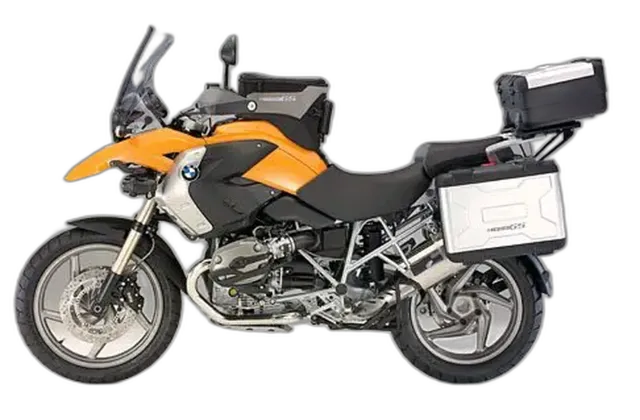
BMW R 1200 GS (MY2008)
The Switchback Whisperer
Buyer's Guide
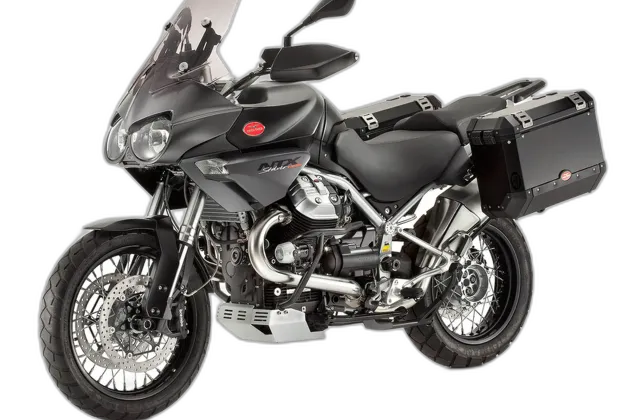
Moto Guzzi Stelvio 1200 NTX (MY2009)
Torque, Luggage and Guzzi Grit